Canada Proposes New Oil Pipeline to Supply Asian Markets
Ottawa, Sunday, 5 July 2026.
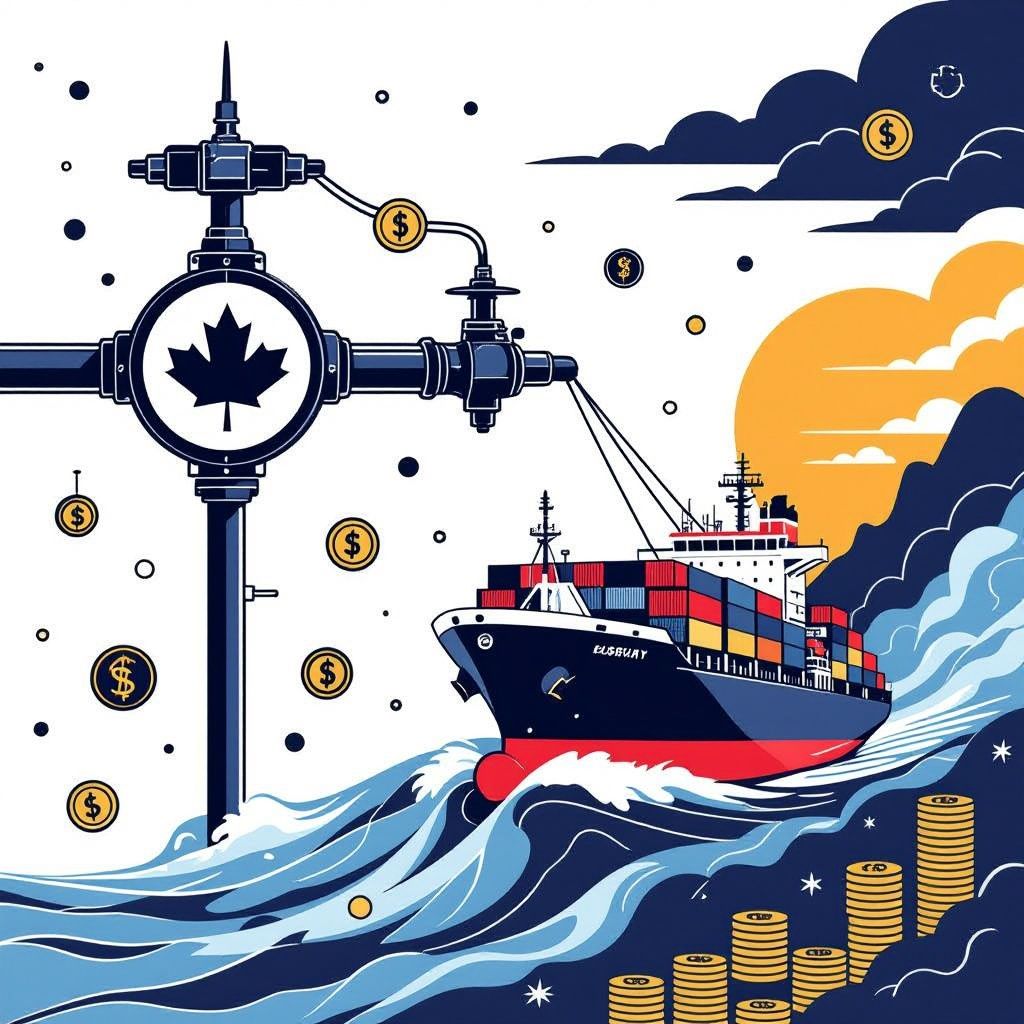
Seeking independence from US trade pressures, Canada has proposed a new C$35 billion pipeline to deliver one million barrels of oil daily to Asian markets.
A Strategic Pivot Amid Continental Trade Pressures
On July 2, 2026, Canadian Prime Minister Mark Carney and Alberta Premier Danielle Smith announced a major government-backed pipeline project designed to transport 1 million barrels of oil per day [1]. This initiative, officially submitted to the federal Major Projects Office, marks a significant geopolitical realignment [1]. It represents Canada’s strategic effort to diversify its energy exports away from the United States, following the trade war initiated by President Donald Trump in 2025 [1]. By building this direct link to a Vancouver-area deepwater port, Canada aims to establish long-term energy partnerships and secure market access in the rapidly growing Indo-Pacific region [1].
Economic Projections and Market Diversification
The economic implications of this shift are substantial. The pipeline is designed to meet significant Asian demand, specifically targeting major energy-importing nations such as Japan, Korea, China, and India [1]. According to government projections, the project is expected to increase Canada’s real GDP by more than 0.6% annually by the 2040s [1]. To support this trade capacity, the federal government has scheduled the commencement of new infrastructure phases to begin on July 6, 2026 [2].
The Southern Route and the British Columbia Compromise
The pipeline’s path reflects a complex political compromise. On July 2, 2026, the Canadian federal government and British Columbia Premier David Eby announced a permanent ban on oil tankers along the northern B.C. coast, which ruled out northern terminals [1]. Consequently, the proposed route shifts south, terminating at the Roberts Bank port in Delta, B.C. [1][2]. The project will largely mirror the existing Trans Mountain footprint, stretching from Bruderheim, Alberta, through B.C. interior communities such as Kamloops, Barriere, and Clearwater [2][3]. At the terminal, plans feature a 2.6 square kilometer facility complete with storage tanks and two supertanker berths to accommodate VLCC-class vessel exports [1][2].
Securing Interprovincial Cooperation
Securing B.C.’s cooperation required intense negotiations. Premier David Eby agreed that the provincial government would not challenge the pipeline proposal in court, acknowledging that B.C. lacks the constitutional authority to stop federal pipeline projects [1][2]. In exchange, B.C. secured federal funding for provincial energy, mining, and transportation projects [1]. This legal truce has been described by industry analysts as a clear signal that Alberta and B.C. are building together rather than fighting apart, creating a smoother regulatory path forward [2].
Capital Demands, Ownership, and Carbon Mandates
The financial scale of the project is immense, carrying an estimated construction cost ranging from C$35.2 billion to C$43.7 billion [1]. This represents a potential cost variance of 24.148% from the lower baseline estimate [1]. The ownership structure is heavily state-aligned, with a 90% stake jointly held by the federally owned Trans Mountain Corp. and the Alberta Petroleum Marketing Commission [2]. The remaining 10% stake is held by Pembina Pipeline Corp., which retains an option to increase its share to 20% once the pipeline is fully operational [1][2].
Environmental Compliance and Industry Commitments
Environmental compliance is another critical and costly pillar of the project. Developers must integrate the ‘Pathways’ carbon capture system, which carries an estimated economic burden of more than $20 billion [1][2]. Oil Sands Alliance firms have agreed to a 2032 startup date for this carbon capture infrastructure, with construction planned to begin later this decade, before 2030 [1]. Despite these heavy costs, industry leaders such as Kendall Dilling, President of the Oil Sands Alliance, note that companies are incentivized to move quickly to grow production rather than waiting years to invest [1].
Indigenous Consultation and Regional Infrastructure Impacts
The project’s success hinges heavily on meaningful engagement with local Indigenous communities. First Nations along the route have demanded detailed consultations to protect their constitutionally protected treaty rights [2]. Valerie Cross, an executive councillor for the Tsawwassen First Nation, emphasized that consultations must address the project’s impact on lands, waters, fisheries, and the Fraser River Estuary [2]. Additionally, the Musqueam First Nation has expressed the need to fully understand how the planned marine and environmental measures will protect their traditional lands and waters for future generations [2].
Socioeconomic Strains on Interior Communities
Beyond environmental concerns, local municipal leaders are bracing for the socioeconomic strains of a massive construction project. In the B.C. interior, Clearwater Mayor Merlin Blackwell noted that while using the existing corridor is logical, the sudden influx of workers will severely stretch the region’s limited housing stock, road networks, and municipal infrastructure [3]. These concerns are compounded by other regional developments, such as Taseko Mines’ Yellowhead copper project, which could add 2,000 construction jobs to a local population of only about 2,500 residents [3].
Project Timeline and Future Outlook
Looking forward, the federal government aims to officially designate the project in the national interest by October 1, 2026 [2]. An open season to secure binding commitments from oil producers is scheduled for 2027, which will be followed by a final investment decision [1]. If approved, construction is slated to commence as early as fall 2027, with a target project completion date of 2034 [2][3]. However, political wildcards remain, including a referendum scheduled by Alberta Premier Danielle Smith for Autumn 2026 regarding the province’s future relationship with Canada, which could reshape federal-provincial cooperation on major infrastructure projects [2].