Global Markets Brace for Impact as Middle East Conflict Halts Oil Shipping
Tehran, Tuesday, 10 March 2026.
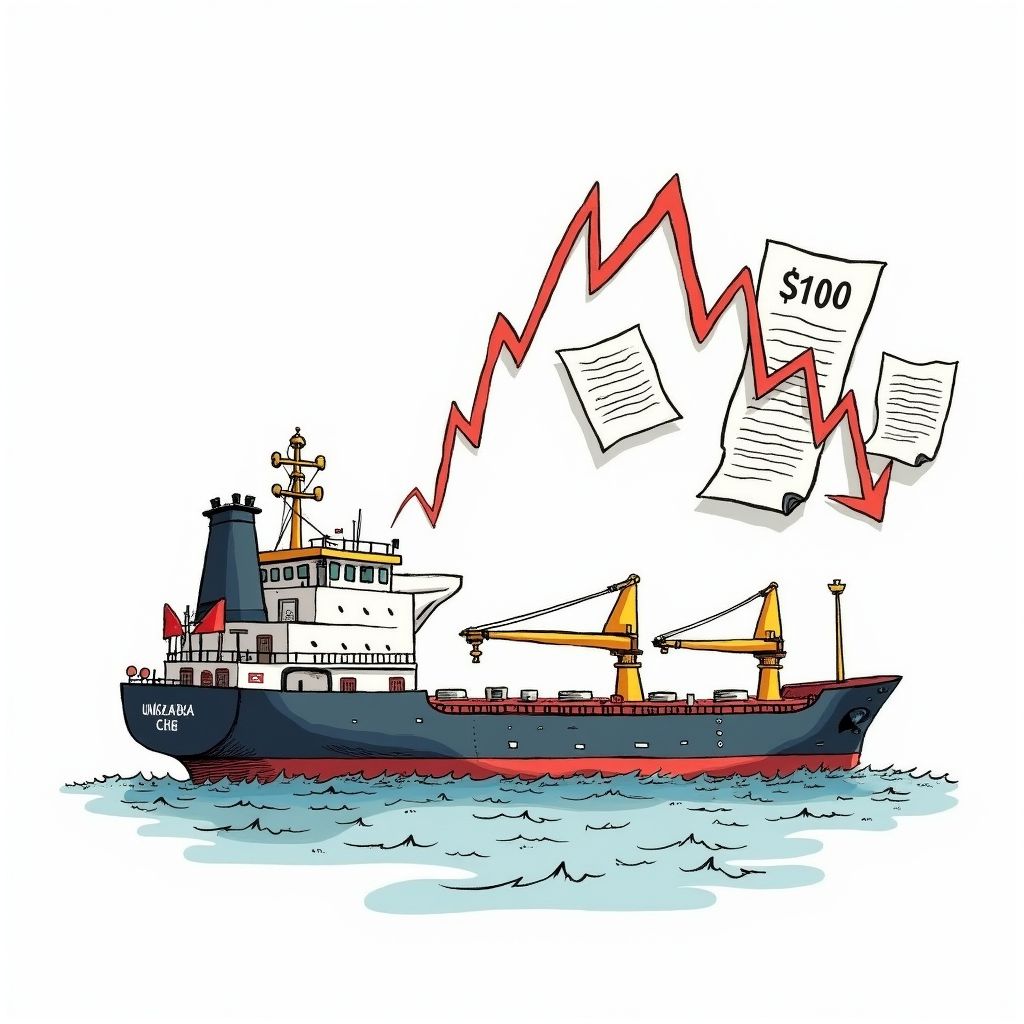
A staggering 95% drop in Strait of Hormuz shipping has driven crude prices above $100 a barrel, threatening severe global supply chain disruptions amid escalating Middle Eastern conflict.
Shifting Military Doctrines and Geopolitical Standoffs
Following President Trump’s recent demands for Tehran’s unconditional surrender—a strategy he branded as “Make Iran Great Again”—the conflict has rapidly mutated into a broader regional war [1]. Despite Trump’s public claims on March 7, 2026, that Iran’s military leadership and communications “are gone” and its air force “wiped out entirely” [6], the Islamic Revolutionary Guard Corps (IRGC) has forcefully rejected any notion of an imminent American victory [3]. Iran’s new hard-line Supreme Leader, Ayatollah Mojtaba Khamenei, who recently succeeded his father, is overseeing a radical shift in military doctrine [5]. Senior IRGC commanders announced that Tehran will now exclusively deploy long-range missiles equipped with warheads heavier than one metric ton to counter allied forces [4].
Energy Markets React to the Hormuz Chokepoint
The geopolitical brinkmanship has already inflicted severe damage on global energy markets. Shipping traffic through the Strait of Hormuz plummeted by 95% during the first week of March 2026, effectively choking off one-fifth of the world’s oil supply [2][5]. Iranian attacks in the strait have brought tanker movement to a near standstill, resulting in the deaths of at least seven mariners to date [5]. Consequently, crude oil prices have exhibited extreme volatility. After briefly soaring to $119 per barrel—breaking the $100 threshold for the first time since July 2022—U.S. crude plunged back to $86 per barrel [2][5], representing a dramatic price correction of -27.731 percent.
Escalating Regional Fallout and the Humanitarian Toll
While financial markets attempt to price in the conflict’s trajectory, the physical battlefield continues to expand across the Middle East. On March 9, 2026, Iran launched a coordinated barrage across the Arabian Peninsula, attacking Kuwait, Qatar, and Bahrain, which left at least one person dead in Manama [5]. The United Arab Emirates reported intercepting 15 ballistic missiles and 18 drones, though shrapnel wounded two individuals in Abu Dhabi [5]. By March 10, the UAE also reported a drone attack on its consulate in the Kurdish region of Iraq [5]. Concurrently, the Syrian military warned of an existential regional threat after detecting Hezbollah reinforcements along the Lebanese border and reporting artillery fire near Damascus [3].
Sources
- wsnext.com
- www.nbcnews.com
- timesofindia.indiatimes.com
- timesofindia.indiatimes.com
- www.wcax.com
- www.instagram.com
- www.bbc.com
- understandingwar.org