Dollar's Dip: Trump's Policies and Intervention Fears
Washington, Tuesday, 27 January 2026.
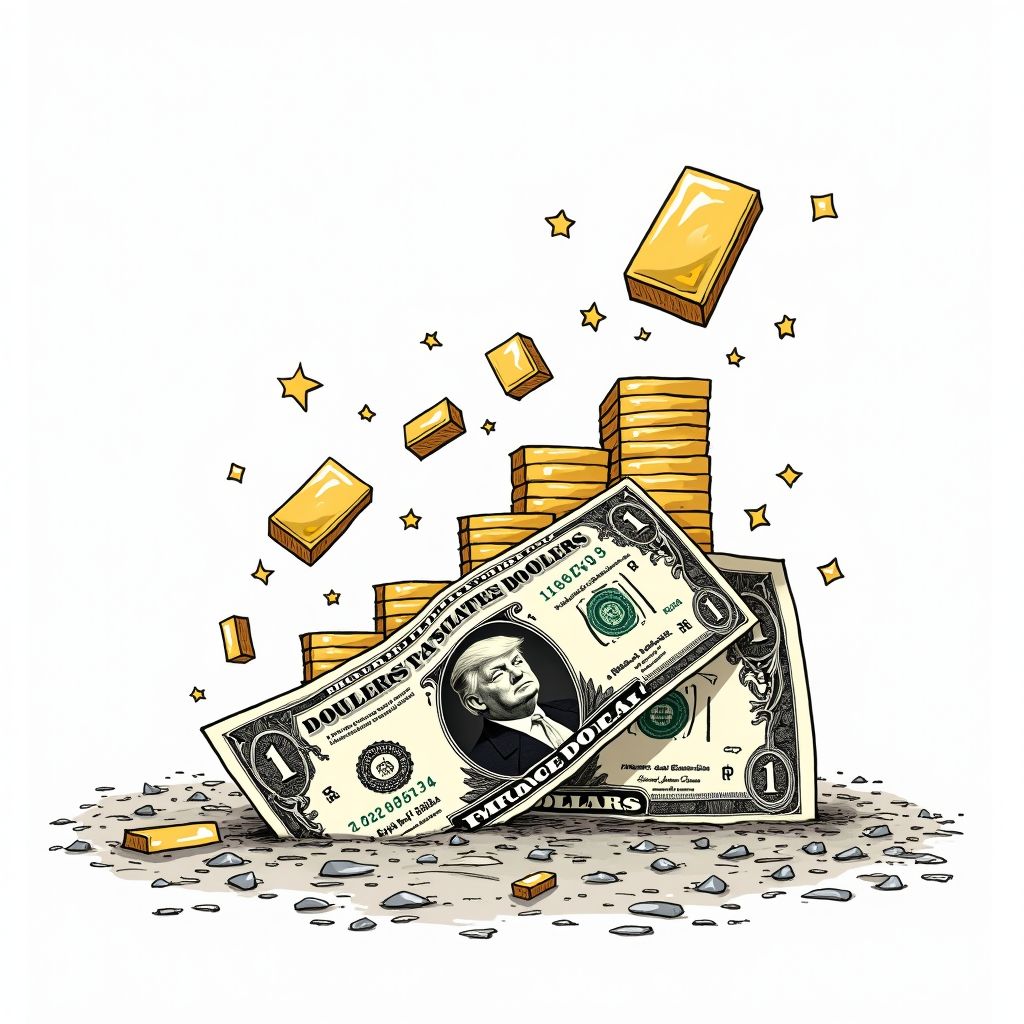
The dollar faces pressure in early 2026 due to Trump’s policies and fears of intervention. The dollar index hit a four-month low. Investors are fleeing to gold, which has surged to over $5,000 per troy ounce.
Dollar’s Dip: Trump’s Policies and Intervention Fears
The dollar faces pressure in early 2026 due to Trump’s policies and fears of intervention [1]. The dollar index hit a four-month low [7]. Investors are fleeing to gold, which has surged to over $5,000 per troy ounce [4].
Trump’s Influence and Policy Impacts
The U.S. dollar’s stability is being reassessed by investors due to factors including the Trump administration’s desire for a weaker currency and increasing geopolitical risks [1]. On January 20, 2026, President Trump threatened Canada with a trade embargo, contributing to the uncertainty [1]. Furthermore, Trump’s domestic policies, including an immigration crackdown, have raised concerns and could potentially lead to a government shutdown in January 2026 [1]. These factors are prompting investors to reconsider their U.S. investments [1].
Market Reactions and Currency Movements
Currency markets have reacted notably, with the euro nearing a four-month peak of $1.19075 on January 26, 2026 [7]. The Australian dollar also held near a 16-month high of $0.6941 on the same day [7]. The dollar’s weakness is further highlighted by its drop to JPY 153.40 after verbal intervention on January 26, 2026 [6]. This follows a period where the dollar had already fallen to its lowest level since Christmas Eve, reaching slightly below JPY 155.65 [6].
Central Bank Actions and Economic Indicators
In response to these market conditions, central banks are under scrutiny. The Federal Reserve is holding a two-day meeting as of January 27, 2026, to decide its monetary policy [3]. There’s a 97% chance the Fed will hold the base rate level, which is currently at 3.5% [4]. The FOMC is expected to keep its policy rate between 3.5% and 3.75% [4]. Adding to the complexity, the Bank of Japan and the New York Fed were suspected of rate checks for the yen on January 24, 2026, potentially signaling the first joint Japanese-U.S. intervention in 15 years [1][alert! ‘The source suggests suspicion of rate checks, not confirmation.’].
Expert Opinions and Future Outlook
Experts suggest that these shifts indicate a broader reassessment of the dollar’s standing. Paul Donovan from UBS noted on January 25, 2026, that “the deterioration in the international standing of the U.S. and recent domestic events may be corroding some of the perceived supports of the dollar’s reserve status” [4]. Thierry Wizman at Macquarie pointed out that traders are flocking to gold and defense stocks rather than the USD, suggesting that “the implicit arrangements that have prevailed since WW2 are unraveling” [4]. The Fed’s interest rate decision on January 28, 2026, will be critical, with potential implications for the dollar’s trajectory [4].
Sources
- www.reuters.com
- tradingeconomics.com
- www.fxstreet.com
- fortune.com
- www.reddit.com
- www.marctomarket.com
- www.reuters.com
- www.reuters.com