Mass Arrests Outside US Embassy Test Limits of British Counterterrorism Laws
London, Saturday, 31 October 2026.
London police arrested nearly 140 peaceful demonstrators outside the US Embassy, escalating tensions as banned-group detentions surpassed 4,000 ahead of a crucial UK Supreme Court legal challenge.
Unprecedented Police Response at US Embassy Protest
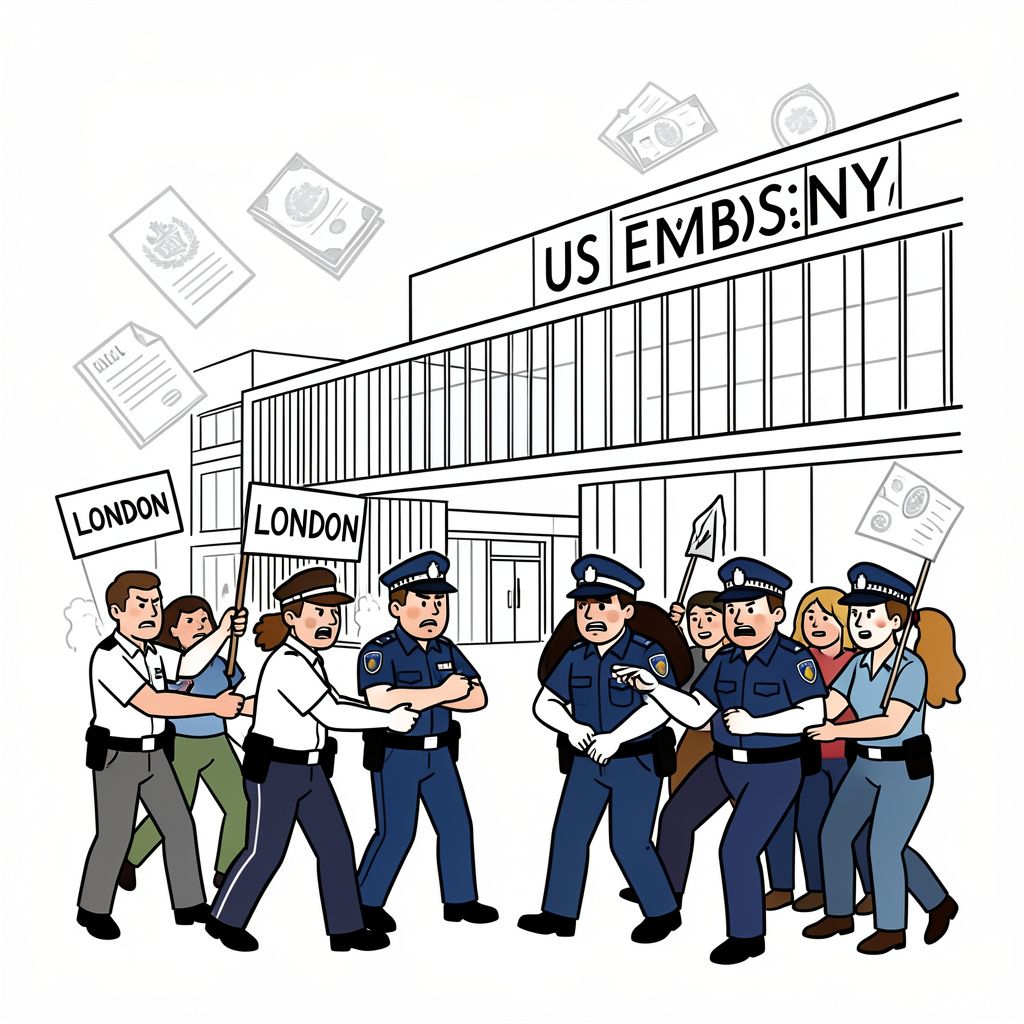
Nearly 140 demonstrators were arrested outside the United States Embassy in London on Saturday, 30 October 2026, as police enforced a sweeping crackdown on expressions of support for the banned group Palestine Action. The Metropolitan Police confirmed 139 arrests, primarily for supporting a proscribed organization, marking one of the largest enforcement operations at a diplomatic site in recent memory [1]. Commander Adam Slonecki, leading the operation, stated that officers were prepared to detain anyone deemed to be ‘meeting to purposefully commit a crime,’ underscoring the heightened legal risks associated with the protest [1][3]. The protest, organized by the group Defend Our Juries, drew approximately 400 participants, with a simultaneous vigil held outside the US Consulate in Edinburgh [1][3].
Legal and Political Context of the Crackdown
The arrests occurred just days before a pivotal UK Supreme Court hearing on 4 November 2026, where the legality of Palestine Action’s proscription under terrorism laws will be challenged [1][3][5]. Since the ban was enacted in July 2025, over 4,000 arrests have been recorded for supporting the group, representing approximately 103.439% of all terrorism-related detentions in the year to June 2026—a dramatic surge from just 234 arrests in the preceding 12-month period [1][3][4]. Palestine Action was proscribed in June 2025, making membership or public support for the group a criminal offense punishable by up to 14 years in prison [3][5]. The group’s activities have included high-profile incursions into military-industrial sites, such as a 2024 raid on an Elbit Systems UK factory and a 2025 breach of a Royal Air Force base, which activists claimed aimed to disrupt the supply chain enabling military actions in Gaza [2].
Demographic and Motivational Insights from the Protest
Among those arrested were elderly demonstrators, including 79-year-old Sue Morhall and 72-year-old Reverend Bill White, both of whom have been detained multiple times for similar protests [1][3]. Morhall, who has been arrested five or six times previously, told reporters, ‘It’s a terrible shame that people who are trying to stop a genocide are being arrested… it’s the principle, and this is one that I feel very strongly about’ [1][3]. Reverend White, who resigned from the Labour Party in protest over the ban, stated, ‘I’m appalled that Britain is helping facilitate the genocide that is happening in Palestine. We supply weapons that are being used on Palestinians’ [1][3][8]. Charles Allison, a 75-year-old retired lawyer, echoed these sentiments, expressing fears that civil liberties were being ‘devalued and watered down’ by the government’s approach [3].
Broader Implications for Civil Liberties and Transatlantic Relations
The Metropolitan Police’s enforcement strategy extended beyond placard-waving demonstrators, with commanders warning that even providing logistical support—such as bringing water to elderly or disabled protesters—could result in arrest under the Serious Crime Act 2007 [6]. A spokesperson for Defend Our Juries condemned the measures as ‘morally bankrupt,’ arguing that the crackdown risked endangering vulnerable individuals while failing to address the core issues of military complicity in conflict zones [6]. The protests also highlighted tensions between UK and US policies, with demonstrators accusing both governments of enabling human rights violations in Gaza through military and diplomatic support [1][3]. The UK government has maintained that the proscription is a necessary measure to counter terrorism, while critics argue it infringes on freedom of speech and peaceful assembly [3][5].
Sources
- www.theguardian.com
- apnews.com
- news.sky.com
- apnews.com
- www.independent.co.uk
- novaramedia.com
- www.arabnews.com
- www.facebook.com