Super Typhoon Champi Threatens Major Asian Semiconductor Hubs and Supply Chains
Taipei, Thursday, 22 October 2026.
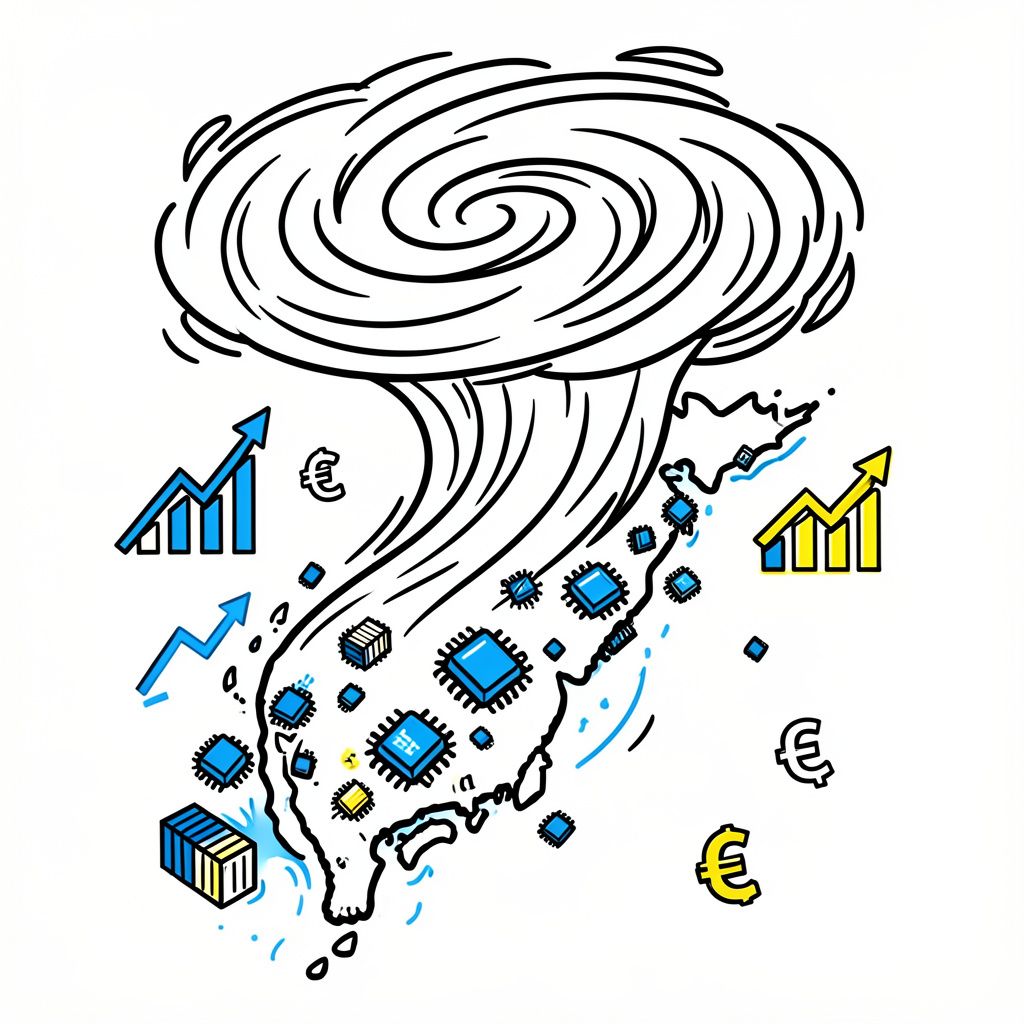
Super Typhoon Champi, packing 298 km/h winds, threatens Taiwan and East Asia, risking massive disruptions to global microchip manufacturing, shipping infrastructure, and technology supply chains.
Record-Breaking Intensity and Classification
Super Typhoon Champi has intensified into the most powerful storm recorded in 2026, tying Super Typhoon Sinlaku with peak 1-minute sustained winds of 185 mph [1][2]. This intensity classifies the system as equivalent to a Category 5 hurricane on the Saffir-Simpson scale, marking it as the strongest tropical cyclone on Earth this year [3][5]. Meteorologists define a super typhoon when 1-minute sustained winds reach at least 150 mph, a threshold Champi significantly exceeded during its peak over the Philippine Sea [1][6]. Recent observations indicate the storm’s maximum sustained winds have moderated slightly to 175 mph, though gusts have topped 200 mph in the eyewall region [1][4]. The storm’s central pressure dropped to 895 millibars, indicating extreme intensity despite being slightly higher than Hurricane Polo’s 892 millibars recorded earlier in the year [2].
Projected Path and Forecast Uncertainty
As of October 21, 2026, the storm center was located approximately 910 km east-southeast of Oluanpi, Taiwan, moving west-northwest at 15 mph [1][8]. Forecast models suggest a slight turn toward the northwest with continued weakening expected through Thursday, October 22, 2026 [1]. While some models predict a track toward Taiwan and eastern China, others indicate a potential northeast turn toward Japan, creating uncertainty for regional planners [2]. The storm is expected to shift westward and could begin moving away from Taiwan toward Japan’s Kyushu island by Saturday, October 24, 2026 [8]. Heavy rain is forecast to affect Taiwan from Thursday night into Saturday, with totals up to 18 inches in northeastern areas [1]. East-central China may experience heavy rainfall from Friday night through Sunday, October 25, 2026 [1].
Supply Chain and Infrastructure Risks
The storm presents significant operational risks to major semiconductor manufacturing hubs centered in Taiwan, raising concerns over potential disruptions to global tech supply chains [GPT]. Transportation infrastructure is already impacted, with China Airlines and Tigerair Taiwan canceling flights to and from Okinawa as of October 21, 2026 [8]. Ferry routes including Keelung-Lienchiang, Kaohsiung-Magong, and Kinmen-Xiamen have been suspended starting October 21, 2026 [8]. Strong winds with gusts up to 120 mph are expected to affect Taiwan and eastern China from Thursday night into Sunday, potentially causing structural damage and prolonged power outages [1]. Flooding and mudslides pose additional threats to manufacturing output and freight logistics across the region [1]. The reduction in wind speed from earlier peaks shows a 7 km/h decrease in maximum sustained winds as of October 21, 2026, though risks remain high [8].
Regional Warnings and Preparations
The Central Weather Administration issued a sea warning late on October 20, 2026, with a land warning expected for the afternoon of October 21, 2026 [8]. Local authorities in New Taipei City have deployed mobile pumps in Wanli, Jinshan, and Shimen districts to mitigate flooding risks [8]. The Coast Guard Administration has warned of long-period swells and announced fines up to NT$250,000 for entering restricted coastal areas [8]. Tourist sites including Wuling Farm, Fushoushan Farm, and Taipingshan National Forest Recreation Area closed at noon on October 21, 2026 [8]. President William Lai urged the public not to underestimate the storm even if it does not make direct landfall [8]. Temperatures in northern Taiwan are expected to remain cooler due to the northeasterly monsoon, with highs of 24°C on October 21, 2026 [8].
Sources
- www.yahoo.com
- www.nytimes.com
- www.facebook.com
- www.washingtonpost.com
- www.facebook.com
- www.facebook.com
- www.foxweather.com
- www.taipeitimes.com