Iran’s ‘Jellyfish’ Drone Swarm: A Game-Changer in Modern Warfare?
Tehran, Tuesday, 23 June 2026.
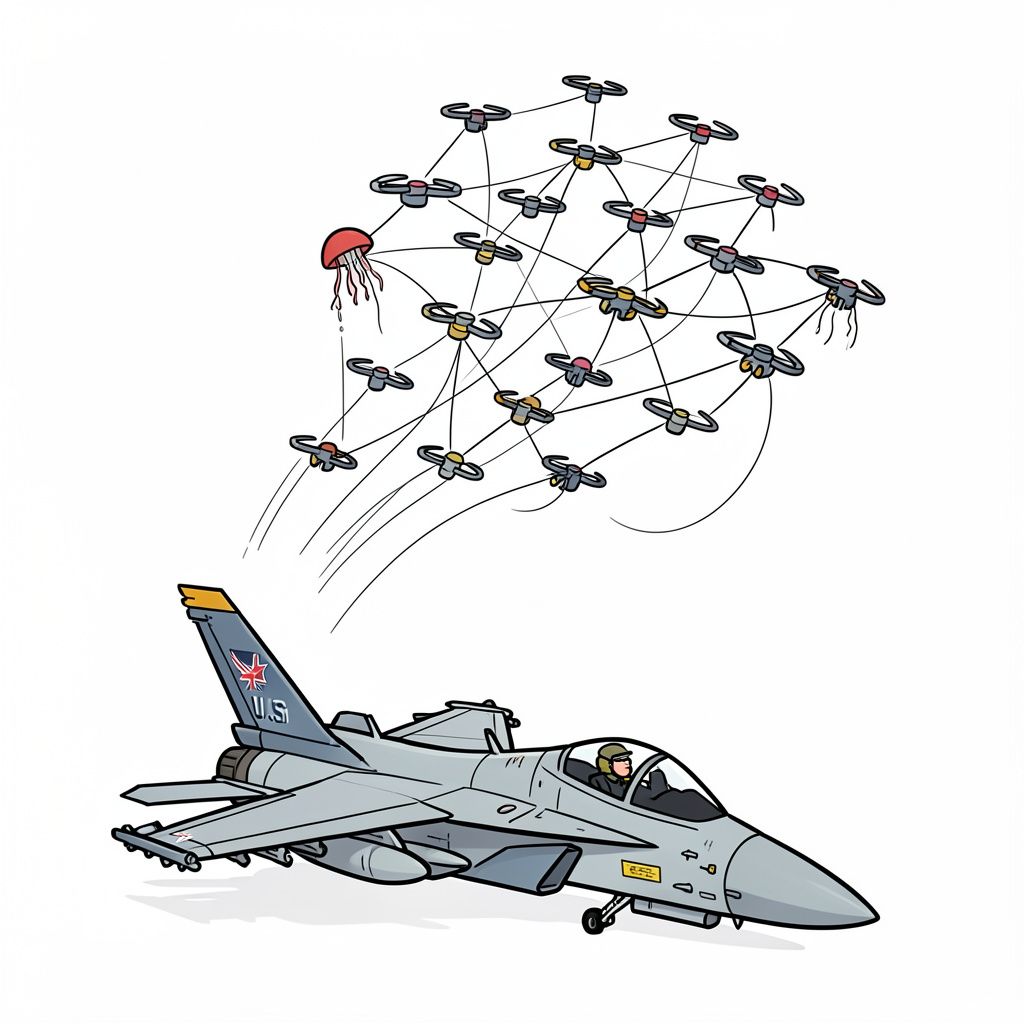
A downed US F-15 pilot’s account of Iranian drones moving in a synchronized ‘jellyfish’ formation has sent shockwaves through military circles. This unprecedented tactic, observed during a June 2026 operation, suggests Iran has leapfrogged into next-generation drone warfare—capable of overwhelming air defenses. If confirmed, it marks a pivotal shift in asymmetric combat, forcing the Pentagon to rethink its strategies. The pilot’s description of drones ‘interconnected and moving as one’ raises urgent questions: How did Iran achieve this? And what does it mean for future conflicts?
The Jellyfish Formation: A Tactical Revolution
The downed F-15 pilot’s description of Iranian drones moving in a ‘jellyfish’ formation represents more than just a novel visual spectacle - it signifies a fundamental evolution in drone warfare tactics. According to intelligence briefings, the formation involved ‘multiple drones interconnected and moving as one with smaller drones below the bigger drones like legs,’ creating what one source described as a ‘minefield of drones’ [1]. This coordinated movement pattern suggests Iran has developed sophisticated swarm intelligence capabilities that could potentially overwhelm traditional air defense systems through sheer numbers and synchronized behavior [2]. The jellyfish analogy isn’t merely poetic - it reflects a biological inspiration where individual units (drones) operate with decentralized coordination, much like jellyfish tentacles moving in unison [GPT].
Technological Leapfrogging in Asymmetric Warfare
Iran’s apparent advancement in drone swarm technology comes at a critical juncture in the 2026 Iran-US conflict. The country has been rapidly expanding its drone capabilities since 2020, with particular focus on Shahed-series drones that have seen extensive use in regional conflicts [3]. The jellyfish formation suggests Iran has successfully integrated three key technological components: 1) advanced mesh networking for real-time drone-to-drone communication, 2) AI-driven swarm coordination algorithms, and 3) heterogeneous drone platforms capable of specialized roles within the formation [1]. Drone expert Emma Bates warned that ‘if it can coordinate itself into a recognizable shape and maintain that shape, and if it’s got explosives on board… that’s a very capable approach’ that could force adversaries to spend ‘huge dollars’ on countermeasures [2]. This development aligns with Iran’s broader strategy of asymmetric warfare, where technological innovation compensates for conventional military inferiority.
The April 2026 Incident: What We Know
The jellyfish formation was first observed during the April 3, 2026 downing of a US F-15 over central Iran - the first confirmed loss of a US fighter jet to Iranian forces during Operation Epic Fury [1][4]. The two-person crew (pilot and weapons system officer) reported seeing the formation shortly before their aircraft was hit [1]. While the pilot was rescued within hours, the weapons system officer evaded capture for 36 hours in mountainous terrain before extraction [1]. The incident occurred during a period of intense hostilities following the February 28, 2026 US/Israeli airstrikes that killed Supreme Leader Ali Khamenei [5]. Notably, this wasn’t the pilot’s first downing - he had previously been shot down in a friendly fire incident by Kuwaiti forces earlier in the conflict [1]. The timing raises questions about whether Iran deliberately deployed this new tactic during a high-value target engagement.
Strategic Implications for US Air Superiority
If confirmed, the jellyfish drone swarm represents a significant threat to US air superiority in the Middle East. Current US air defense systems, including the Patriot missile system and Aegis combat system, are designed to counter traditional threats like ballistic missiles and manned aircraft [GPT]. These systems may struggle against swarms of small, agile drones operating in coordinated formations. The jellyfish tactic appears specifically designed to exploit vulnerabilities in radar coverage and missile guidance systems by presenting multiple simultaneous targets [2]. This development comes as the US has already been grappling with Iran’s growing drone capabilities - during the 2026 conflict, Iran launched hundreds of drones and missiles against US and allied positions, including a massive attack on April 13 that reportedly involved over 300 drones [5]. The jellyfish formation could represent the next generation of this threat, potentially forcing the US to accelerate development of directed-energy weapons and AI-driven counter-swarm technologies.
The China-Russia Connection: Technology Transfer Concerns
While Iran has been developing its drone capabilities for years, the sudden emergence of the jellyfish formation has raised questions about potential foreign assistance. CNN reported that China and Russia may have played a role in Iran’s drone technology development, though neither country has officially commented on these allegations [2]. This potential technology transfer would fit a broader pattern of military cooperation between these nations. Russia has been using Iranian-made drones in its war in Ukraine since 2022, while China has been expanding its military ties with Iran through joint exercises and technology exchanges [GPT]. The jellyfish formation bears striking similarities to experimental drone swarm tactics demonstrated by China’s military in recent years, particularly in exercises involving coordinated attacks by heterogeneous drone groups [alert! ‘specific technical comparisons require classified intelligence’][GPT]. If confirmed, this technology transfer would represent a significant escalation in the proxy technology war between the US and its adversaries.
Economic and Geopolitical Fallout
The jellyfish drone revelation comes as the US and Iran are negotiating a tenuous peace agreement following four months of intense conflict. The war has already had severe economic consequences, with global GDP impact estimated at $2.2 trillion annually and oil prices exceeding $100 per barrel (up from $67-71 pre-conflict) [6]. The International Energy Agency called the Strait of Hormuz closure ‘the greatest energy security challenge in history’ [6]. Iran’s apparent technological leap could strengthen its negotiating position, particularly regarding sanctions relief and economic reconstruction commitments [5]. The US has already spent approximately $29 billion on Operation Epic Fury, with potential costs rising to $50 billion, while facing severe munitions expenditure [6]. Goldman Sachs has lowered its 2026 US growth forecast due to the conflict’s economic impact [6]. The drone swarm capability could also embolden Iran’s regional proxies, potentially complicating post-war security arrangements in Lebanon and Syria.
The Future of Drone Warfare
The jellyfish formation represents just one manifestation of a broader revolution in drone warfare that is reshaping modern conflict. Military analysts predict several key trends emerging from this development: 1) Increased focus on directed-energy weapons like lasers and high-powered microwaves to counter drone swarms, 2) Development of AI-driven air defense systems capable of real-time swarm countermeasures, 3) Expansion of drone-on-drone combat capabilities, and 4) Integration of drone swarms with traditional air forces [GPT]. The US has been developing its own drone swarm capabilities, including the Air Force’s Golden Horde program and the Navy’s LOCUST swarm technology, but the jellyfish formation suggests Iran may have leapfrogged ahead in certain aspects of swarm coordination [GPT]. This development could accelerate the global arms race in drone technology, with nations scrambling to develop both offensive swarm capabilities and defensive countermeasures. The economic implications are substantial - Bates’ warning about ‘huge dollars’ being required to counter these capabilities suggests a new era of defense spending focused on drone warfare [2].