Trump Launches Major Military Campaign in Iran, Killing Supreme Leader Khamenei
Washington D.C., Sunday, 1 March 2026.
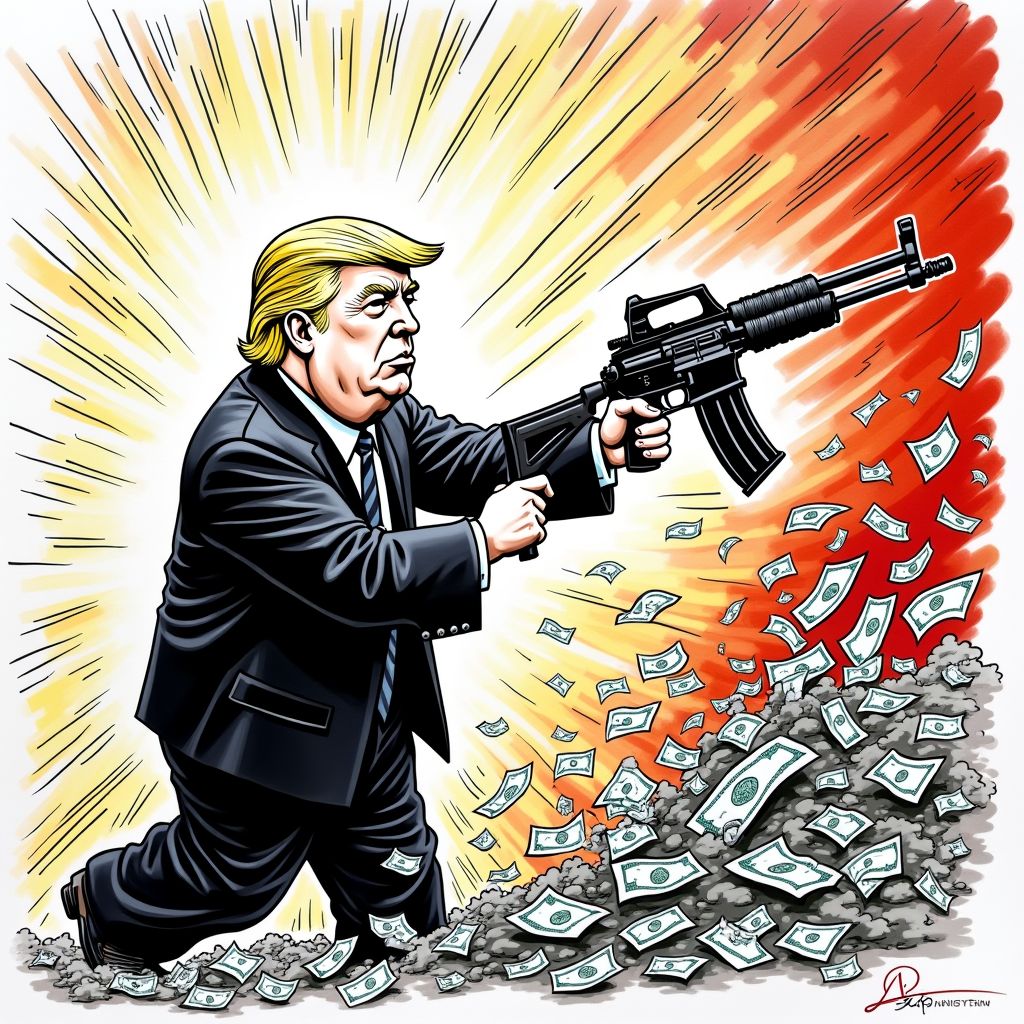
President Trump’s “Operation Epic Fury” has eliminated Iran’s Supreme Leader, triggering immediate geopolitical instability and anticipating sharp market reactions to this explicit pursuit of regime change.
Escalation to Decapitation
The speculative instability regarding Iran’s leadership has rapidly materialized into a confirmed decapitation strike. As detailed in our previous coverage regarding the potential [power vacuum following Ebrahim Raisi’s death][1], the region was already fragile; however, the events of Saturday, February 28, 2026, have fundamentally altered the strategic landscape. President Donald Trump confirmed the launch of “Operation Epic Fury,” a joint military campaign with Israel that has reportedly killed Supreme Leader Ayatollah Ali Khamenei [2][3][5]. The operation, which began around 1:00 a.m. Eastern Time on Saturday, utilized ship-launched Tomahawk cruise missiles and air power to target Iran’s nuclear capabilities and leadership infrastructure [4][7]. This military action follows the collapse of diplomatic negotiations in Geneva just two days prior, on Thursday, February 26, where Iranian officials reportedly refused to meet U.S. demands for “zero nuclear enrichment” [5][7].
Civilian Toll and Legal Outcry
The immediate human cost of the offensive has been substantial. Iranian state media reported at least 201 deaths and over 700 injuries resulting from the initial bombardment [5]. Among the reported devastation was a strike on a primary school that killed over 100 people, predominantly schoolgirls [2]. These casualties have intensified accusations from international legal experts, such as Professor Mark Kersten, who characterized the war as an “unequivocally illegal” violation of the United Nations charter [2]. Critics argue that by launching the offensive without UN Security Council authorization or broader international support, the United States risks being perceived globally as a “rogue actor” [2][9].
Explicit Pursuit of Regime Change
Unlike the limited engagement of June 2025’s “Operation Midnight Hammer,” the administration has explicitly pivoted to a strategy of regime change [6][7]. In an eight-minute video released on Truth Social, President Trump urged the Iranian people to “take over your government,” framing the military intervention as their “only chance for generations” to seize freedom [6][8]. This rhetoric aligns with the administration’s broader “muscular approach” to foreign policy, despite Vice President JD Vance’s earlier suggestion that any operation would avoid prolonged conflict [7][8]. Trump, who monitored the strikes from Mar-a-Lago, asserted that the regime had rejected every opportunity to renounce its nuclear ambitions [3][8].
Regional Retaliation and Market Implications
The geopolitical fallout was instantaneous, threatening critical energy corridors. Within two hours of the initial U.S. strikes, Iranian Foreign Minister Abbas Araghchi announced retaliatory missile attacks targeting U.S. allies [5]. These strikes reportedly hit sites in Israel, the United Arab Emirates, and Bahrain—the latter hosting the U.S. Navy’s Fifth Fleet [3][5]. Domestically, the operation has deepened the rift between the White House and Congress. Senate Minority Leader Chuck Schumer noted that the administration failed to provide critical details regarding the threat’s immediacy, while House Democrats are scheduled to meet today, Sunday, March 1, to discuss a resolution reining in war powers [3]. Former Vice President Kamala Harris condemned the action, stating that the President is dragging the nation into a “war of choice” [3].
Sources
- wsnext.com
- www.huffpost.com
- www.bbc.com
- www.washingtonpost.com
- time.com
- www.pbs.org
- www.bbc.com
- www.cnn.com
- www.huffingtonpost.co.uk