High Fuel Costs and Trade Strains Shift Iowa Senate Race to a Toss-Up
Des Moines, Monday, 24 August 2026.
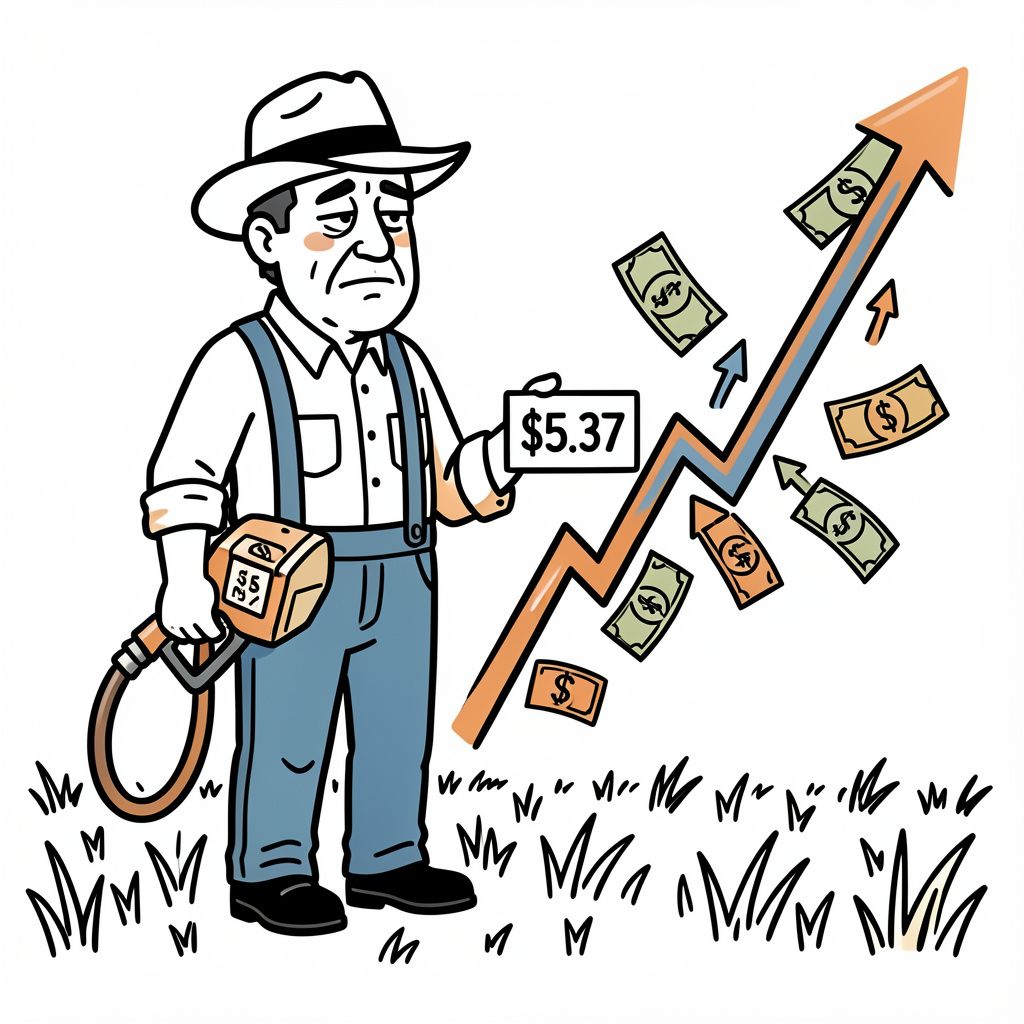
Rising fertilizer and fuel costs, including diesel reaching $5.37 per gallon, are severely straining Iowa farmers, pushing the state’s 2026 U.S. Senate race into a competitive toss-up.
Economic Pressures Reshape Iowa Political Landscape
Growing economic pressures across the Midwestern agricultural sector are shifting political dynamics in Iowa, where financial strain among farmers is emerging as a critical factor in the battle for control of the United States Senate [1]. Despite previous strong margins for conservative candidates, declining farm incomes and trade uncertainties are prompting shifting voter sentiment that could impact the broader macroeconomic policy agenda in Washington [1]. In 2024, President Donald Trump won Iowa by a margin of 13.2 percentage points; however, current voter sentiment in the state is shifting due to economic pressures including rising diesel costs [1]. Diesel prices have increased from $3.50 per gallon one year ago to $5.37 per gallon currently, representing a significant surge in operational costs for agricultural producers [1]. This price change reflects a percentage increase of 53.429 over the last year, squeezing margins for farmers already dealing with tight profitability [1].
Trade Policy and Agricultural Backlash
On 2026-08-21, President Trump announced a new beef import plan that pauses tariffs on imported ground beef, prompting backlash from Republican lawmakers representing farming and ranching districts [1]. Subsequently, on 2026-08-22, the U.S. imposed 50% tariffs on select Canadian products following the breakdown of trade negotiations between the two nations [1]. Iowa Farmers’ Union leader Aaron Lehman stated, It’s chaos. We are just not on the right path. At the time when farmers are dealing with all this uncertainty, we should be doing more to help them bring stability [1]. The U.S. Senate farm bill remains stalled in committee due to partisan disagreements, leaving agricultural leaders in Iowa waiting for legislative action [1]. Denise Ryan, a farmer from Columbus Junction, noted, It is very stressful. There is no doubt about it. All sorts of different factors sometimes going against us, and so many things we can’t control [1].
Senate Race Shifts to Toss-Up
The Cook Political Report downgraded Iowa and Texas Senate races from lean Republican to toss-ups as of Thursday, 2026-08-20 [2]. The 2026 Iowa Senate election race between Hinson (R) and Turek (D) is currently classified as a Toss Up by RealClearPolitics, with a RealClearPolitics (RCP) polling average showing Hinson leading by +0.7 [3]. As of 2026-08-23, Polymarket betting odds indicate a 61% probability that a Republican will win the Iowa Senate seat [3]. Democrats are campaigning to regain control of Congress and governors’ mansions in the midterm elections, which are scheduled for 2026-10-22 [1]. In Iowa, agricultural voter sentiment is shifting against Republicans due to rising fertilizer and diesel costs, combined with Trump-era tariffs; Senate Majority PAC (SMP) has invested $30 million in the race for Democrat Josh Turek [2].
Broader Strategic Implications
Republicans’ clear advantage in the battle for the chamber has all but evaporated, with Democrats within striking distance in Iowa, Alaska, and Texas [2]. As of August 19, 2026, the Cook Political Report shifted the battle for the Senate from herculean for Democrats to a toss-up, reversing the initial cycle outlook [2]. Senate Minority Leader Chuck Schumer highlighted the competitiveness of these regions, noting regarding a Kansas candidate, Kansas is a good example of why you can’t paint every state with the same brush [2]. Mark Mueller, Iowa Corn Growers Association President, stated, We already had very tight margins… [higher diesel prices have] just ratcheted the margins even tighter [1]. The outcome in Iowa remains pivotal, with historical election data reflecting a consistent focus on party competitiveness in districts IA-1 through IA-4 and statewide offices [3].