Trump Threatens Major Military Strikes on Iran to Keep Vital Shipping Lane Open
Washington, Saturday, 11 July 2026.
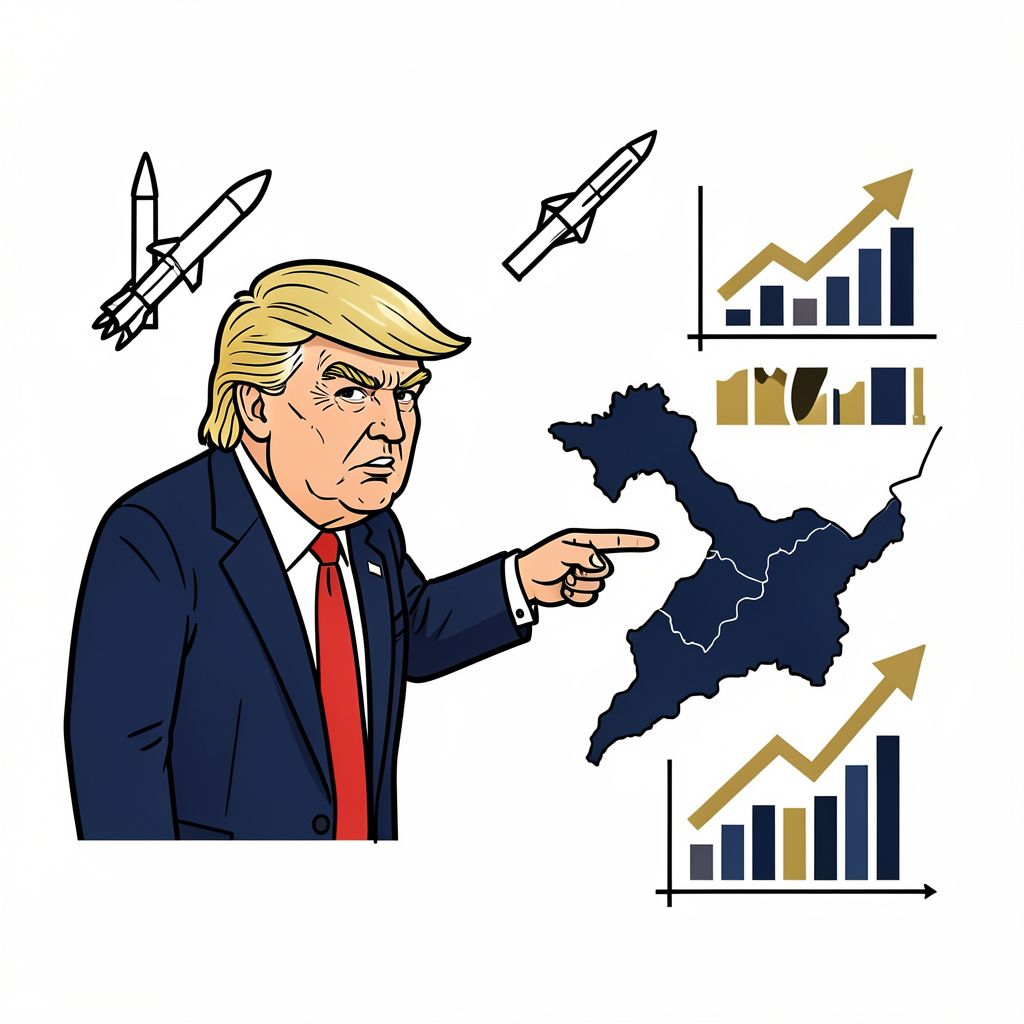
Following reports of an assassination plot, President Trump warned Iran that 1,000 missiles are prepared to strike unless the vital Strait of Hormuz shipping lane remains open.
A Fragile Truce Shattered
The diplomatic path between Washington and Tehran has collapsed into a high-stakes military standoff, marked by direct threats of total destruction and allegations of assassination plots. On Saturday, July 11, 2026, U.S. President Donald Trump issued a severe military warning to the Iranian regime, declaring that 1,000 American missiles are “locked and loaded” and aimed at Iran [1]. This warning comes as the U.S. demands that Iran publicly state that the Strait of Hormuz remains open to all international maritime transit [1]. This rapid escalation follows a series of dramatic events, including Iran’s retaliatory strikes on 85 U.S. military facilities in Bahrain and Kuwait on July 8, 2026, which severely disrupted global energy markets and sent crude oil prices climbing [7].
The Collapse of the June Ceasefire
The current crisis represents the complete unraveling of the 60-day ceasefire established under a Memorandum of Understanding (MoU) signed on June 17, 2026 [3][4]. Tensions boiled over on July 7, 2026, when the Trump administration revoked oil waivers and initiated a military campaign targeting Iranian missile and nuclear infrastructure [3]. Following subsequent Iranian attacks on commercial vessels in the vital Strait of Hormuz on July 8, 2026, President Trump declared the truce officially “over” [3][4]. The U.S. military responded with swift, wide-ranging retaliatory strikes across the region [3][4].
High-Stakes Maritime Conflict and the Battle for Hormuz
The Strait of Hormuz, a critical maritime chokepoint that handles approximately 20% of the world’s petroleum and gas transit, has once again become the primary theater of conflict [4]. While hundreds of oil tankers successfully navigated the strait’s southern route near the Omani coast in the preceding weeks, mitigating immediate fears of a global energy crisis, the security of this waterway is now deeply compromised [5]. The underlying dispute stems from conflicting interpretations of the June MoU; Iran has demanded the right to charge transit fees, claiming the U.S. violated the agreement by rerouting commercial vessels without Tehran’s approval, whereas the U.S. maintains that the strait is an international waterway [3][4].
U.S. Strikes and Military Mobilization
In response to these transit disputes, the U.S. military has conducted extensive operations to degrade Iranian capabilities. Between July 7 and July 8, 2026, U.S. forces struck over 170 Iranian targets, including air defense systems, drone and missile storage facilities, and military speedboats near the Strait of Hormuz [2]. On July 9, 2026, U.S. Central Command (CENTCOM) confirmed further strikes against approximately 90 targets inside Iran, hitting missile launchers, a runway, and military infrastructure near the Bushehr nuclear power plant, Choghadak, and bridges near Mashhad [4]. This brings the total number of hit targets to at least 260 across the multi-day offensive, resulting in the deaths of at least nine Iranian military personnel [4].
Assimplots and Leadership Transitions
Adding a highly volatile personal dimension to the conflict, U.S. intelligence recently received reports of an Iranian plot to assassinate President Trump [6]. The intelligence, shared by Israeli operatives, prompted heightened security measures, including the Secret Service transporting the president from the NATO summit in Turkey on an older Air Force One outfitted with superior defensive measures [6]. Trump confirmed he was a target as he departed Turkey on Wednesday, July 8, 2026 [6]. By Saturday, July 11, 2026, Trump warned that any attempt on his life would result in orders to “decimate and destroy all areas of Iran,” backed by 1,000 “locked and loaded” missiles [1].
The Vow of the New Supreme Leader
The assassination threats are closely tied to the shifting leadership dynamics within Iran. The conflict traces back to February 2026, when Iran’s former Supreme Leader, Ayatollah Ali Khamenei, was killed during joint U.S.-Israeli airstrikes [2][4]. Following a days-long funeral that concluded with his burial in Mashhad on July 9, 2026, his son and successor, Mojtaba Khamenei, issued his first public message [1][4]. Despite suffering injuries in the same February strikes that killed his father, Mojtaba Khamenei declared that avenging his father’s “innocent blood” is “inevitable” and represents “the will of our nation” [1][4].
Domestic Political Calculations in a Midterm Year
This international crisis unfolds against the backdrop of intense domestic political maneuvering in the United States, with less than four months remaining until the 2026 midterm elections [6]. President Trump’s aggressive foreign policy stance is mirrored by assertive executive actions at home. On Thursday, July 9, 2026, Trump fired the remaining two Democratic members of the independent Election Assistance Commission, leveraging a recent Supreme Court ruling in the Slaughter case [6]. Meanwhile, congressional dynamics remain fluid; progressive Democrats are rallying behind Abdul El-Sayed in Michigan following Graham Platner’s exit from the Maine Senate race, though party leadership harbors concerns over El-Sayed’s general election viability [6].
Economic Policy and Landowner Envoys
Economic policy also looms large as the administration navigates this geopolitical storm. A bipartisan housing bill is set to become law at midnight on Saturday, July 11, 2026, though Trump has threatened a veto, causing friction among congressional Republicans who fear the political fallout of rejecting affordability measures just ahead of the midterms [6]. Concurrently, Trump continues to court his domestic base, swearing in country musician John Rich as a special envoy for American landowners on Friday afternoon, July 10, 2026, to advocate against large-scale solar and wind developments on agricultural lands [6].
The Path Forward: Prolonged Conflict or Continued Talks?
As of July 11, 2026, the White House is preparing for a prolonged exchange of fire that could last from several days to multiple weeks, depending on Iran’s actions in the Strait of Hormuz [3][5]. While Vice President JD Vance warned that military retaliation will continue until the shipping lanes are fully reopened, President Trump has kept a narrow window open for diplomacy, stating on July 10, 2026, that negotiations could still continue despite the official termination of the ceasefire [2][3]. However, the prospects for a diplomatic breakthrough remain highly uncertain [2][4].
Stalemate in the Strait
Iranian negotiators, led by Parliament Speaker Mohammad Bagher Ghalibaf, have rejected American ultimatums, asserting that the Strait of Hormuz will only open under “Iranian arrangements” and warning that further U.S. strikes will be met with immediate reciprocity [3][4]. With U.S. officials expressing skepticism over Iran’s willingness to honor any future agreements, the global community remains on high alert [3]. The coming days will determine whether this cycle of retaliatory strikes escalates into a full-scale regional war or if backchannel negotiations can salvage a peaceful resolution [3][5].
Sources
- www.aljazeera.com
- www.nytimes.com
- www.axios.com
- www.theguardian.com
- www.jpost.com
- thehill.com
- wsnext.com