Trump Ties Proposed Cash Payments to Congressional Election Outcome
Washington, Monday, 5 October 2026.
President Trump proposed giving adult citizens $5,000 cash payments if Republicans retain Congress, alongside smaller Medicare rebates, raising questions regarding fiscal feasibility and legislative approval.
Campaign Promise Versus Fiscal Reality
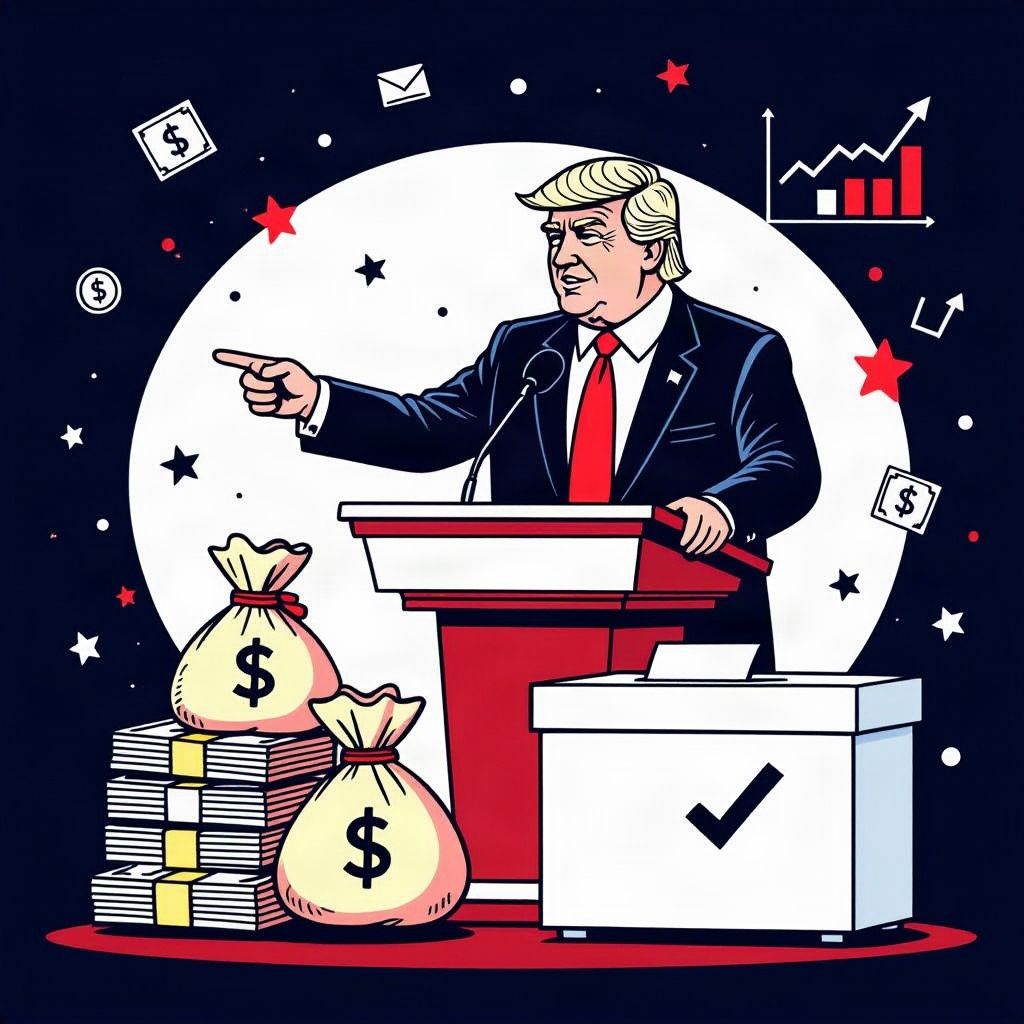
Former President Donald Trump has reiterated a pledge to issue $5,000 dividend checks to Americans if Republicans retain control of Congress in the upcoming midterm elections [1]. While highlighting two existing federal cash distribution programs currently underway, the proposal faces scrutiny over its fiscal feasibility, prospective inflationary pressure, and potential impact on macro-economic stability [1][3]. Corporate leaders and investors are closely monitoring the political rhetoric as the upcoming election results could significantly shift national fiscal policy [1]. Today, on 5 October 2026, the distinction between implemented policy and conditional campaign promises remains a critical focal point for economic analysts [4].
Immediate Relief Programs Underway
Distinct from the conditional dividend, the administration has announced one-time $90 payments to 20.8 million Medicare Part B beneficiaries, funded via the Medicare Improvement Fund [1][3]. Distribution of these funds is scheduled for October 2026, aimed at helping seniors pay for Medicare Part B premiums [2][3]. Additionally, as of 26 September 2026, the federal government began distributing $500 refund checks to approximately 950,000 individuals who purchased unsubsidized coverage through the federal marketplace [1]. A Reuters analysis indicates 71% of this total, amounting to $339 million, is allocated to residents of 13 competitive states [1]. The White House asserts these immediate payments utilize existing funds rather than requiring new congressional appropriation [2].
Conditional Dividend and Legislative Hurdles
The proposed $5,000 Trump dividend lacks specified funding sources or authorization mechanisms and would require congressional approval [1]. The initiative is estimated to cost approximately $1.2 trillion, though President Trump has cited investments in the U.S. and tariffs as potential funding sources [1][4]. Trump estimates the cost of the program at approximately $1 trillion, claiming it will be funded by his economic policies and tariffs [4]. However, the official White House website lists total investments from companies and foreign governments at $11.2 trillion, contradicting Trump’s claim of having secured $21 trillion [4]. Legislative experts note that money from the Medicare Improvement Fund is generally appropriated by Congress, and not given out by presidential fiat [2].
Voter Sentiment and Economic Projections
Public opinion polls show mixed results regarding the proposal, with a Rasmussen Reports survey conducted 13–15 September 2026 showing likely voters split 47% to 48% on the current $5,000 proposal [1]. An Economist/YouGov poll conducted 11–14 September 2026, found 57% of registered voters doubted the payments would be delivered even if Republicans retained Congress [1]. Several Democratic critics have accused the administration of utilizing the $5,000 payment proposal as an attempt to bribe voters to support GOP candidates [4]. Representative Jamie Raskin, D-Md., characterized the move as a political bribe, while Representative David Schweikert, R-Ariz., expressed commitment to fiscal responsibility [1]. The election has not occurred, so the condition for the $5,000 promise remains unfulfilled [1].