Supreme Court Case Tests the Limits of Presidential Control Over the Federal Reserve
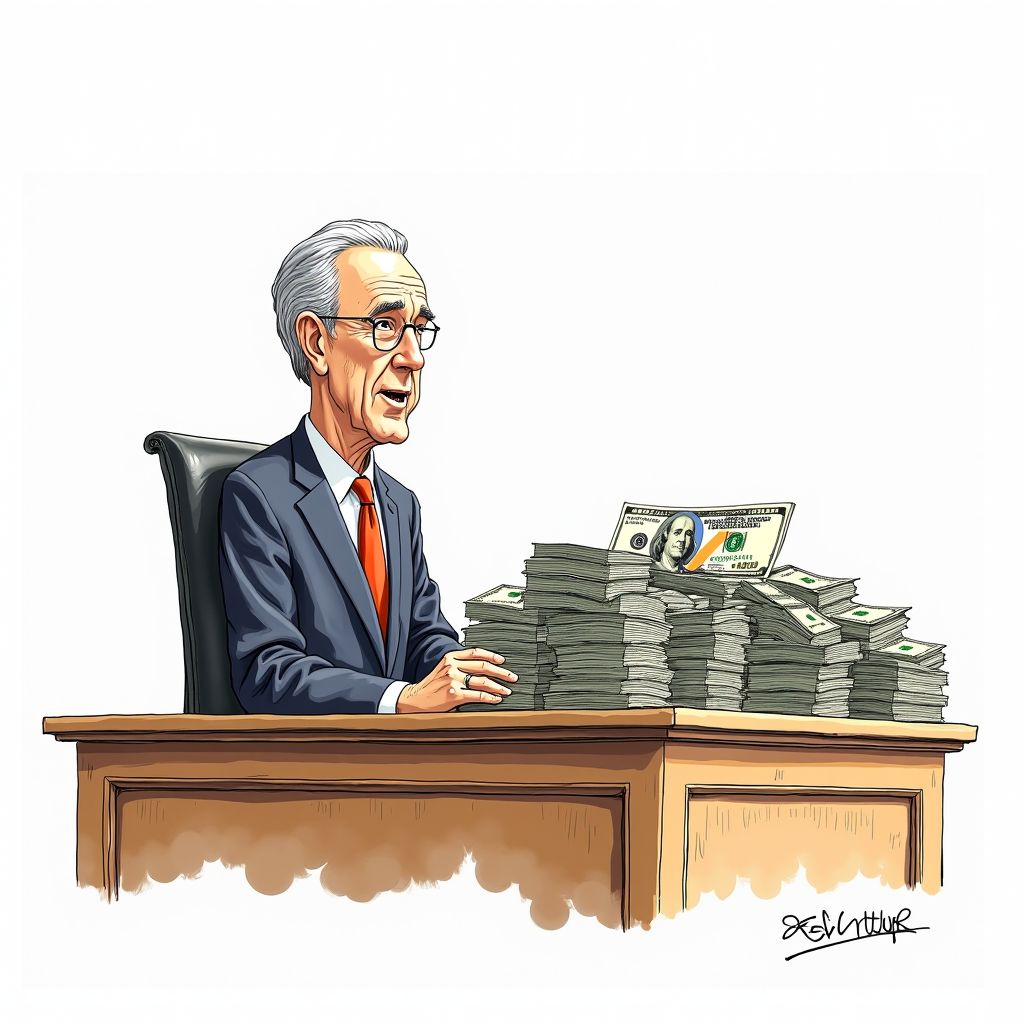
Washington, Sunday, 18 January 2026.
Amid a new criminal probe into Chair Powell, the Court weighs if the President can fire Fed governors, potentially ending the central bank’s independence from political influence.
Escalating Tensions at the Central Bank
This report serves as an update to our ongoing coverage of the legal battle over Federal Reserve independence, specifically regarding the article “Supreme Court Scrutinizes Presidential Authority to Direct Central Bank Policy” [https://wsnext.com/129643a-Federal-Reserve-Supreme-Court/]. While the Supreme Court prepares to hear oral arguments this coming Wednesday regarding the removal of Governor Lisa Cook, the conflict between the White House and the Federal Reserve has widened significantly. On January 11, 2026, Federal Reserve Chair Jerome Powell revealed that the Department of Justice (DOJ) has launched a criminal investigation into his conduct, issuing grand jury subpoenas related to the central bank’s headquarters renovation [1][4][5]. This development transforms a singular employment dispute into a multi-front institutional crisis, with the administration simultaneously targeting the Fed’s leadership through both constitutional litigation and criminal law [1][4].
The Powell Investigation: A New Front
The DOJ’s investigation focuses on alleged irregularities in the renovation of the Federal Reserve’s Washington, D.C. headquarters, a project where costs escalated from an initial estimate of $1.9 billion to $2.5 billion [5]. This represents a cost increase of approximately 31.579 percent. Chair Powell, whose term is set to expire on May 15, 2026, has characterized the investigation as a political pretext designed to force his resignation or influence monetary policy [3][5]. In a statement following the revelation of the subpoenas, Powell asserted that the threat of criminal charges is a direct consequence of the Fed setting interest rates based on economic data rather than “following the preferences of the President” [4][5]. President Trump, who has expressed frustration with the Fed’s pace of interest rate cuts, reportedly commented on the situation by stating, “That jerk will be gone soon” [1].
Oral Arguments in Trump v. Cook
Against this volatile backdrop, the Supreme Court is scheduled to hear oral arguments in Trump v. Cook on Wednesday, January 21, 2026 [2][5]. The case centers on President Trump’s August 2025 attempt to fire Governor Lisa Cook for alleged mortgage fraud, accusing her of designating two different properties—one in Michigan and one in Atlanta—as her primary residence to secure favorable loan terms [2][5]. Cook “vigorously contests” these allegations, describing the discrepancy as an “inadvertent notation” and arguing that the charges are a pretext for removing her due to policy disagreements [1][5]. The administration, represented by Solicitor General D. John Sauer, argues that the President has the authority to determine when “sufficient cause” exists for removal, asserting that Cook’s financial conduct constitutes gross negligence [1][5]. Conversely, legal scholars like Lev Menand warn that a ruling against Cook could provide a “road map” for the President to remove other governors, including Chair Powell [1].
Structural Implications for the Economy
The convergence of the Cook litigation and the Powell investigation has heightened concerns regarding the future of U.S. monetary policy. Daniel Tarullo, a Harvard Law professor and former Fed Governor, argues that the central bank’s independence is “really at stake,” calling Trump v. Cook potentially one of the most significant decisions of the Roberts Court [6]. The outcome will determine whether the statutory “for cause” protection in the Federal Reserve Act offers meaningful job security or if the President can remove governors at will [6]. Economists warn that political control over the money supply—a dynamic observed in nations like Turkey and Venezuela—inevitably leads to inflation [3][4]. With a decision expected by June 2026, investors face a period of heightened uncertainty as the Court weighs whether the Federal Reserve will remain a “quasi-private entity” distinct from the executive branch or become subservient to the White House [3][5].