Ford Idles $5.8 Billion Battery Plant and Cuts 1,600 Jobs Amid Policy Rollbacks
Dearborn, Wednesday, 18 February 2026.
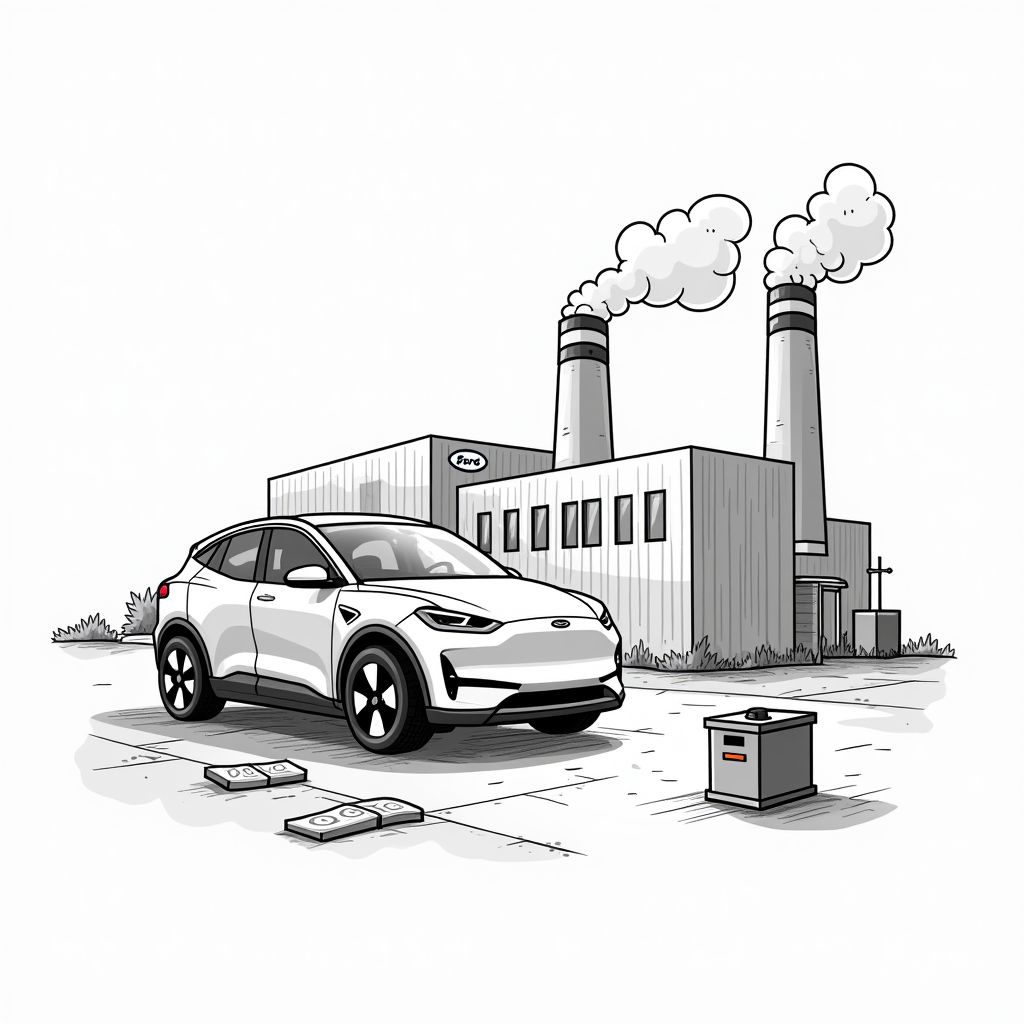
Just four months after opening, Ford halted its Kentucky facility and laid off 1,600 workers, citing federal subsidy rollbacks and a strategic pivot to stem billions in EV division losses.
The Glendale Shutdown
The suspension of operations at the BlueOval SK facility in Glendale, Kentucky, represents a significant reversal for Ford Motor Company (F). The massive battery plant, which spans 607 hectares, was established as a joint venture between Ford and South Korean manufacturer SK On [1]. However, the partnership was dissolved in December 2025, leading Ford to pivot its focus from pure electric vehicle (EV) battery manufacturing toward energy storage systems [1]. The facility had only been operational since the summer of 2025, meaning the closure comes just months after production commenced, leaving approximately 1,600 employees out of work [1].
Policy Headwinds and Local Impact
Ford attributed the closure to a combination of weaker-than-expected EV demand and the expiration of critical federal incentives. Specifically, the federal tax credits—which provided $7,500 for new EVs and $4,000 for used EVs—ended on September 30, 2025 [1]. This policy shift has become a flashpoint for political debate in Kentucky. Governor Andy Beshear explicitly blamed the administration’s rollback of these subsidies for the job losses, stating that the workers were let go “solely because of Donald Trump pushing that big, ugly bill” [1]. The situation presents a complex political irony, as Hardin County, where the plant is located, voted 64% for President Trump in the 2024 election [1]. Despite the political rhetoric, workers like Derek Dougherty have expressed a pragmatic view, noting that “whatever the government policy would be, the company made the decision” [1].
Financial Hemorrhage
The operational halt at Glendale is part of a broader effort to stem bleeding within Ford’s Model e division. During the company’s Q4 2025 earnings call, CFO Sherry House projected losses of $4 billion to $4.5 billion for the division [2]. These figures include a staggering $19.5 billion write-off in EV investments as the automaker recalibrates its strategy [3]. While Ford continues to target a breakeven point for Model e by 2029, the company is currently absorbing significant costs, including hundreds of millions lost from cancelling plans for all-electric three-row crossovers in the first half of 2025 [2]. To mitigate these losses, Ford is implementing a “reset plan” that reduces the emphasis on high-priced EVs in favor of more affordable models and hybrid vehicles [1][2].
The “Skunkworks” Strategy
Facing what CEO Jim Farley describes as a “global competition with China,” Ford has deployed a “skunkworks” team in California led by Alan Clarke to radically rethink EV design and manufacturing [3]. Farley has warned that Chinese competitors offer superior cost and quality, necessitating a complete overhaul of Ford’s approach to survive [3]. The new strategy focuses on extreme efficiency; for example, the body of Ford’s upcoming $30,000 mid-sized pickup, due in 2027, will be constructed using just two aluminum castings [3]. This replaces the 146 welded parts found in the current Ford Maverick, representing a parts reduction of approximately 98.63 percent for that assembly [3]. Furthermore, the new electrical architecture cuts 1,219 meters of wiring and reduces weight by 10 kilograms, while aerodynamic improvements are expected to boost driving range by 80 kilometers [3].
Market Reaction and Future Outlook
Despite the immediate turbulence, Ford maintains a long-term plan for the Kentucky site. The facility is projected to reopen in late 2026 or early 2027 as a wholly-owned Ford subsidiary, potentially employing over 2,100 workers [1]. Investors appear to be digesting the volatility with some optimism; following the release of the quarterly earnings on February 10, 2026, the Vanguard Russell 1000 Value Index Fund increased its stake in Ford by 0.75%, purchasing an additional 15,334 shares [4]. As of Wednesday, Ford’s stock opened at $14.09, trading significantly above its 52-week low of $8.44 [4].