Two Stocks Lose Billions in a Single Day—What Went Wrong?
New York, Thursday, 18 June 2026.
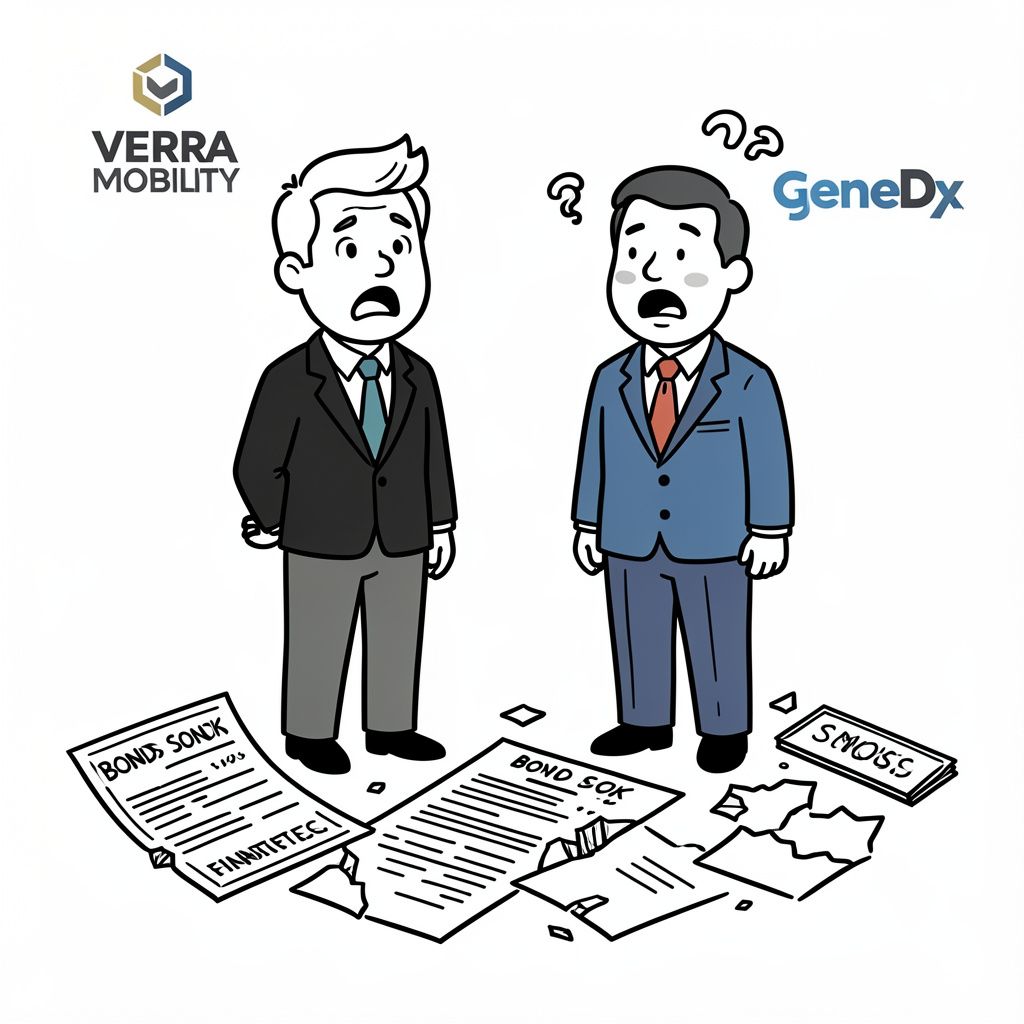
Verra Mobility and GeneDx saw their stocks crash by 70% and 49%, wiping out $1.4 billion and triggering lawsuits. The collapse followed a major contract termination and a 94% acquisition write-off, raising red flags about corporate transparency and market stability. Investors allege misleading disclosures, while analysts warn of deeper risks in volatile sectors. How did two companies unravel so quickly?
The Avis Termination: A $1.4 Billion Shockwave
On 18 June 2026, Verra Mobility Corporation (NASDAQ: VRRM) experienced a catastrophic stock collapse, plummeting by (new-old)/old*100 where new = 3.15 and old = 10.50, resulting in a 70% decline [1]. The immediate trigger was a termination notice from Avis Budget Group, Verra’s largest client, which sent shockwaves through the mobility technology sector [1][2]. The market capitalization wipeout totaled $1.4 billion, a figure that underscores the fragility of client-dependent business models in volatile markets [1]. Verra Mobility, which provides tolling, violation processing, and fleet management solutions, had built its growth narrative around long-term contracts with major rental car companies [GPT]. The abrupt termination not only shattered this narrative but also exposed potential vulnerabilities in Verra’s revenue diversification strategy [2].
Allegations of Misrepresentation Surface
Within hours of the stock crash, securities class action lawsuits were filed against Verra Mobility, alleging that the company had misled investors about the stability of its relationship with Avis Budget Group [1][3]. The lawsuits, initiated by firms including Hagens Berman and Bronstein, Gewirtz & Grossman, claim that Verra downplayed the risk of rental car companies replacing Verra’s services with in-house solutions or third-party providers [1][3]. The class period for these lawsuits spans from 24 February 2026 to 26 May 2026, suggesting that concerns about client concentration may have been building for months [3]. Peretz Bronstein, founding partner of Bronstein, Gewirtz & Grossman, stated that their practice ‘centers on restoring investor capital and ensuring corporate accountability, which serves to uphold the essential integrity of the marketplace’ [3]. This legal scrutiny adds another layer of complexity to Verra’s recovery efforts, as the company must now navigate both operational challenges and potential reputational damage [1][3].
GeneDx’s Acquisition Write-Off: A 94% Miscalculation
While Verra Mobility’s collapse dominated headlines, GeneDx Holdings (NASDAQ: WGS) faced its own financial reckoning on the same day. The clinical diagnostics company saw its stock drop by 49%, a decline that followed the announcement of a 94% write-off related to its acquisition of Fabric Genomics [4][7]. The $33.2 million acquisition, completed in June 2025, was positioned as a strategic move to expand GeneDx’s addressable market through high-margin interpretation services [5]. However, first-quarter 2026 results revealed a tenfold increase in net loss year-over-year, with Fabric Genomics contributing a $2.5 million revenue miss and triggering $31.2 million in impairment charges [5]. The write-off represents approximately 93.976% of the acquisition cost, raising serious questions about due diligence and valuation practices [5].
ARR Shortfall and Guidance Cuts: The Numbers Behind the Collapse
GeneDx’s troubles extended beyond the Fabric Genomics write-off. The company reported an Annual Recurring Revenue (ARR) shortfall of approximately $200 million compared to February 2026 guidance, driven by an adverse shift toward lower-margin genome products [5]. This shift, where ARR for genome products was roughly 50% of exome products, contradicted earlier projections and forced GeneDx to slash its 2026 revenue guidance by 12% [5]. The company also revised its growth expectations for exome and genome revenue to ‘at least 20%’, down from a previous forecast that had not been publicly quantified but was implied to be higher [5]. These revisions paint a picture of a company struggling to reconcile its ambitious growth targets with operational realities. The securities class action lawsuit filed against GeneDx alleges that the company misled investors about Fabric Genomics’ value, product mix changes, and growth trajectory [4][6]. Reed Kathrein, a partner at Hagens Berman, stated, ‘We’re investigating whether GeneDx may have intentionally or recklessly misled investors about Fabric’s real value to the company, the key changes in its product mix that have dramatically reduced their growth expectations, and when management first knew of the product shift’ [4].
Legal Deadlines and Investor Options
For investors in both companies, critical legal deadlines are approaching. Verra Mobility shareholders who purchased stock between 24 February 2026 and 26 May 2026 have until 4 August 2026 to request appointment as lead plaintiff in the class action lawsuit [1][3]. GeneDx investors face a similar deadline of 3 August 2026 for those who purchased shares between 16 April 2025 and 4 May 2026 [4][6]. These deadlines are not merely procedural; they represent the final opportunity for investors to seek recovery for alleged securities fraud [1][4]. Law firms handling these cases operate on a contingency fee basis, meaning investors do not share in the recovery costs [3]. Additionally, whistleblowers with non-public information about either company may contact law firms to provide information under the SEC Whistleblower Program, which offers rewards of up to 30% of any successful SEC recovery [4]. The flurry of legal activity underscores the severity of the allegations and the potential for significant investor recoveries [1][3][4][6].
Broader Implications for Market Transparency and Stability
The simultaneous collapses of Verra Mobility and GeneDx highlight growing scrutiny over corporate acquisitions and client contract stability in volatile markets. For Verra, the Avis termination exposes the risks of over-reliance on a single client, even when that client represents a significant portion of revenue [2]. The mobility technology sector, which has seen rapid growth in recent years, may now face increased investor skepticism about the sustainability of its business models [GPT]. For GeneDx, the Fabric Genomics write-off serves as a cautionary tale about the challenges of integrating acquisitions and the dangers of overvaluation [5]. The diagnostics industry, particularly companies focused on rare disease testing, operates in a complex regulatory and reimbursement landscape that can quickly erode projected margins [GPT]. Both cases also raise questions about financial transparency and the accuracy of forward-looking statements, issues that have become increasingly prominent in the wake of recent market volatility [1][4]. Analysts warn that these collapses could trigger broader market reactions, particularly in sectors where companies rely heavily on a small number of clients or where acquisition-driven growth strategies are prevalent [GPT].
What Comes Next for Verra Mobility and GeneDx?
As both companies grapple with the fallout from their respective crises, their paths forward remain uncertain. Verra Mobility must demonstrate its ability to diversify its client base and stabilize its revenue streams in the absence of Avis Budget Group [2]. The company’s next earnings report will be closely watched for signs of progress in this area, as well as any updates on its legal strategy [1]. For GeneDx, the focus will likely be on operational turnaround and restoring investor confidence [5]. The company’s ability to meet its revised guidance and improve its gross margins will be critical in determining whether it can recover from the Fabric Genomics write-off [5]. Both companies face the additional challenge of managing their public narratives amid ongoing litigation, which could further erode trust among investors and clients alike [1][4]. Market observers will be watching closely to see whether these collapses represent isolated incidents or the beginning of a broader trend of corporate reckonings in volatile sectors [GPT].
Sources
- www.globenewswire.com
- www.globenewswire.com
- www.globenewswire.com
- www.globenewswire.com
- www.bizwireexpress.com
- www.globenewswire.com
- x.com