Billion-Dollar BART Extension to San Jose at Risk of Collapse
San Jose, Saturday, 20 June 2026.
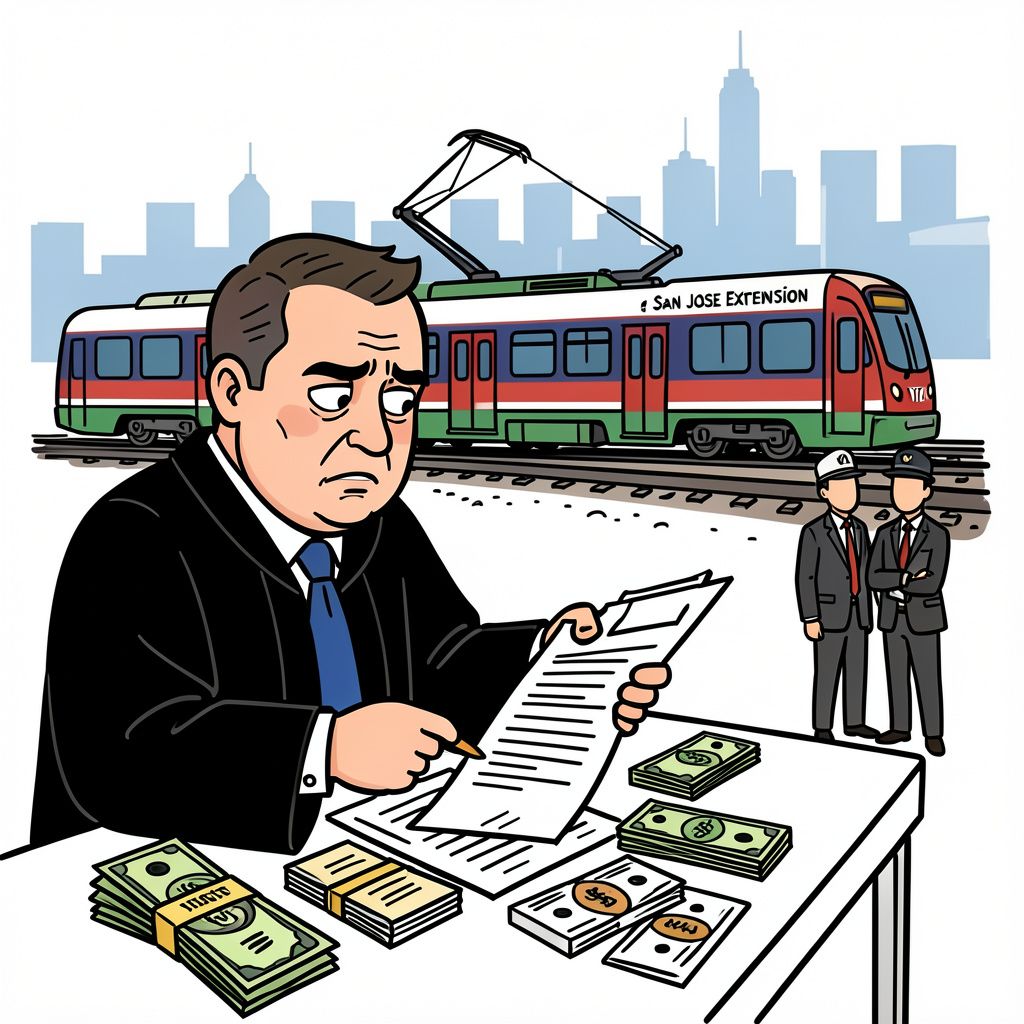
A scathing 2026 report by the Santa Clara County Civil Grand Jury reveals the $12.7 billion BART extension to San Jose is teetering on financial disaster. With ridership 86% below projections and annual losses hitting $69 million, the project faces a $1 billion funding gap—even after securing $5.1 billion in federal funds. The grand jury warns of ‘no realistic plan’ to address escalating costs, expiring tax measures, and declining ridership, calling VTA’s oversight ‘ineffectual.’ Worse, critical decisions were made without independent analysis, locking in a single-bore tunnel design that may cost taxpayers dearly. As Silicon Valley’s growth hangs in the balance, this project could set a dangerous precedent for future infrastructure investments.
A Decade of Dysfunction: How VTA’s Oversight Failures Put BART Extension at Risk
The Santa Clara County Civil Grand Jury’s June 2026 report paints a damning picture of the Valley Transportation Authority’s (VTA) management of the BART Silicon Valley Phase II (BSVII) project. With a projected cost of $12.75 billion and an estimated completion date of 2037—delayed from an initial 2026 target—the extension from Berryessa to Santa Clara has become a case study in transit project mismanagement [1][2]. The grand jury found that VTA’s Board and its Oversight Committee failed to hold staff accountable for missed deadlines, cost overruns, and inadequate financial planning. Notably, the Board approved a $76 million tunnel-boring machine (TBM) purchase in December 2022, locking in a single-bore tunnel design without independent analysis of alternatives, despite initial preferences for a twin-bore approach [3]. This decision, made without the Oversight Committee’s input, exemplifies the governance failures that have plagued the project.
Financial Black Hole: Ridership Projections Miss by 86%, Annual Losses Hit $69 Million
The financial risks identified in the grand jury report are staggering. Phase I of the BART extension, which opened in 2020, has operated at an average annual loss of $69 million over its first five years, with ridership in January 2026 reaching just 14% of projections (2,789 rides/day vs. a forecasted 20,110) [1][4]. For Phase II, VTA forecasts annual operating costs of $274 million against fare revenues of just $60 million, resulting in an estimated annual loss of $214 million [3]. The project’s total cost has ballooned from an initial $4.7 billion in 2014 to $12.75 billion in 2026, a 171.277% increase [1][2]. Despite securing $5.1 billion in federal funding from the Federal Transit Administration (FTA), the project faces a funding gap of $700 million to $1.2 billion, with no contingency plan in place [1]. The grand jury report explicitly states, “There is no realistic plan to deal with foreseeable financial risks,” including reliance on expiring voter-approved sales tax measures and uncertain federal support [1][5].
Governance in Crisis: Board Turnover and Lack of Expertise Undermine Oversight
The grand jury report highlights systemic governance issues that have undermined the BSVII project. VTA’s Board, composed of 16 members serving 2-year terms—shorter than the 4-year terms at peer agencies like LA Metro and OCTA—lacks stability and transportation expertise [1][3]. Appointments are made without public deliberation, and some groups bypass statutory requirements for transportation expertise, as noted in a 2024 State Auditor report: “The process for selecting directors for the Board is not always transparent enough to ensure the appointment of directors experienced in transportation issues” [3]. The Oversight Committee, formed in October 2023, has failed to provide strategic guidance or independent analysis. Meetings are limited to two hours and dominated by staff presentations, with critical issues often addressed in private pre-meetings, leaving the full Board uninformed [1][3]. The grand jury report concludes, “The VTA Board has failed in its responsibility to provide effective management, oversight, and financial control of the BSVII Project” [1].
The Tunnel Decision: A $1 Billion Mistake?
One of the most contentious decisions in the BSVII project was the adoption of a single-bore tunnel design. In December 2022, VTA approved the $76 million purchase of a custom TBM, effectively locking in the single-bore approach before completing an “apples-to-apples” comparison with the twin-bore alternative [3]. The Oversight Committee had requested this analysis in November 2023, but it was delivered 17 months late, in August 2025, after the Board had already committed to the single-bore design [3]. A subject-matter expert (SME) recommended concurrent tunneling using two TBMs (Scenario 1a) to reduce costs and accelerate the schedule, but VTA staff pushed forward with the single-bore Scenario 1 without independent analysis [3]. The KST contract modification, approved in June 2025, could increase costs by up to $1 billion due to design changes, yet the Oversight Committee failed to provide a risk assessment to the Board [3]. San José Mayor Matt Mahan, who chairs the Oversight Committee, acknowledged the risks of delay but emphasized the need to “accelerate actual building rather than endless second-guessing” [5].
A Precedent for Failure: What’s at Stake for Silicon Valley’s Future
The BSVII project’s struggles extend beyond financial and governance failures—they set a dangerous precedent for future infrastructure investments in high-growth urban areas. The grand jury report warns that without immediate corrective action, the project risks becoming a “boondoggle” that diverts public funds from other critical transit needs [1][2]. The economic implications are significant: Silicon Valley’s continued expansion relies on efficient transit systems to connect a workforce that increasingly demands sustainable commuting options. The project’s failure could exacerbate traffic congestion, estimated to cost the Bay Area $2.6 billion annually in lost productivity [GPT]. Moreover, the project’s mismanagement has eroded public trust, as evidenced by VTA’s poorly organized website, which lacks a high-level dashboard for costs, timelines, and progress [1]. The grand jury has given VTA until December 31, 2026, to adopt a strategy to reduce dependency on new sales tax measures, implement a cash-flow model, and develop an alternative funding strategy [1]. However, with the November 2026 ballot measure looming and federal funding uncertain, time is running out. As BART Assistant General Manager Shane Edwards stated, “BART remains fully committed to the successful delivery of this critical regional investment. However, that commitment depends on VTA’s immediate corrective action to restore transparency and accountability” [1].
Sources
- localnewsmatters.org
- www.mercurynews.com
- santaclara.courts.ca.gov
- www.kqed.org
- santaclara.courts.ca.gov