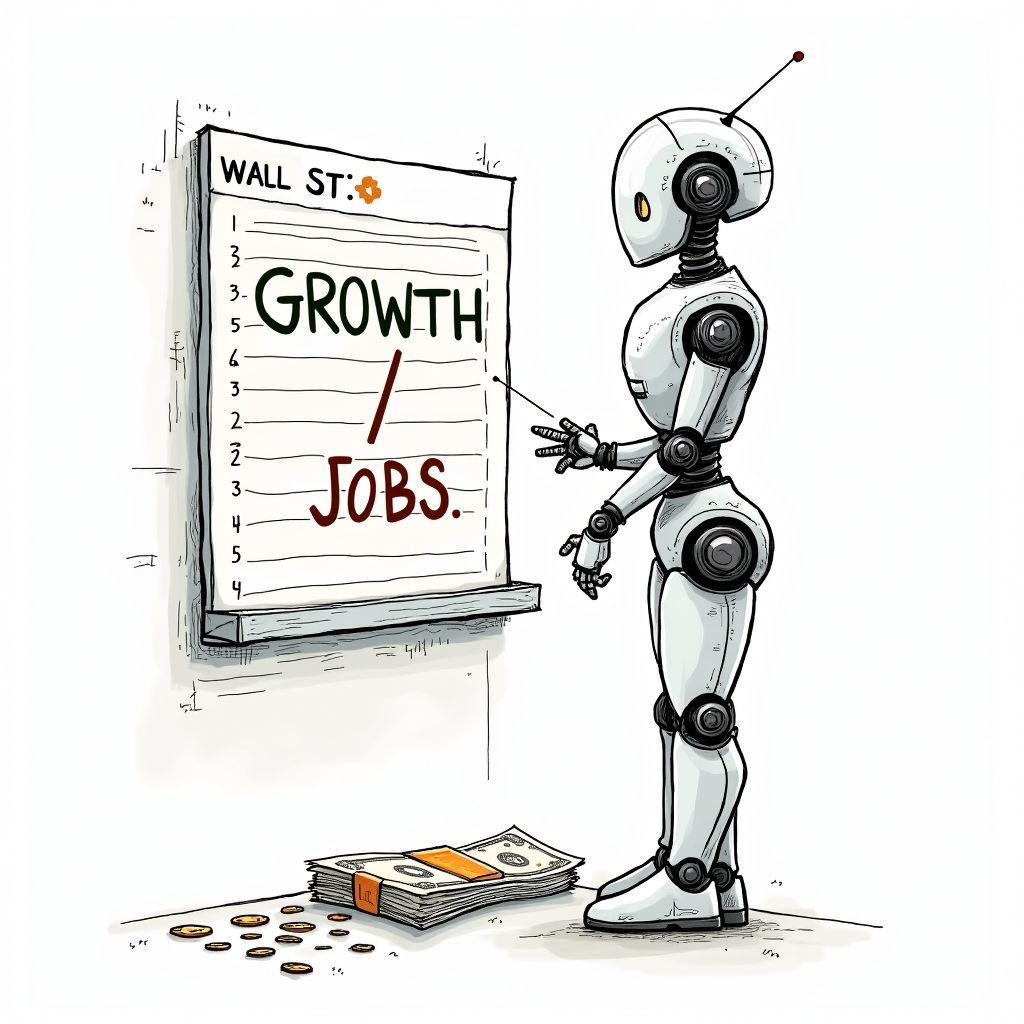
Goldman Sachs Warns: AI Productivity Boom May Sever Link Between Growth and Jobs
New York, Thursday, 15 January 2026.
Goldman Sachs’ Chief Economist Jan Hatzius identifies a critical shift in the US economy as we enter 2026: the traditional correlation between robust GDP growth and a healthy labor market is fracturing. While AI adoption is projected to drive productivity gains of up to 25%, this efficiency is actively decoupling economic expansion from job creation. Unemployment has already risen to 4.4% despite solid output, with youth unemployment spiking to 8.3%. This divergence suggests AI is accelerating the economy’s “speed limit” while simultaneously dampening labor demand, creating a paradox where the economy booms while workers struggle. As productivity trends accelerate, policymakers face the unprecedented challenge of navigating a “jobless growth” phase that could fundamentally alter the social contract.
The Productivity Wedge
Jan Hatzius, speaking in a podcast released this week, highlights that US productivity trends have accelerated from a 1.5% baseline observed between 2008 and 2020 to approximately 2% today [1]. The concern lies in the potential for AI to push this figure even higher. Hatzius projects that as AI adoption deepens, productivity growth could climb by another half percentage point to 2.5%, effectively raising the economy’s speed limit [1]. While mathematically impressive—representing a potential 25 percent increase in efficiency—this shift is driving a “wedge” between robust GDP numbers and the labor market, leaving workers facing a landscape where output grows without a corresponding increase in hiring [1].
Labor Market Reality
The friction is already visible in recent data. Rick Rieder, Chief Investment Officer at BlackRock, noted last month that the US unemployment rate had ticked up from 4.1% to 4.4% in a matter of months [1]. The situation is particularly acute for younger demographics; unemployment for individuals aged 20 to 24 is currently hovering at 8.3% [1]. This data supports Hatzius’s observation that despite solid headline economic growth, consumer and worker sentiment remains “sour” because labor market opportunities are deteriorating rather than expanding [1].
The Efficiency Dividend and Corporate Winners
While the labor market cools, capital markets are identifying clear beneficiaries of this efficiency drive. Goldman Sachs has highlighted specific equities, such as Bank of America and EPAM Systems, as companies positioned to benefit significantly from investing in AI productivity [2]. The underlying logic is that AI acts as a lever for margin expansion; by automating complex tasks, companies can maintain or increase output while managing payroll costs more aggressively. This dynamic has fueled a market environment where efficiency is rewarded, even as it decouples from headcount growth.
Historical Echoes and Future Risks
Economists are divided on whether this transition will mirror past industrial revolutions or represent a fundamental break. Optimists like Fundstrat’s Tom Lee compare the current AI boom to the introduction of flash-frozen foods in the 1920s—a technology that decimated farm labor from 40% of the workforce to 2% but ultimately freed up human capital for new industries [3]. However, the darker counter-narrative invokes Wassily Leontief’s 1983 warning that human labor could eventually face the same obsolescence as horses after the advent of the tractor [3]. Mustafa Suleyman, CEO of Microsoft AI, has reinforced this view, describing AI as a “fundamentally labor-replacing tool” capable of producing knowledge at “almost zero marginal cost” within two decades [5].
Conclusion
As the US economy moves further into 2026, the decoupling of growth from employment represents a profound structural shift. Goldman Sachs’ analysis suggests that the “wedge” between GDP and jobs is not a temporary anomaly but a feature of the AI-driven productivity boom [1]. For investors, this signals a continued bull market in efficiency-driven stocks, with the bank projecting a 7% total return for the S&P 500 this year [4]. For the broader economy, however, it signals a period of volatility where traditional metrics of success may increasingly fail to reflect the lived reality of the workforce [1].
Sources
- www.capitalaidaily.com
- www.cnbc.com
- fortune.com
- www.businessinsider.com
- futurism.com
- www.linkedin.com
- www.newyorker.com