Partisan Rift at White House Dinner Marks Shift in Federal-State Relations
Washington, Monday, 23 February 2026.
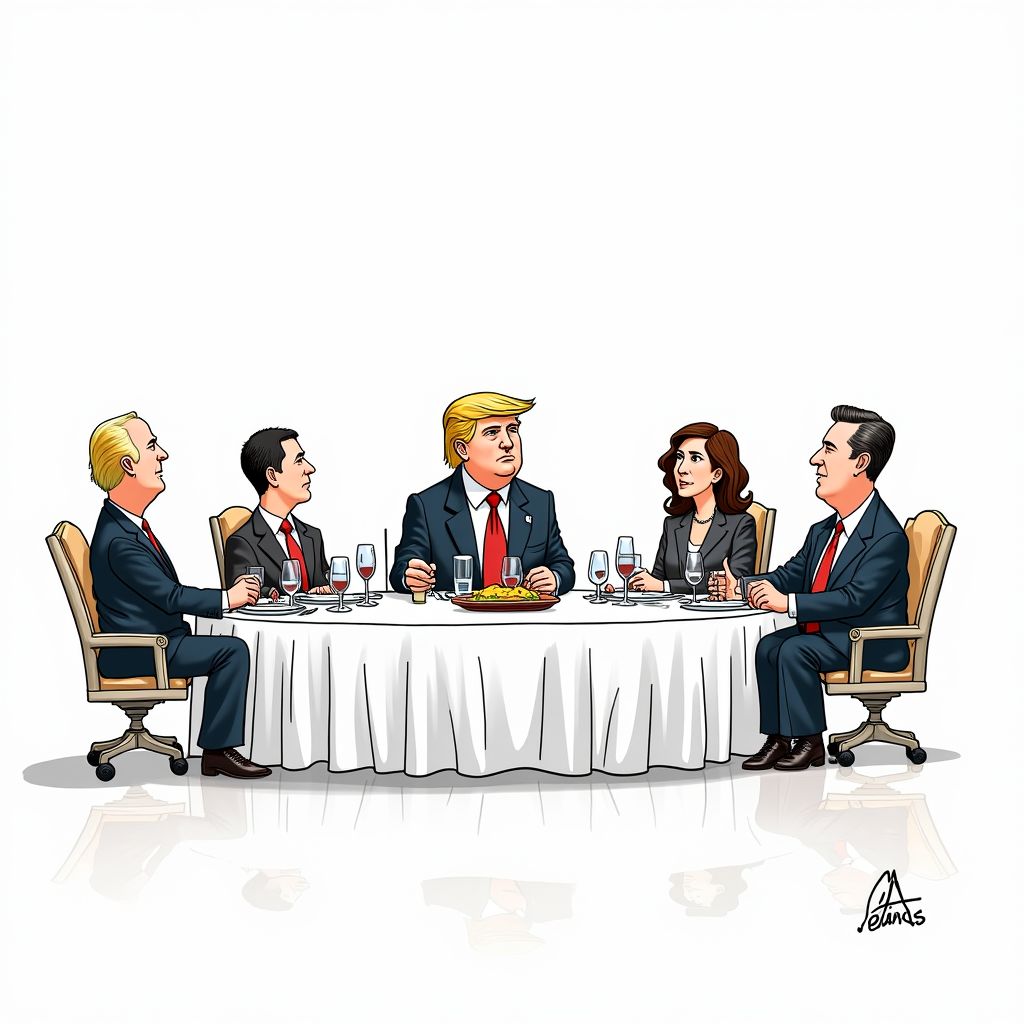
The National Governors Association (NGA) winter meeting concluded on February 22, 2026, with a historic breach in protocol: for the first time, the nonpartisan organization refused to facilitate the traditional White House gathering. This decision followed the administration’s initial refusal to invite specific Democratic governors, leading to a boycott where no Democrats attended the February 21 dinner with President Trump. While NGA leaders publicly emphasized unity and “reigniting the American Dream,” this partisan fragmentation at the executive level signals a concerning shift in federal-state dynamics. For investors and policy analysts, this breakdown suggests increasing friction in the deployment of federal resources and the coordination of economic policy across state lines.
A Historic Breach in Protocol
The fracture in federal-state relations began when the administration initially declined to invite Democratic Governors Jared Polis of Colorado and Wes Moore of Maryland to a working event on Friday, February 20, 2026 [1][4]. Although the White House reportedly relented on the invitations, the initial exclusion prompted dozens of Democrats to threaten a boycott [1]. Consequently, no Democratic governors attended the annual dinner on Saturday, February 21, leaving the event populated solely by administration officials and Republican governors [1]. Massachusetts Governor Maura Healey characterized the President’s handling of the weekend as a “farce,” while the NGA—an organization founded over a century ago—took the rare step of withdrawing its facilitation of the event entirely [1][4]. This separation underscores a deepening volatility in how the executive branch engages with state leadership, a dynamic that historically ensures the smooth implementation of federal programs.
Infrastructure and Funding at an Impasse
The political theater at the White House had immediate policy implications, particularly regarding infrastructure and environmental management. During the weekend’s proceedings, President Trump explicitly criticized Maryland and Virginia regarding a sewage spill in the Potomac River, stating, “We have to clean up some mess that Maryland and Virginia have left us,” and attributing the issue to “incompetence” [1]. For investors monitoring municipal bonds and regional utility sectors, such rhetoric signals potential risks in federal-state cooperation for essential services. The friction extended to the President’s own party; NGA Chair and Oklahoma Governor Kevin Stitt was labeled a “RINO” (Republican In Name Only) by the President after attempting to mediate the standoff earlier in the week [4]. Despite this, Stitt maintained a diplomatic tone at a Politico event on February 19, acknowledging the difficulty of the President’s job while emphasizing the NGA’s bipartisan mission [4].
Economic Sentiment vs. Market Reality
Inside the NGA meetings, away from the White House tension, the focus shifted to the disconnect between economic data and voter sentiment. On Saturday, polling expert Dr. Frank Luntz presented data to the governors highlighting a “striking paradox”: while objective metrics indicate Americans are wealthier and possess more opportunities than in the past, public sentiment remains historically negative [5]. Luntz argued that partisan identity has superseded income and geography as the primary driver of this dissatisfaction [5]. This analysis suggests that consumer confidence is becoming increasingly decoupled from macroeconomic performance, a trend that complicates forecasting for retail and service sectors. To bridge this gap, Governor Stitt promoted an initiative titled “Reigniting the American Dream,” which focuses on tangible deliverables such as workforce permits and affordable energy grids, urging states to issue permits to address labor shortages [1][3].
The 2028 Shadow and Future Governance
The weekend also served as a stage for positioning ahead of the 2028 electoral cycle. Several governors in attendance, including Wes Moore, Josh Shapiro, Gavin Newsom, J.B. Pritzker, and Andy Beshear, are currently viewed as potential presidential contenders [4]. Governor Beshear is reportedly planning a book release this fall, a standard maneuver for aspiring national candidates [4]. Despite the political maneuvering, Governor Moore, serving as NGA Vice Chair, emphasized that he had “no desire to have beef” with the President, though he noted the administration’s approach made cooperation difficult [4]. As the conference concluded on February 22, the NGA leadership reiterated a commitment to “putting America first” over partisan attacks, yet the unprecedented boycott of the White House dinner suggests that the operational relationship between the states and the federal executive branch faces a challenging road ahead [3].