Why Wall Street Suspended Trading for Amazon and Nvidia
New York, Monday, 28 September 2026.
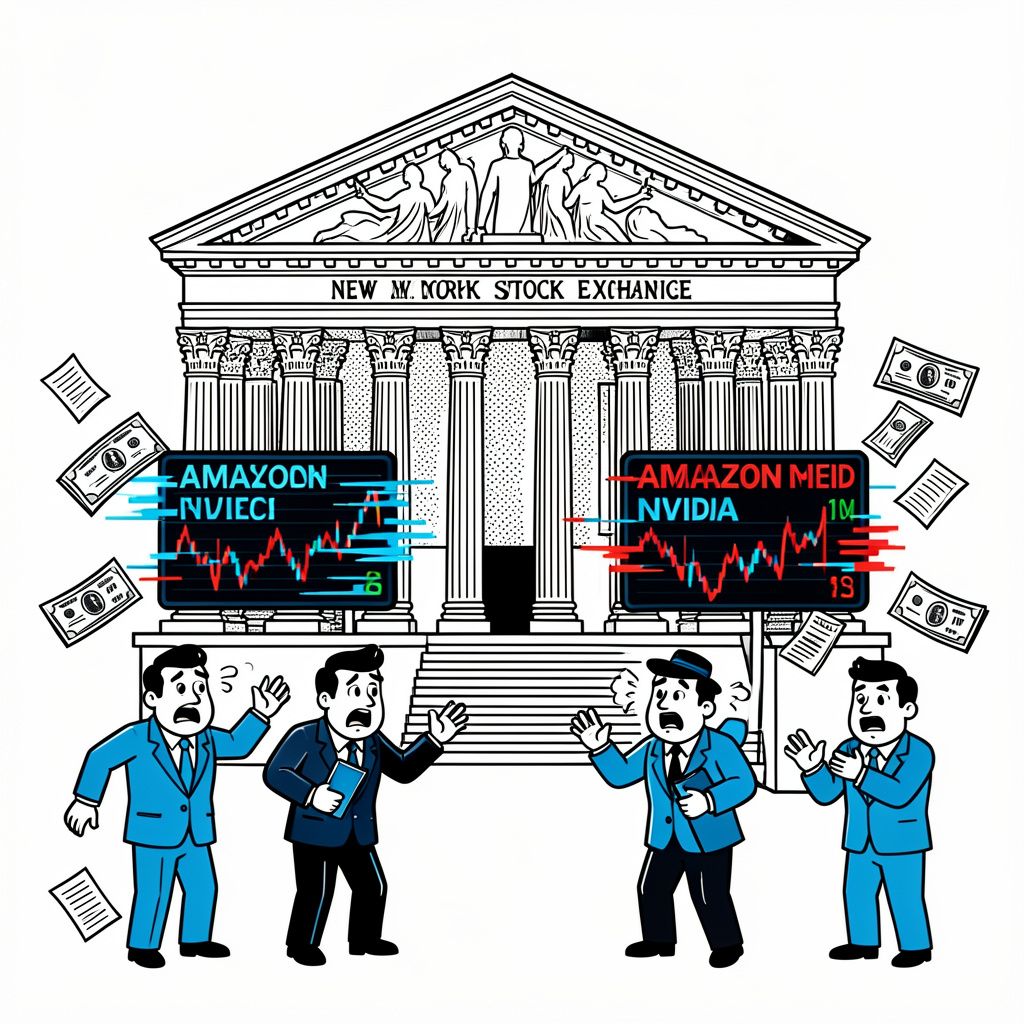
A technical glitch at the New York Stock Exchange triggered automated safety protocols, halting trading in Amazon and Nvidia to prevent conflicting quote data from triggering uncontrolled algorithmic spirals.
Distinguishing Glitches from Volatility Controls
The trading halts experienced on 27 September 2026 were not the result of standard volatility controls but rather stemmed from a technical disruption requiring immediate safety protocols [1]. Unlike the Limit Up-Limit Down (LULD) mechanism, which is a designed protocol that suspends trading for five minutes if a stock’s price drifts outside specified percentage bands, this event was triggered by conflicting quote data generated by exchange matching engines [1]. System stability requires trading halts the split second exchange matching engines generate conflicting quote data, because allowing automated algorithms to trade against unverified prices creates uncontrollable systemic liquidity spirals [1].
Regulatory trading halts are distinct from operational glitches, as they are enacted by exchange officials specifically for material news dissemination or compliance reviews [1]. The automated market safeguards that activated on Monday function as federally mandated systemic firewalls governed by the Securities and Exchange Commission (SEC) and the Financial Industry Regulatory Authority (FINRA) to prevent erroneous order execution during infrastructure failures [1]. This distinction is critical for investors understanding that the halt was a protective measure against infrastructure failure rather than a reaction to price movement alone [1].
Infrastructure Vulnerabilities and Market Stability
Modern exchanges like the NYSE utilize matching engines and data dissemination via the Securities Industry Automation Corporation (SIAC) and the Consolidated Tape Association [1]. Outages occur when hardware bottlenecks, software anomalies, or data feed disconnects distort the National Best Bid and Offer (NBBO), leading to the type of disruption seen with Amazon and Nvidia shares [1]. Operational NYSE technical glitches result from infrastructure failures, including server gateway timeouts, multicast ticker plant disconnections, or auction pricing calculation bugs [1].
Engineers must often reset matching partitions, purge order queues, and initiate controlled pre-opening quotation periods to resolve such issues [1]. While Market-Wide Circuit Breakers are distinct mechanisms triggered when benchmark indices decline past established thresholds, this event highlighted specific exchange-level vulnerabilities [1]. In contrast to the NYSE disruption, market status reports from NASDAQ indicated that their systems, including NTX, PSX, and various options markets, were operating normally during the same timeframe [2].
Protocols for Investors During Exchange Interruptions
During exchange interruptions, high-frequency algorithms redirect routing pathways, causing widened bid-ask spreads across secondary venues and alternative trading systems, which increases execution risk for market orders [1]. Recommended trader protocol during halts includes verifying pending limit orders, tracking official SIP/exchange notice boards for halt codes, and assessing correlated ETF or derivative pricing [1]. Investors are advised to avoid market orders until reopening auctions establish stable reference prices to mitigate the risk of erroneous execution [1].
The malfunction underscores ongoing vulnerabilities in market infrastructure and automated circuit breakers designed to mitigate rapid algorithmic price volatility [1]. As of 10:19:26 ET on 28 September 2026, regulatory messages from major counterpart exchanges showed no active alerts, confirming the issue was isolated to the specific NYSE infrastructure failure [2]. Market participants must remain vigilant regarding official communications to distinguish between broader market stops and isolated technical halts [1][2].