Funding Standoff Halts TSA PreCheck and Global Entry Operations Nationwide
Washington, Sunday, 22 February 2026.
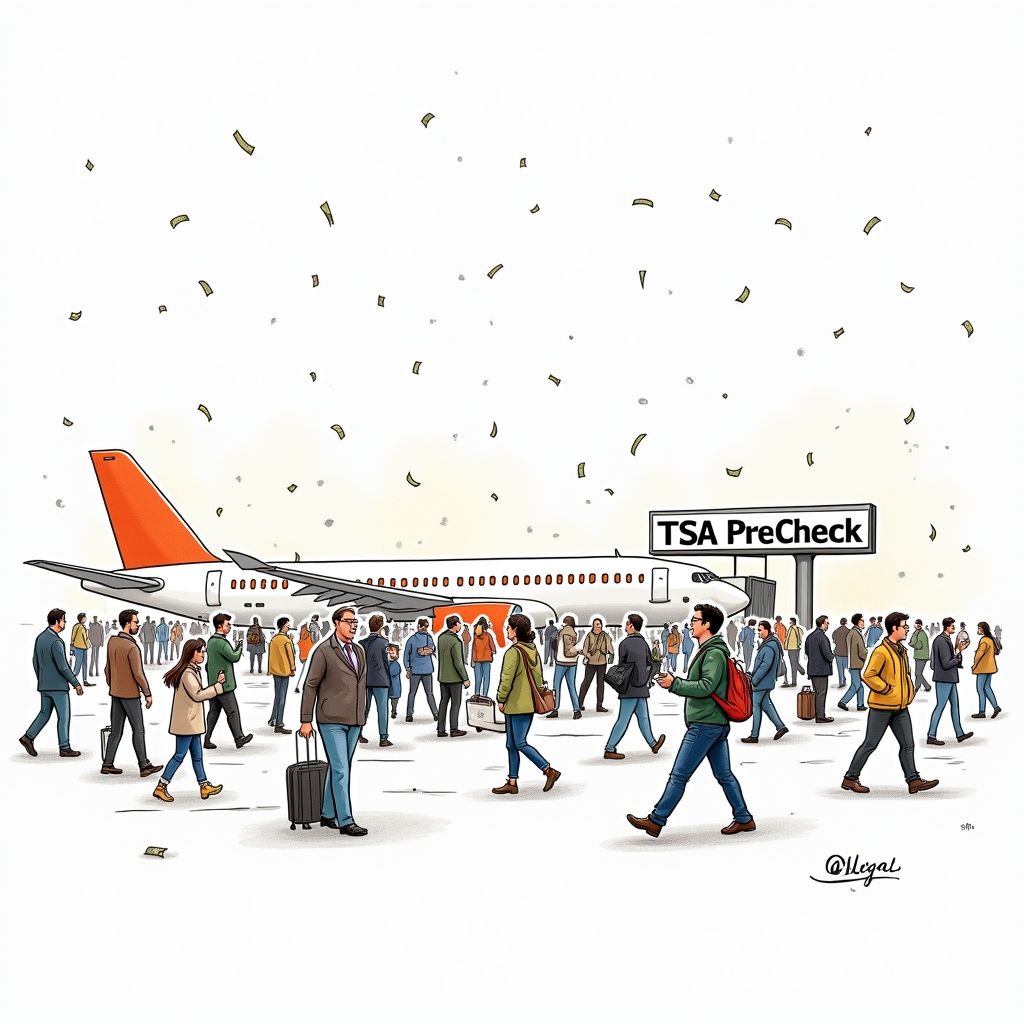
Effective Sunday at 6 a.m. ET, the Department of Homeland Security has suspended TSA PreCheck and Global Entry, citing an ongoing funding lapse. This operational halt, triggered by a legislative stalemate over immigration enforcement reforms following fatal incidents in Minneapolis, forces vetted travelers into standard security lanes. DHS Secretary Kristi Noem characterizes the decision as a necessary reallocation of resources to prioritize the general population, yet the move threatens to create significant congestion at major transit hubs. With a winter storm approaching the Northeast and negotiations stalled, this escalation highlights how the budgetary conflict is now directly disrupting national commerce and corporate logistics.
Operational Contraction and Resource Reallocation
The suspension of the Transportation Security Administration’s (TSA) PreCheck and U.S. Customs and Border Protection’s (CBP) Global Entry programs officially commenced at 6 a.m. ET on Sunday, February 22, 2026 [1][2]. This operational pause, confirmed by Department of Homeland Security (DHS) officials, serves as a direct response to the funding lapse that has constrained agency resources since mid-February [2][3]. DHS Secretary Kristi Noem defended the measure as a strategic necessity, stating that the department is prioritizing the “general traveling population” at ports of entry while suspending “courtesy and special privilege escorts” to mitigate the broader impact of the shutdown [2][5]. Consequently, travelers who previously utilized these expedited screening lanes must now navigate standard security checkpoints, a shift expected to significantly increase processing times at major transit hubs [1][4].
Legislative Deadlock Over Immigration Reform
The current budgetary impasse, which triggered the partial government shutdown on February 14, 2026, is rooted in a contentious disagreement between the Trump administration and congressional Democrats regarding immigration enforcement protocols [2][4]. Negotiations stalled after Democrats demanded specific reforms to Immigration and Customs Enforcement (ICE) operations following the deaths of Renee Good and Alex Pretti in Minneapolis during federal law enforcement actions [2][6]. While Democrats have conditioned DHS funding on these changes, the White House has rejected the proposals, with Press Secretary Karoline Leavitt dismissing the latest Democratic offer as “unserious” [6]. House Democrats have criticized the administration’s management of the shutdown, arguing that the suspension of traveler programs is effectively “kneecapping” secure travel to score political points [5].
Asymmetric Funding and Workforce Strain
The financial architecture of this shutdown reveals a stark disparity in how different DHS components are funded. While TSA and Federal Emergency Management Agency (FEMA) personnel face pay stoppages, ICE and CBP continue to operate using $75 billion in funding approved the previous year under the “Big, Beautiful Bill” act [4][6]. This leaves the vast majority of the TSA workforce vulnerable; approximately 95 percent of the agency’s employees—roughly 61,000 individuals—are deemed essential and must work without immediate pay, while around 2,900 have been furloughed [4]. Deputy Administrator Ha Nguyen McNeill has warned that this financial pressure often forces officers to choose between work and personal financial obligations, leading to increased unscheduled absences that can severely degrade checkpoint efficiency [4].
Compounding Disruptions and Weather Risks
The logistical strain on the national travel network is already evident in recent data, which recorded a total of 5615 flight disruptions, comprised of 222 cancellations and 5,393 delays [4]. This operational fragility faces an immediate stress test as a significant winter storm is forecast to impact the Mid-Atlantic and Northeast, coinciding with the reduction in workforce flexibility [2]. Beyond the airports, the shutdown’s effects are rippling through disaster response capabilities; the Trump administration has ordered FEMA to suspend the deployment of hundreds of aid workers to disaster-affected areas to conserve resources, further widening the scope of the emergency measures [1][5].