Potential US-Iran Conflict Looms Amidst Stalled Nuclear Talks
Washington, Thursday, 19 February 2026.
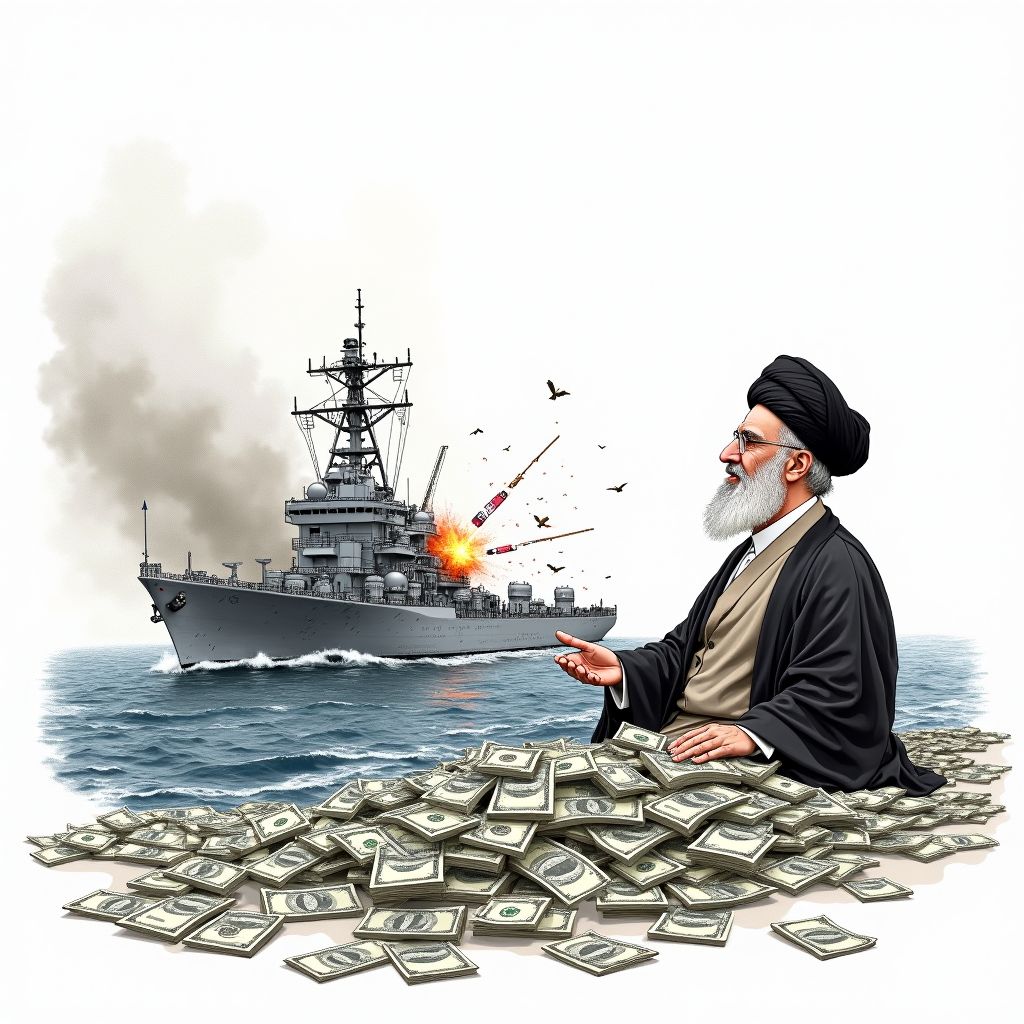
Tensions escalate as Trump considers military action against Iran as early as February 21, 2026, while Iran conducts military drills in the Strait of Hormuz. Ayatollah Ali Khamenei posted an AI-generated picture of a sunken USS Gerald Ford.
Escalating Tensions in the Middle East
The potential for military action comes on the heels of recent Iranian naval drills in the Strait of Hormuz, which briefly disrupted a critical artery for global oil exports [6]. As reported on Tuesday, February 17, 2026, the Islamic Revolutionary Guard Corps (IRGC) initiated live-fire naval drills, leading to a temporary closure [6]. For context on the initial market reactions and geopolitical considerations, refer to our previous coverage [https://wsnext.com/49fab7d-Strait-of-Hormuz-Nuclear-negotiations/]. Now, the situation has further deteriorated, with the U.S. possibly considering military intervention [1][2].
Trump Considers Military Options
President Trump and his national security advisors have been discussing potential military strikes against Iran, with some timelines suggesting action as early as Saturday, February 21, 2026 [1][2]. While no final decision has been made, top national security officials have briefed President Trump that the military is prepared for strikes, though the timeline could extend beyond the immediate weekend [2]. Adding to the tension, White House Press Secretary Karoline Leavitt stated on Wednesday, February 17, 2026, that there are ‘many reasons and arguments that one could make for a strike against Iran’ [1]. The discussions took place in the White House Situation Room on Wednesday, February 18, 2026 [2][4].
Diplomatic Impasse and Military Buildup
Indirect talks between the U.S. and Iran in Geneva on Tuesday, February 17, 2026, have shown limited progress, with both sides still far apart on key issues [1][4]. While Iranian Foreign Minister Abbas Araghchi described the meeting as ‘more constructive’ than previous sessions, Leavitt stated on February 19, 2026, that Washington and Tehran remain significantly divided [1][7]. The U.S. Defense Department is actively deploying additional weaponry, including warships, air defenses, and submarines, to the Middle East, signaling readiness for potential military action [4]. The USS Gerald R. Ford is en route to the Mediterranean Sea to join the USS Abraham Lincoln in the Persian Gulf [4]. However, a senior retired defense official noted that the U.S. may still lack sufficient military assets in the region for a full-scale intervention [4].
Iranian Response and Regional Implications
Iran has responded to the increased U.S. military presence with its own displays of force. On Monday, February 17, 2026, Iran’s Islamic Revolutionary Guard Corps launched a maritime drill in the Strait of Hormuz [1]. The IRGC also conducted missile tests in the Strait of Hormuz on February 18, 2026, and warned pilots to avoid the southern region of the country on February 19, 2026, due to rocket launches [2][7]. Ayatollah Ali Khamenei posted an AI-generated image on X depicting the USS Gerald R Ford at the bottom of the ocean [1][2]. The Israeli government is reportedly preparing for a scenario of war ‘within days’ and advocating for a ‘comprehensive operation’ against Iran [5]. The heightened tensions have already impacted oil markets, with Brent crude futures (April delivery) rising 1.1% to $71.11 per barrel and U.S. West Texas Intermediate futures (March delivery) increasing 1.1% to $65.92 on Thursday, February 19, 2026 [6]. These price movements reflect investor concerns about potential disruptions to the 13 million barrels per day of crude oil that transit the Strait of Hormuz, representing 31% of global seaborne crude flows [6].
Uncertainty and Future Prospects
The situation remains highly volatile, with the possibility of military conflict looming [5][6]. While President Trump has stated that ‘diplomacy is always his first option,’ the rapid deployment of U.S. air power to the region suggests a more assertive stance [6]. The Iranian side is expected to provide more details on potential agreements in the next couple of weeks, but the U.S. believes the onus is on Tehran to make concessions [1][7]. Secretary of State Marco Rubio is scheduled to visit Israeli Prime Minister Benjamin Netanyahu around March 4, 2026, indicating ongoing coordination between the two allies [2][4]. The coming days will be critical in determining whether the U.S. and Iran can de-escalate tensions and find a diplomatic solution, or whether the region is headed towards a major military confrontation [alert! ‘The situation is rapidly evolving, and any of these plans could change’]. All U.S. military forces required for possible action were expected to be in place by mid-March 2026 [1][2][4].