Violent Cost-of-Living Protests Disrupt Milan Retail District Ahead of Holidays
Milan, Sunday, 18 October 2026.
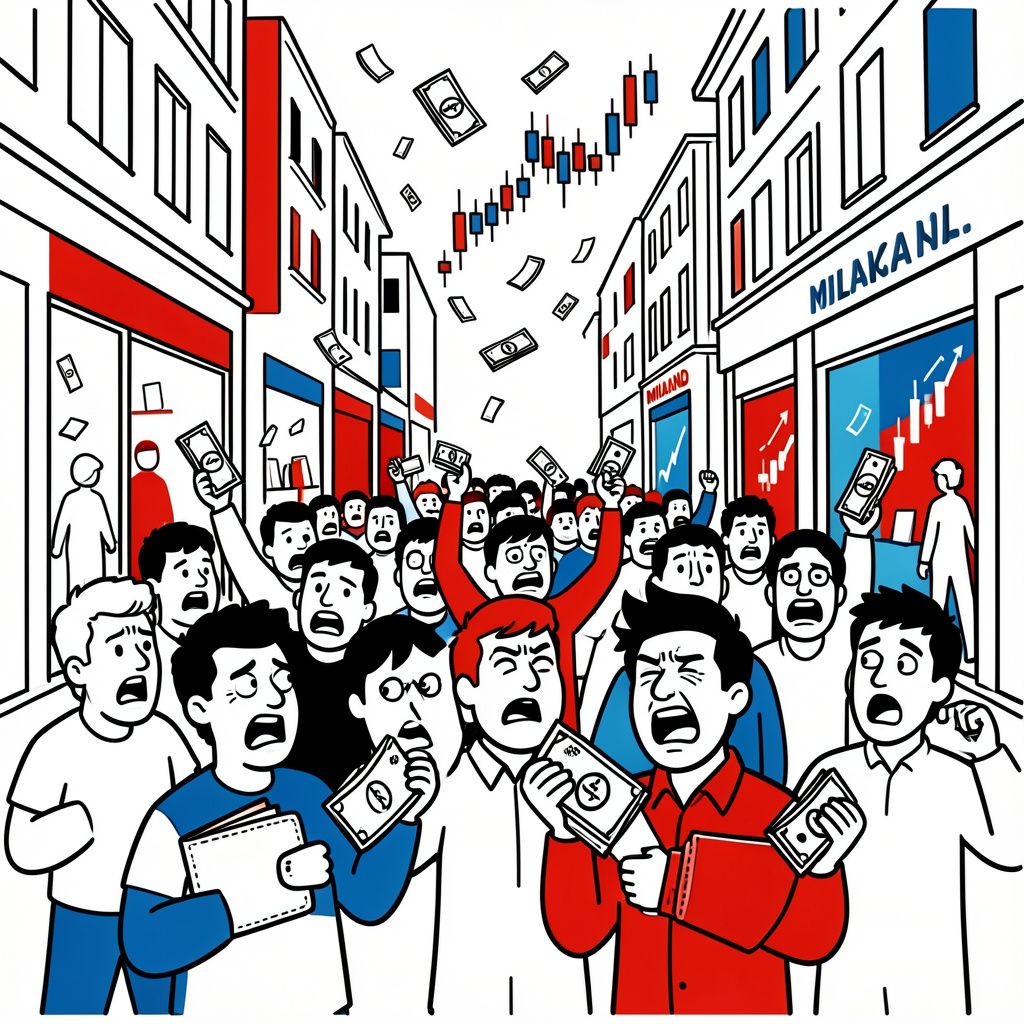
Escalating cost-of-living protests in Milan turned violent on Saturday, leaving over 100 officers injured and causing €500,000 in retail damages ahead of the crucial holiday shopping season.
Violent Clashes Erupt in Milan’s Financial Heart
On Saturday, 17 October 2026, what began as a peaceful march against rising living costs escalated into violent confrontations in central Milan’s Piazza del Duomo [1][2]. Approximately 5,000 demonstrators gathered for the protest organized by the movement ‘Italia in piazza’, but masked protesters began throwing stones, paving blocks, and other objects at riot police [1][3]. Security forces responded with water cannons and tear gas to disperse the crowds in Italy’s financial capital [1]. At least 104 law enforcement officers required hospital treatment following the clashes, with injuries ranging from minor wounds to serious head trauma [2][4]. Police detained 72 individuals, of whom 17 were arrested and 22 formally reported, with approximately half identified as minors [2][4].
Retail District Suffers Extensive Damage
The violence resulted in widespread looting and property destruction across Milan’s luxury retail district, including Corso Vittorio Emanuele II and Piazza dei Mercanti [2][3]. A Foot Locker store was among the retail locations looted during the unrest, with perpetrators barricading themselves inside before police arrival [3][4]. Confcommercio, the Italian retailers’ association, estimated damages exceeding €500,000, accounting for both physical destruction and lost revenue from mandatory store closures at 17:00 [4]. The damage calculation includes shattered storefront windows, destroyed ATM transit shelters, overturned trash bins, and looted public property throughout the city center [3][4]. Mayor Giuseppe Sala announced intentions to provide compensation to affected merchants, though no specific implementation date was provided [4].
Political Response and National Context
Italian Prime Minister Giorgia Meloni condemned the violence through social media, stating ‘Demonstrating is a right. Setting our cities ablaze is not,’ while calling out ‘hooligans who exploit demonstrations to sow chaos’ [1][2]. Milan’s center-left mayor Giuseppe Sala acknowledged that ‘the reasons for the protests were understandable’ regarding cost-of-living concerns, but emphasized that ‘violence against law enforcement and serious damage to the city are not justifiable’ [1][4]. Deputy Prime Minister Matteo Salvini criticized ‘social centers and left-wing decay’ in his public statements [2][6]. The unrest coincided with nationwide demonstrations in neighboring France against rising living costs, where French police similarly deployed tear gas and water cannons against violent protesters [1][6].
Economic Implications Ahead of Holiday Season
The timing of these riots poses immediate risks to retail operations and consumer confidence ahead of the critical holiday shopping season [1][4]. The disruption occurred in one of Europe’s premier luxury retail districts, raising concerns about supply chain stability and urban commercial viability [GPT]. Local business representatives indicated that stores were forced to close at 17:00 on the day of the unrest, compounding revenue losses from physical damage [4]. The Lega party proposed mandatory bail for demonstration organizers to enforce accountability, reflecting growing political pressure to prevent future occurrences [2]. Archbishop of Milan noted that while vandalism erupted around the Duomo, prayer services continued inside, symbolizing the tension between social unrest and institutional stability [4].
Sources
- abcnews.com
- www.milanotoday.it
- milano.corriere.it
- tg24.sky.it
- stream24.ilsole24ore.com
- www.ansa.it
- www.ilpost.it
- www.instagram.com