China Sets Lowest Growth Goal Since 1990s as Beijing Pivots to Stability
Beijing, Friday, 6 March 2026.
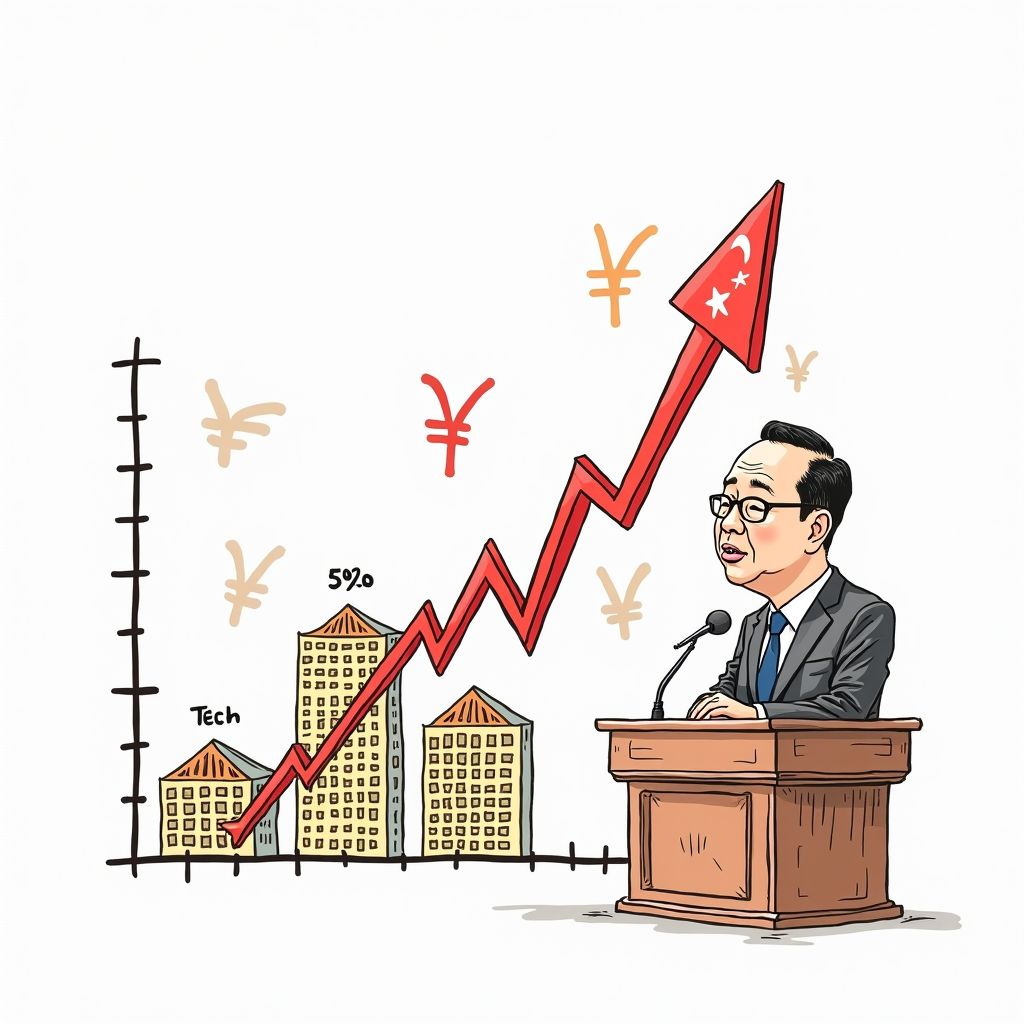
On March 5, 2026, Beijing officially set its GDP growth target between 4.5% and 5%, marking the lowest ambition for the Chinese economy since the early 1990s. This strategic pivot, announced by Premier Li Qiang during the National People’s Congress, signals a candid acknowledgment of deepening structural challenges, including a persistent property crisis and deflationary pressures where consumer prices remained flat throughout 2025. While the administration plans to issue 1.3 trillion yuan in special treasury bonds and create 12 million urban jobs to combat a youth unemployment rate that hit 16.3% in January, the focus has visibly shifted from rapid expansion to consolidation. Most telling is the divergence in sector performance: while high-tech manufacturing added nearly a percentage point to GDP, traditional real estate dragged growth down by 6 points, highlighting the high-stakes transition facing the world’s second-largest economy amidst looming U.S. tariffs.
Confronting the Deflationary Headwinds
The administration’s conservative growth target appears to be a direct response to the economic friction experienced throughout 2025, which Premier Li Qiang candidly described as a “very unusual year” [2]. A primary concern remains the sluggish domestic demand; while the government had aimed for consumer price growth of around 2% in 2025, prices ultimately remained flat [1]. To reignite consumption and break this deflationary cycle, Beijing has outlined aggressive fiscal measures for 2026, including the issuance of 1.3 trillion yuan in ultra-long-term special treasury bonds [1]. Additionally, 250 billion yuan has been specifically allocated to support a consumer goods trade-in program, designed to encourage households to upgrade appliances and vehicles [1]. Despite these interventions, analysts like Han Shen Lin of The Asia Group note that the current plans may not fully address the underlying weak consumption, suggesting that the market should brace for “more deflation in the horizon” [1].
Labor Market Pressures
Beyond inflation, the government is acutely focused on stabilizing the labor market, which has shown signs of strain among younger demographics. While the overall urban unemployment rate averaged 5.2% in 2025, the youth unemployment rate spiked to 16.3% in January 2026 [1]. In response, the 2026 government work report has set a target to create over 12 million new urban jobs, aiming to keep the surveyed urban unemployment rate at approximately 5.5% [2][3]. This focus on employment is critical, as investment directors note that for ordinary citizens, the unemployment situation takes precedence over broader macroeconomic figures [1].
A Tale of Two Economies: Tech Surges while Property Stalls
The shift in China’s economic engine is becoming increasingly pronounced, creating a stark divergence between emerging technologies and traditional drivers of growth. In 2025, the country’s GDP expanded by 5% to reach 140.19 trillion yuan, but this topline figure masks significant sectoral volatility [2][4]. High-tech manufacturing and equipment manufacturing saw robust growth of 9.4% and 9.2% respectively, driven by a massive surge in the production of new energy vehicles, which exceeded 16 million units [2]. Conversely, the traditional real estate sector has become a significant drag on the economy. Between 2023 and 2025, while sectors like AI, robotics, and electric cars added 0.8 percentage points to GDP, traditional sectors including real estate were responsible for a combined 6 percentage point decline [1].
Geopolitical Friction and National Security
Beijing’s cautious outlook is further complicated by an increasingly tense external environment. The government work report revealed a defense budget of 1.91 trillion yuan for 2026, representing a 7% year-on-year increase, signaling a continued prioritization of military modernization despite slower economic growth [4]. This aligns with a noticeable hardening of rhetoric regarding Taiwan; the language in the report has shifted from merely “opposing” independence to explicitly stating a resolve to “strike” against it [4]. Simultaneously, energy security concerns have manifested in immediate policy actions, with China ordering its largest state oil refiners to suspend exports of diesel and gasoline, citing fears that conflict involving Iran could disrupt energy access [1].
Navigating a Year of Transition
As China navigates 2026, the leadership is clearly prioritizing long-term stability over short-term acceleration. Premier Li Qiang emphasized that the 4.5% to 5% target is designed to leave room for structural adjustments and risk prevention, laying a stronger foundation for future development [3]. However, the path forward is fraught with uncertainty; the drafting team for the target-setting report has warned that unpredictable factors may be more numerous than anticipated [1]. With the potential for new U.S. tariffs looming and a crucial meeting between President Xi Jinping and U.S. President Donald Trump tentatively expected later in March—though its status remains uncertain—Beijing’s pivot to consolidation reflects a pragmatic approach to a volatile global landscape [1][4].