Iran Strikes Airport in Azerbaijan Escalating South Caucasus Tensions
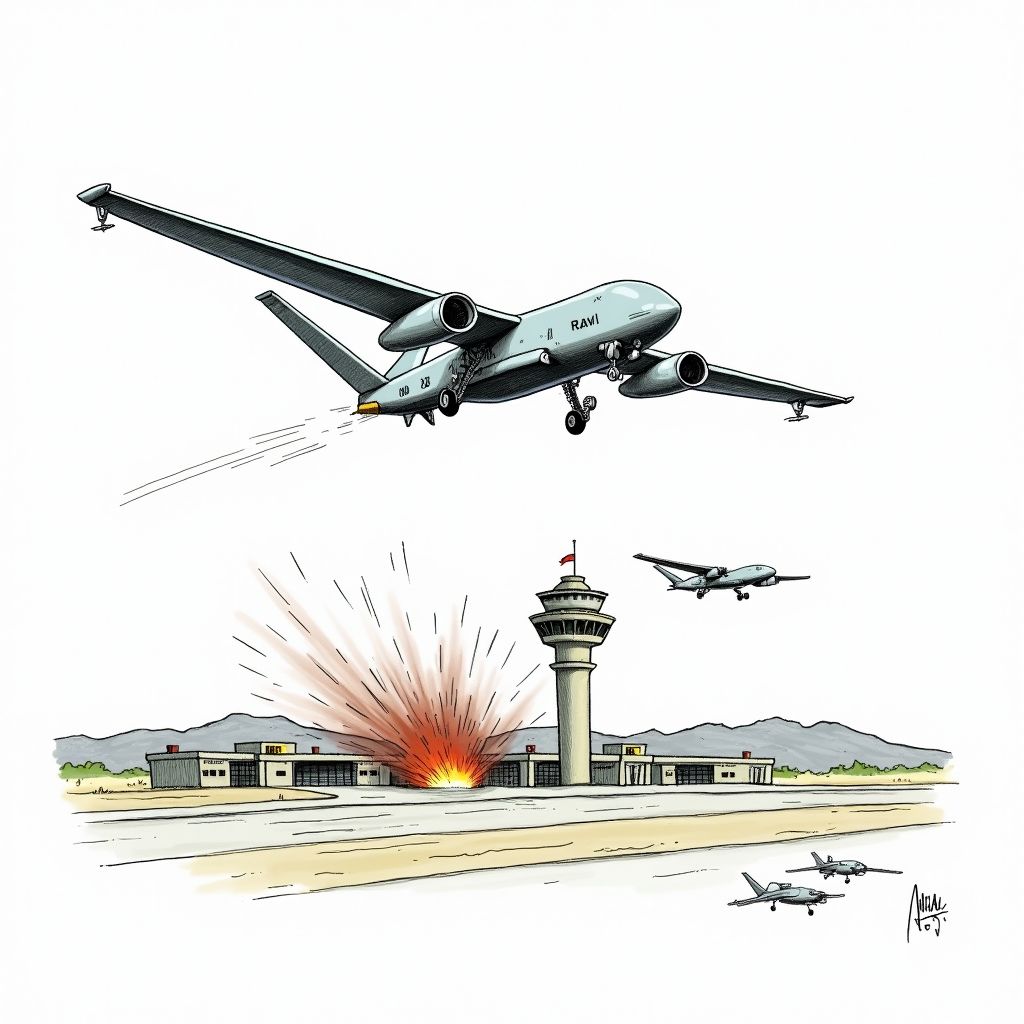
Nakhchivan, Thursday, 5 March 2026.
Iranian drones struck the passenger terminal at Azerbaijan’s Razi Airport today, injuring two people. This unprecedented attack on the Nakhchivan exclave marks a significant escalation, signaling a dangerous expansion of the regional conflict and threatening the stability of the critical South Caucasus energy corridor.
Details of the Strike on Nakhchivan
Authorities confirmed that three Iranian drones targeted the passenger terminal of Razi Airport in the Nakhchivan exclave earlier today [1][3]. The facility, which serves both military and civilian purposes, is located approximately 10 kilometers from the Iranian border [2][4]. Visual evidence from the scene depicts a drone descending toward the airport, followed by a significant explosion, a rising cloud of smoke, and visible damage to the main terminal structure [1][2]. While the airport appeared to be the primary objective, reports indicate that a second drone landed in the vicinity of a local school, widening the scope of the threat to civilian infrastructure [2].
Casualties and Immediate Response
The Azerbaijani Foreign Ministry reported that two individuals sustained injuries during the attack, though no fatalities have been confirmed at this time [2][4]. Emergency crews were immediately dispatched to the site to contain a fire resulting from the strikes [1][2]. In a swift diplomatic response, the government in Baku summoned the Iranian ambassador to issue a formal reprimand, explicitly stating that Azerbaijan reserves the right to implement “appropriate response measures” to defend its sovereignty [2][4].
A Widening Regional Conflict
This incident represents the first direct Iranian attack on Azerbaijan since the broader regional war erupted earlier this week [4]. The geopolitical landscape in the Middle East and South Caucasus has deteriorated rapidly following the commencement of hostilities on March 1, 2026, which targeted Iranian leadership and infrastructure [5]. Tensions escalated further after the U.S. Navy sank the Iranian frigate IRIS Dena in the Indian Ocean on March 3, an event that resulted in the deaths of 87 Iranian sailors [5]. Iranian officials had vowed that the United States would “bitterly regret” the action, a threat that appears to be manifesting in erratic attacks across the region [5].
Spillover into Neighboring Airspace
The aggression has not been confined to the Caucasus. Turkish defense officials reported that a ballistic missile launched from Iran traversed Iraqi and Syrian airspace before being intercepted by NATO defense elements over the Eastern Mediterranean [7]. Debris from the interception fell in the Dörtyol district of Hatay, Turkey [7]. While no casualties were reported in the Turkish incident, the Ministry of National Defense in Ankara issued a stern warning, asserting that Turkey possesses the capacity to ensure its security regardless of the threat’s origin [7].
Sources
- www.euronews.com
- www.jpost.com
- www.euronews.com
- www.ynetnews.com
- www.timescolonist.com
- www.timesofisrael.com
- www.mia.az