U.S. Military Captures Venezuelan President Maduro to Face Charges in New York
Caracas, Saturday, 3 January 2026.
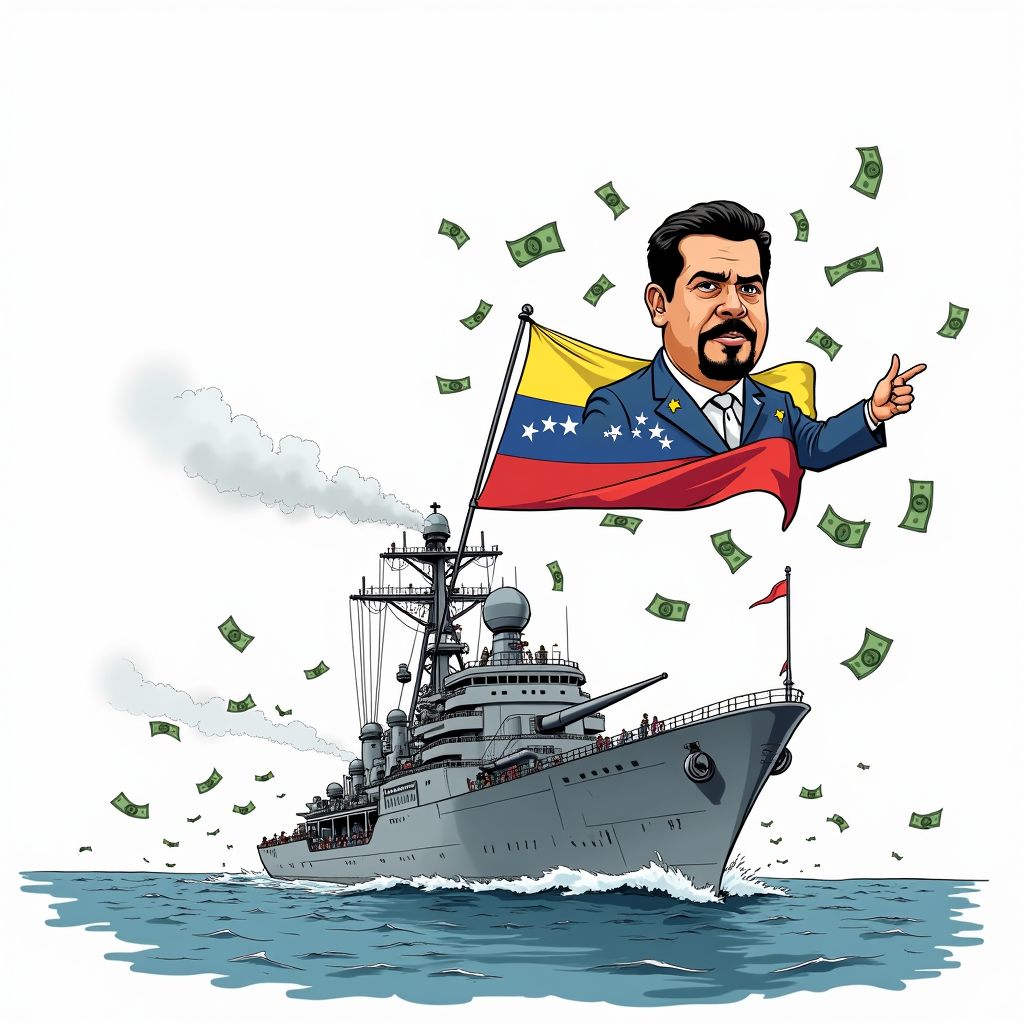
Following strategic strikes on Caracas, U.S. forces captured Nicolás Maduro. The Venezuelan leader is now aboard the USS Iwo Jima, en route to New York to face narco-terrorism charges.
A Kinetic Pivot from Diplomacy
This military operation marks a dramatic and violent reversal from the diplomatic landscape observed just 24 hours prior, when Maduro proposed cooperation on drug trafficking amid rising tensions. While the Venezuelan leader had signaled a readiness to negotiate with Washington, the U.S. response came in the form of a “large-scale strike” launched at approximately 02:00 local time on Saturday [1][2]. The operation, described by President Trump as “brilliant,” targeted key military infrastructure, including La Carlota Air Base, the Port of La Guaira, and Fuerte Tiuna, resulting in the capture of President Maduro and his wife, Cilia Flores [1][6]. Reports indicate the operation was executed by the elite Delta Force [6], utilizing a window of opportunity that had been delayed by weather conditions since December 29, 2025 [5].
Operational Logistics and Legal Framework
Following their extraction, Maduro and Flores were transferred to the USS Iwo Jima for transport to New York, where they face a litany of federal charges [1][5]. U.S. Attorney General Pam Bondi confirmed that the indictments, filed in the Southern District of New York, include narco-terrorism conspiracy, cocaine importation conspiracy, and the possession of destructive devices [5][8]. This legal offensive is the culmination of a strategy dating back to March 2020, when the U.S. Department of Justice first indicted Maduro, offering a $50 million reward for his capture [1]. The operation was supported by a massive regional build-up; since August 2025, the Pentagon has amassed approximately 15,000 troops and deployed advanced naval assets, including the USS Gerald R. Ford, to the Caribbean theater [1][5].
Regional Instability and International Reaction
The power vacuum and military aggression have triggered immediate instability within Venezuela. The government has declared a state of emergency in Caracas, Miranda, Aragua, and La Guaira, with Defense Minister Vladimir Padrino vowing to resist the presence of foreign troops [1][3]. Vice President Delcy Rodríguez has demanded “proof of life” for the captured leader, stating his whereabouts remain unknown to his cabinet [1][4]. Internationally, the reaction has been swift and polarized. Colombian President Gustavo Petro announced the deployment of public forces to the Venezuelan border, anticipating a potential refugee crisis, while condemning the missile strikes [4][5]. Meanwhile, Russia denounced the operation as an act of armed aggression, whereas Spain’s Prime Minister Pedro Sánchez has called for de-escalation and offered to mediate the deepening crisis [1][4].
Summary
The capture of Nicolás Maduro represents a historic and volatile shift in U.S. foreign policy, moving from economic sanctions to direct military extraction. As the Venezuelan leader is transported to face the U.S. justice system, the region faces a precarious future defined by a leadership void in Caracas and heightened military alerts in neighboring Colombia. The operation, executed by U.S. forces after months of buildup, has effectively dismantled the previous administration’s command structure, leaving Venezuela under a state of emergency and the international community divided on the legality and consequences of the intervention.
Sources
- www.nytimes.com
- apnews.com
- www.reuters.com
- www.nytimes.com
- www.telemundo.com
- www.bbc.com
- www.facebook.com
- krdo.com