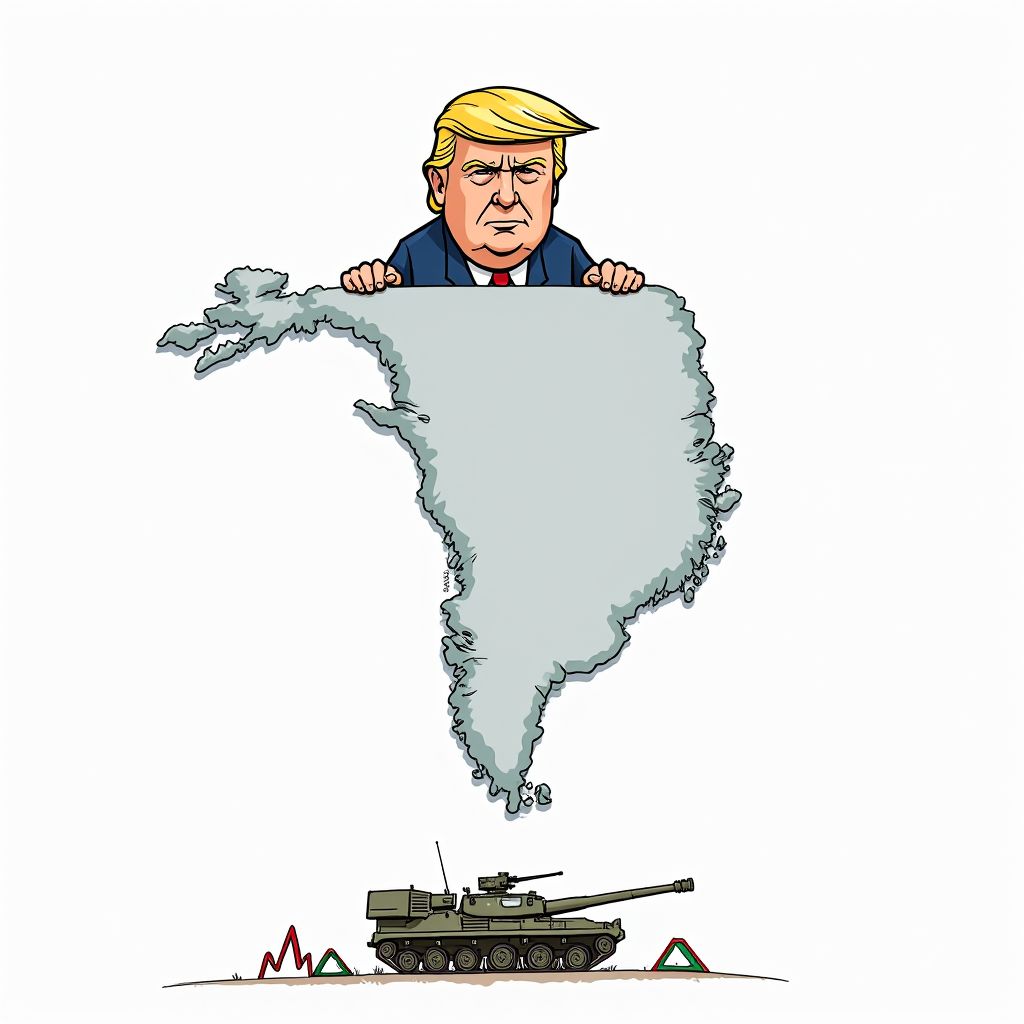
Geopolitics Eclipse Economics as Greenland Standoff Rattles Markets
Washington D.C., Sunday, 25 January 2026.
Investors are rattled by President Trump’s aggressive bid for Greenland, where threats of military force and 25% tariffs have overshadowed traditional economic indicators and corporate earnings.
Market Volatility Amidst Diplomatic Tension
Financial markets have been navigating a distinct period of turbulence characterized by a clash between robust corporate fundamentals and erratic geopolitical signals. While the S&P 500 has managed to secure a year-to-date gain of approximately 1% as of late January 2026, the index has experienced a “short but steep roller-coaster ride” driven by President Trump’s pursuit of Greenland [1]. Current valuations suggest the market is pricing in significant optimism despite these headwinds; the S&P 500 is trading at over 22 times expected earnings, a valuation that is roughly ƒ{(22-15.9)/15.9*100} percent higher than its long-term average of 15.9 [1]. This premium places immense pressure on corporate performance to justify stock prices, particularly as investors digest the implications of the Federal Reserve’s recent policy decisions and the unfolding diplomatic drama in the Arctic.
A Fragile Truce in the Arctic
The immediate threat of a trade war, which had loomed large over the global economy, appeared to recede slightly following high-stakes meetings at the World Economic Forum in Davos, Switzerland. On January 21, 2026, President Trump announced that a “framework of a future deal” regarding Greenland had been reached following discussions with NATO Secretary-General Mark Rutte [3][5]. Crucially for global markets, this diplomatic pivot resulted in the withdrawal of a severe tariff threat on January 22; prior to this breakthrough, the administration had prepared to impose a 10% tariff on exports from eight European nations—including Denmark, Germany, and the United Kingdom—effective February 1, 2026, with an escalation to 25% scheduled for June [5]. This de-escalation has provided temporary relief to investors fearing a disruption of transatlantic supply chains.
Earnings Strength Beneath the Headlines
Beneath the layer of geopolitical anxiety, corporate America is demonstrating resilience. As of January 22, 81% of the 59 companies in the S&P 500 that had reported earnings managed to beat estimates [1]. The data points to a strengthening profit cycle, with earnings for the fourth quarter of 2025 expected to have risen by 9.1% year-over-year [1]. Looking ahead, projections for 2026 are even more bullish, with S&P 500 earnings expected to climb by more than 15% [1]. This growth is critical for sustaining market confidence, as strategists note that while geopolitical distractions like Greenland can sway sentiment, “at the end of the day, earnings are the driver” [1].
Monetary Policy in the Crosshairs
Compounding the complexity of the current financial environment is the precarious position of the Federal Reserve. Investors expected the central bank to hold interest rates steady at its meeting on January 22, following three consecutive quarter-point cuts in late 2025 [1]. The economic rationale for a pause is strong, as the fed funds rate is considered close to neutral and inflation has peaked [1]. However, the central bank’s independence is under scrutiny; Federal Reserve Chair Jerome Powell has faced legal threats from the Trump administration this month, and reports indicate the President is already considering a replacement nominee ahead of Powell’s term expiration in May 2026 [1]. This friction adds another layer of uncertainty to an already volatile economic mix.
Sources
- ca.investing.com
- abcnews.go.com
- www.factcheck.org
- www.brookings.edu
- www.aljazeera.com
- fortune.com
- www.nbcnews.com