PBS Navigates Federal Defunding via Surge in Public Support
Washington, Friday, 14 August 2026.
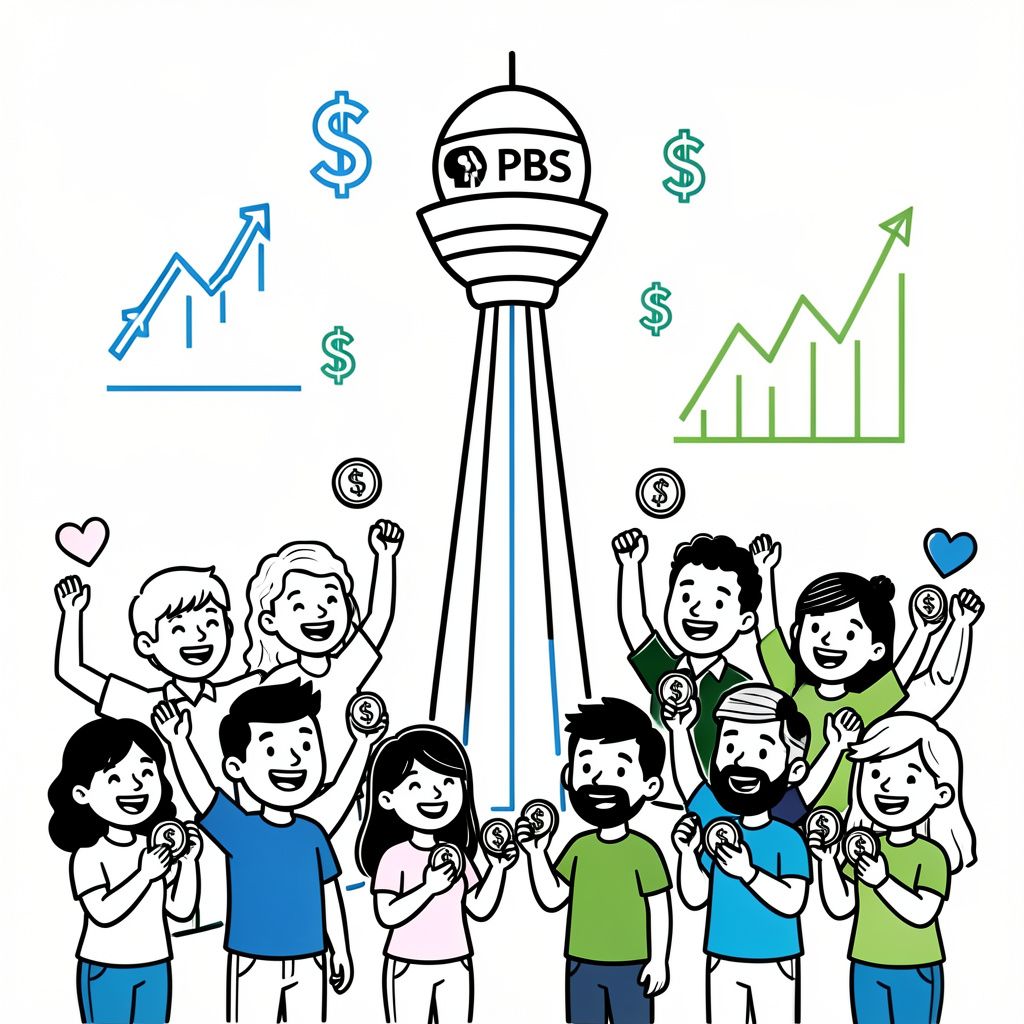
Despite losing $1.1 billion in federal funding and undergoing major operational cuts, PBS gained over one million new members, stabilizing its business model through grassroots public giving.
Legislative Actions and Federal Funding Rescission
In July 2025, the United States Congress voted to rescind approximately $1.1 billion in advance-appropriated federal funding designated for the Public Broadcasting Service (PBS) and National Public Radio (NPR) [1]. This legislative move marked a significant shift in the public media funding framework, forcing executives to navigate heightened reliance on private philanthropy and corporate sponsorships [1]. Subsequently, in Spring 2026, President Donald Trump issued an executive order intended to block all federal funding to PBS and NPR, though a federal judge ruled the order unconstitutional in March 2026 [1]. Despite the legal victory, the Department of Education terminated the 2020-2025 Ready To Learn grant, which had funded PBS educational content for three decades [1].
The Corporation for Public Broadcasting (CPB), established in 1967, announced its dissolution in January 2026 following the funding rescission [1]. This operational contraction represents a critical challenge for the 330+ member stations that rely on the network for content and infrastructure support [1]. PBS leadership has noted that while the executive order was blocked, the initial appropriation cuts provided stations with only three months to find alternative funding, contrasting sharply with a proposed three-year glide path [1]. The political maneuvering involved both Republican-led executive actions and Congressional approval, fundamentally altering the financial landscape for public media across Washington [1].
Operational Impacts and Workforce Reductions
In response to the fiscal pullback, PBS responded by cutting its budget by 21% and eliminating 15% of its workforce, amounting to approximately 100 jobs as of late 2025 [1]. This reduction leaves the organization operating at 79 percent of its previous budget capacity, necessitating strict prioritization of core services [1]. Regional public broadcasting stations are re-evaluating revenue models and distribution networks to maintain local journalism and educational programming amidst these constraints [1]. In Alaska, for example, almost half of the local public media budget comes from the federal government, highlighting the vulnerability of rural connectivity [1].
The termination of the Ready To Learn program has specifically impacted children’s content funding, which PBS had managed for 30 years [1]. PBS CEO Paula Kerger emphasized the risk to quality control in children’s media, noting that unlike algorithm-driven platforms, their content is rigorously tested by educators [1]. The operational strain extends to the network’s role as a backup system for the national emergency alert infrastructure, a function that relies on broadcast reach to remote areas [1]. Without new federal financial support, leadership warns that station closures could occur within the next year by August 2027 [1].
Public Response and Revenue Restructuring
Despite the funding crisis, PBS reports gaining over one million new memberships since the July 2025 rescission, with most committing to recurring monthly donations [1]. This surge in public support has helped move the organization to a more stable financial position, even as revenue from major donors surpassed membership revenue in percentage terms over the last 12 months [3]. PBS is restructuring its business model to rely on a mix of 50% contributed funding, 25% earned revenue, and 25% from high-net-worth individuals and foundation grants [1]. This diversification aims to buffer against future political volatility while maintaining the trust of the viewing public [1].
Kerber stated, “I feel like we have had a role in the life of people and families and communities across this country, and I am deeply committed to making sure that we continue to meet the needs of people” [2]. The organization currently holds the number two position behind the Weather Channel in rankings of trusted public institutions, maintaining a 23-year streak according to polling data [1]. This trust factor is leveraged in lobbying efforts to restore government funding, specifically targeting support for rural communities and infrastructure [1]. The strategic pivot emphasizes that viewers are now the primary stakeholders, with Kerger noting, “The light bulb went off. It’s like, ‘Oh, Viewers Like You. That means us.’” [1].
Future Outlook and Infrastructure Advocacy
PBS is actively lobbying for the reinstatement of federal infrastructure funding, seeking to reopen a previously existing program that provided capital for station infrastructure [1]. In June 2026, the U.S. House of Representatives voted to cut PBS funding that had been advance-appropriated for 2026 and 2027, prompting the Public Media Company to raise emergency bridge funds to stabilize smaller, at-risk stations [1]. Leadership warns that unless help is received, it will become apparent in the next year that stations may be lost, particularly in specific legislative districts [1]. This potential loss is intended to draw attention to the tangible impact of defunding on local communities [1].
There was some movement this year in looking at the infrastructure money, which Kerger described as a really important first step [1]. The organization continues to advocate for the return of federal infrastructure funding to support the network’s role as a national emergency alert backup system [1]. While the legal battle over the executive order concluded with the government missing the appeal deadline, the financial aftermath continues to shape operational strategy [1]. The focus remains on ensuring that public media can evolve over the next 10 to 15 years to meet changing community needs [2].