California's Surging Electricity Rates Threaten Los Angeles Household Budgets
Los Angeles, Thursday, 21 May 2026.
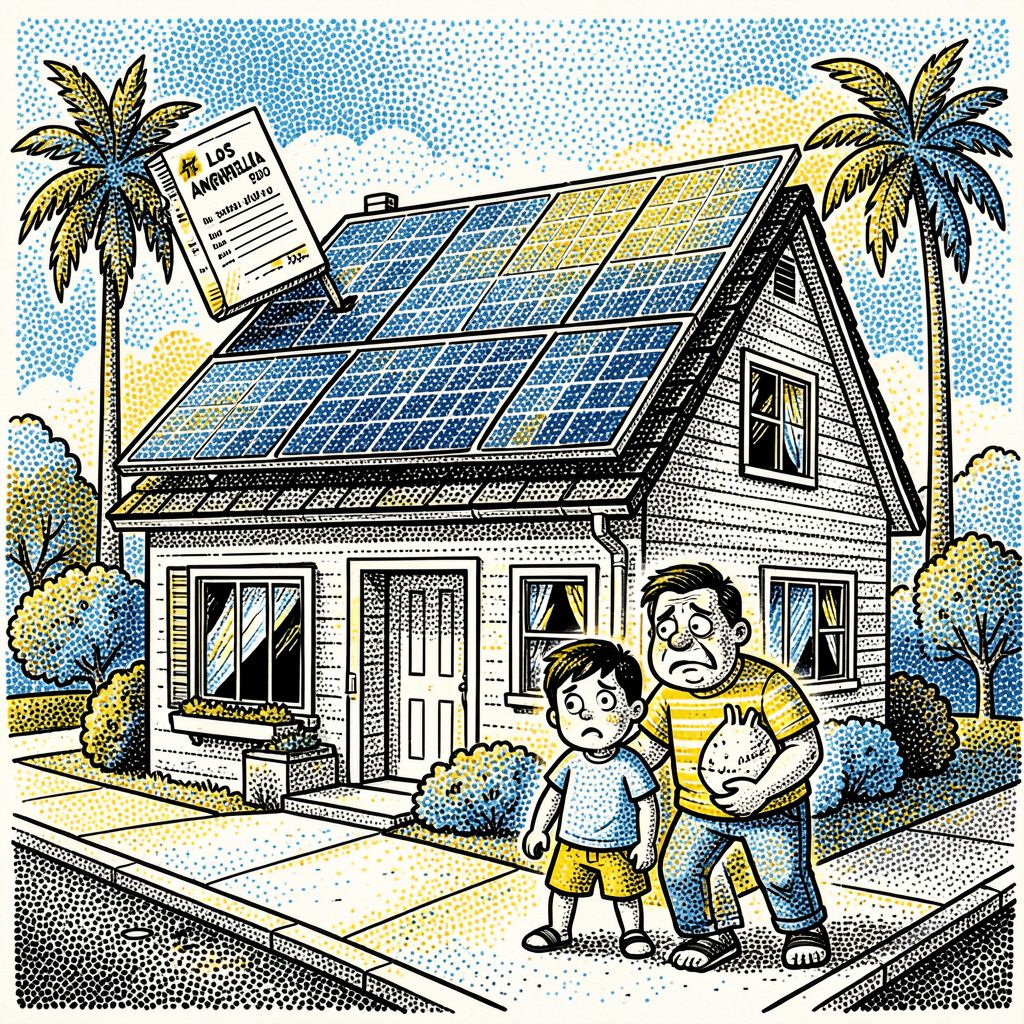
Driven by an 85 percent spike in grid fees, Los Angeles energy bills are soaring. Experts urge homeowners to adopt solar solutions, potentially slashing monthly costs by 90 percent.
The Anatomy of a Soaring Utility Bill
As of May 2026, California residents are facing a harsh new reality when it comes to monthly expenses, driven by structural shifts in how utility companies fund grid infrastructure [1]. Recently, major providers including Southern California Edison (SCE) and the Los Angeles Department of Water and Power (LADWP) implemented sharp rate increases [1]. To understand this macroeconomic burden, one must examine the composition of a standard energy bill, which is split into electric generation, electric delivery, gas charges, and the Power Charge Indifference Adjustment (PCIA) [2]. The most significant driver of recent price shocks is the cost of electric delivery; transmission, distribution, and other grid-related charges now constitute approximately 80 percent of a residential electricity bill [2]. Over the past five years, these specific delivery charges have surged by nearly 85 percent [2]. In Northern and Central California, Pacific Gas and Electric (PG&E) rates have skyrocketed by 127 percent since 2014, with nearly half of that jump occurring strictly between 2022 and 2024 [2].
Market Shifts and the NEM 3.0 Reality
Compounding these base rate increases is the expiration of highly favorable incentive windows, most notably California’s transition to the Net Billing Tariff, widely known as NEM 3.0 [1][3]. Implemented for new interconnection customers starting in April 2023, NEM 3.0 fundamentally altered the return on investment for residential solar [3]. Under older net metering structures, homeowners were compensated for the excess solar energy they exported to the grid at full retail rates [3]. Today, exported generation is credited at a significantly lower grid-value rate [3]. Consequently, the most financially valuable energy is the energy consumed directly by the household [3].
Strategies for Homeowners to Reclaim Control
With summer approaching—a season already prompting social media warnings of potential blackouts and massive utility bills [4]—energy efficiency firms are urging Los Angeles homeowners to act swiftly [1]. The Energy Savings Group, a Los Angeles-based firm that has helped over 6,200 local homeowners save a combined $217 million, warns that delaying infrastructure upgrades carries a literal price [1]. They note that homeowners who secured solar and efficiency audits two years ago are currently saving hundreds of dollars monthly, while those who waited are absorbing the full impact of the 2026 rate hikes [1]. Beyond solar, experts recommend comprehensive weatherization, such as investing in high-quality spray foam insulation, which has garnered high consumer satisfaction in the Los Angeles area for mitigating indoor temperature fluctuations [2][5].
The Broader Economic Ripple Effect
The macroeconomic implications of California’s energy crisis extend far beyond individual homeowners. With approximately 80 percent of renters responsible for paying their own electricity bills, the burden of rising utility costs is distributed widely across the state’s demographic spectrum [4]. As a larger portion of monthly income is diverted to cover basic utility necessities, consumer spending in other sectors of the Los Angeles economy is likely to contract [GPT].