AI Deception Uncovered in Fake Dubai Evacuation Flight Scheme
Dubai, Thursday, 12 March 2026.
An AI-generated persona successfully duped a Dutch newspaper into promoting fake evacuation flights from Dubai, exposing severe misinformation risks for security teams during geopolitical crises.
The Anatomy of a Digital Mirage
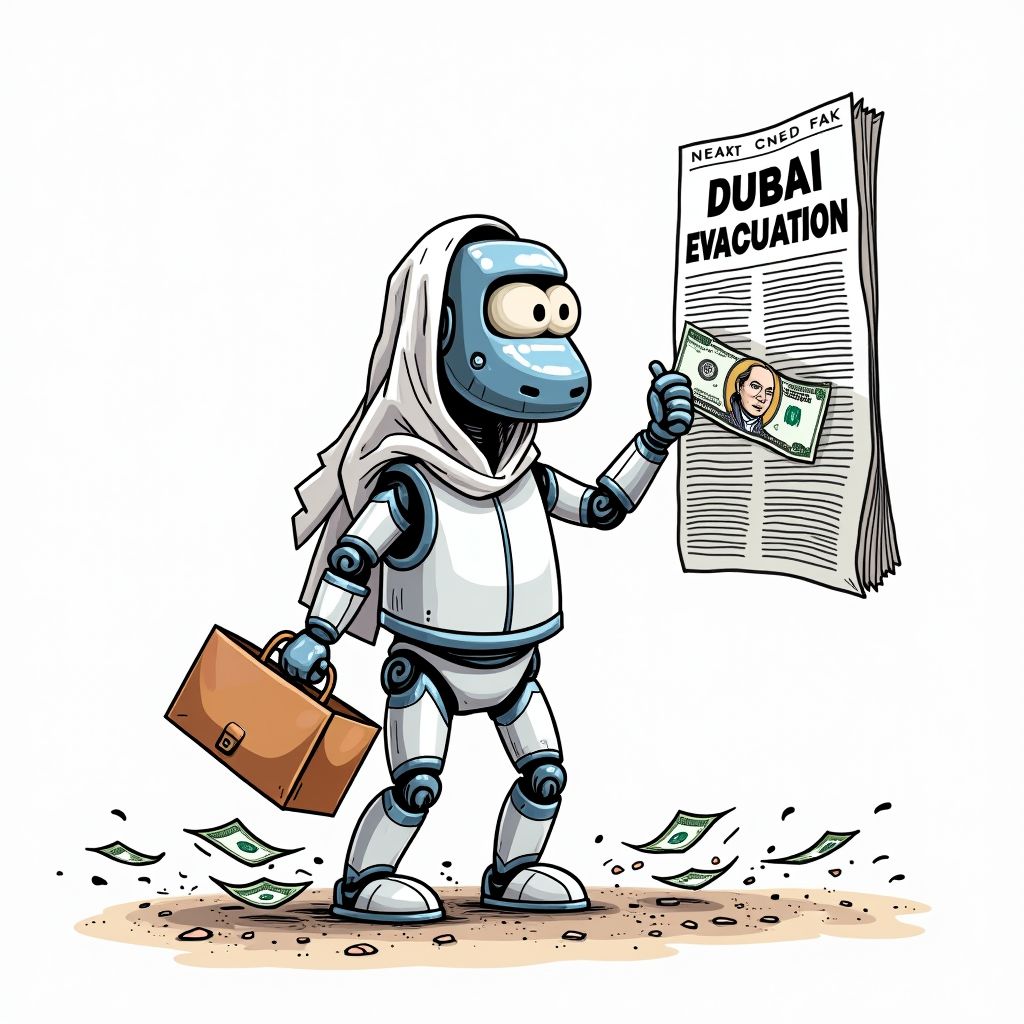
The ongoing conflict in the Middle East, which escalated sharply following United States and Israeli strikes on Iran on February 28, 2026, has created an environment ripe for exploitation [3]. Amidst retaliatory Iranian missile and drone strikes across the Gulf, thousands of expatriates have desperately sought avenues out of the region [1]. Capitalizing on this widespread panic, the Dutch newspaper De Telegraaf published a compelling, yet entirely fabricated, interview on March 5, 2026 [1]. The article, headlined “Dutch people in the Middle East feel abandoned by the government: We just rented a plane ourselves,” featured a woman named “Tamara Harema” who claimed to be organizing private evacuation flights departing from Muscat, Oman, for €1,600 per seat [1].
Profiting from Geopolitical Chaos
The financial mechanics of such fraudulent schemes rely heavily on the severe anxiety generated by active war zones. The broader regional instability has been profound, with the United Arab Emirates reporting the interception of 253 missiles and 1,440 drones fired by Iran since the conflict’s inception, resulting in four fatalities among foreign nationals [3]. Commercial aviation and maritime shipping have been similarly paralyzed; by March 3, 2026, traffic through the critical Strait of Hormuz had plummeted by 90% [3]. In this climate of restricted movement and heightened physical danger, the promise of a €1,600 escape route becomes an incredibly potent lure for stranded individuals [1][3].
The Weaponization of Information in Modern Warfare
The deployment of artificial intelligence to exploit fleeing civilians highlights a broader evolution in the nature of modern crises. The International Committee of the Red Cross (ICRC), in its updated 2025 Commentary to the 1949 Geneva Convention (GC IV), explicitly addresses the profound integration of new technologies, including AI and cyber operations, into contemporary conflict environments [2]. The commentary affirms that existing humanitarian laws apply equally to these digital frontiers, emphasizing that the intrinsic humanitarian character of these legal principles permeates all forms of warfare, both past and present [2].
Navigating the New Security Landscape
For corporate security directors and global executives, the De Telegraaf incident underscores a critical vulnerability in emergency extraction protocols. Relying on unverified digital personas or secondary sources during a crisis can lead to severe operational failures and financial loss [1][GPT]. As AI generation becomes increasingly indistinguishable from reality, organizations must implement rigorous verification frameworks that cross-reference flight data, financial backgrounds, and photographic evidence before committing resources to emergency logistics [1][2][GPT]. The convergence of kinetic warfare and digital deception demands a highly analytical approach to crisis management, ensuring that safety decisions are grounded in verifiable reality rather than algorithmic mirages [GPT].