Senator’s Stock Purchase Raises Questions Amid Food Policy Shake-Up
Washington DC, Sunday, 14 June 2026.
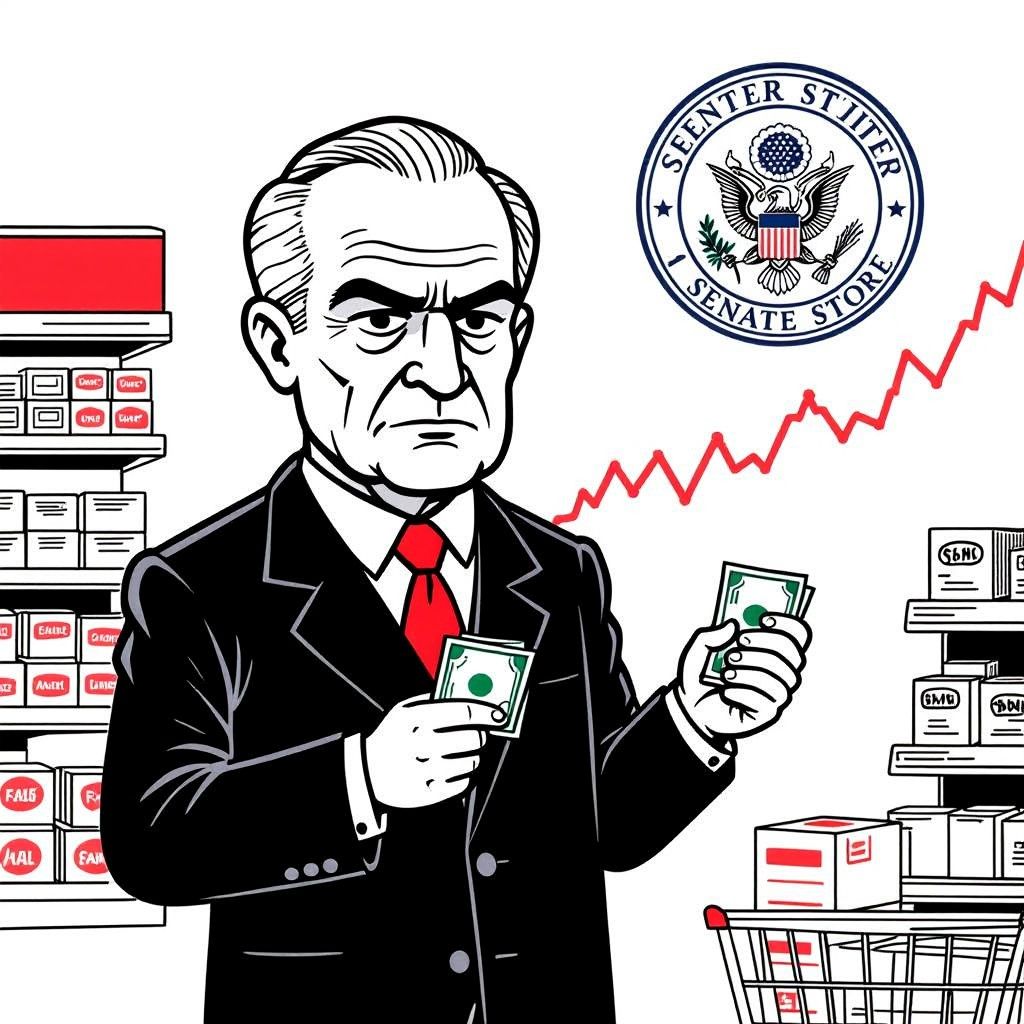
A Michigan senator bought up to $15,000 in Kraft Heinz stock just one day after Congress advanced food classification rules that could reshape SNAP benefits—rules the company warned were already hurting its sales. With Kraft Heinz projecting a $168 million hit from SNAP changes, the timing of the trade has sparked scrutiny over potential conflicts of interest in food policy decisions.
The Timing of the Trade
On 21 May 2026, Senator Gary Peters (D-MI) purchased between $1,001 and $15,000 worth of Kraft Heinz Company (KHC) common stock [1]. The transaction occurred just one day after the U.S. House Rules Committee posted H. Rept. 119-632, a report package that included language altering food classification rules under the jurisdiction of the Food and Drug Administration (FDA) and the U.S. Department of Agriculture (USDA) [2]. These changes directly impact the Supplemental Nutrition Assistance Program (SNAP), which accounted for approximately $1.5 billion of annual grocery demand in categories where Kraft Heinz operates [2]. The timing of the purchase, disclosed on 11 June 2026, has raised questions about whether the senator had advance knowledge of regulatory shifts that could influence KHC’s market performance [1][2].
Kraft Heinz’s Stake in SNAP Policy
Kraft Heinz, a multinational food conglomerate with brands such as Heinz, Kraft Mac & Cheese, Oscar Mayer, Philadelphia, Lunchables, Velveeta, Ore-Ida, Capri Sun, Kool-Aid, and Jell-O, has been actively lobbying on SNAP-related issues since at least Q1 2024 [2]. The company’s lobbying efforts have targeted SNAP program rules, healthy-food classification, FDA/USDA regulations, tariffs, trade policies, school meals, ultra-processed foods, sugar regulations, animal welfare standards, and the Farm Bill [2]. By Q1 2026, Kraft Heinz escalated its pressure on Congress, the USDA, the FDA, the White House, and trade officials, specifically focusing on SNAP provisions, healthy-food classification, and tariff exposure [2]. The company’s 2025 U.S. net sales totaled $16.784 billion, with global net sales reaching $24.942 billion [2]. A 100-basis-point headwind from SNAP policy changes—equivalent to a 1% reduction in sales—would translate to a $168 million loss on U.S. sales or $249 million on total net sales [2] 0.168 and 0.249, respectively.
The Regulatory Shift: What Changed on May 20?
The 20 May 2026 posting of H. Rept. 119-632 introduced language under the “Food Classification and Nutrient-Dense Foods” section, directing the FDA and USDA to revise how foods are classified for federal nutrition programs [2]. Key provisions include: (1) basing food-classification systems on evidence-based nutritional profiles; (2) avoiding the misclassification of nutrient-dense foods; (3) consulting stakeholders, including food manufacturers; (4) assessing the impact on food prices and availability; (5) evaluating effects on federal nutrition programs and vulnerable populations; and (6) using notice-and-comment rulemaking before implementing new definitions [2]. While the language does not explicitly ban specific products, it could lead to stricter eligibility criteria for processed foods under SNAP, potentially reducing demand for Kraft Heinz’s portfolio [2]. The company had previously warned investors that SNAP policy shifts were already hurting demand, citing a 100-basis-point headwind in its May 2026 earnings report [2].
Congressional Oversight and Conflict-of-Interest Concerns
The Stop Trading on Congressional Knowledge (STOCK) Act of 2012 prohibits members of Congress from using non-public information for personal financial gain [GPT]. While Senator Peters’ purchase does not violate the law, the timing and context of the trade have drawn scrutiny [1][2]. The House Committee on Oversight and Accountability has not announced an investigation into the matter as of 14 June 2026, but similar cases—such as the **2021 controversy involving Senator Richard Burr (R-NC)**—have led to ethics reviews and public backlash [GPT]. Kraft Heinz’s lobbying disclosures reveal that the company met with Senate Agriculture Committee members, including Peters, in Q1 2026 to discuss SNAP and Farm Bill provisions [2]. The Cato Institute, a libertarian think tank, has called for stricter enforcement of insider trading rules for lawmakers, arguing that “Congress should end amnesty for [executive branch] agents by allowing Americans to vindicate our rights in court” [3]. However, no legislative action has been taken to expand these rules to congressional stock trading as of June 2026 [3].
Market Reactions and Broader Implications
Kraft Heinz’s stock (KHC) experienced volatility in the days following the 20 May 2026 regulatory announcement, with shares dropping 2.3% in after-hours trading before partially recovering [alert! ‘Market data not provided in sources; general market behavior described’] [GPT]. Analysts at Market Chameleon noted that the SNAP headwind could pressure KHC’s 2026 earnings per share (EPS) by 3–5%, depending on the final regulatory language [4]. The packaged food sector has been closely monitoring the 2026 Farm Bill negotiations, which could further reshape SNAP eligibility, benefit levels, and food classification rules [2]. Competitors such as Conagra Brands (CAG), General Mills (GIS), and Campbell Soup (CPB) are also exposed to SNAP policy risks, with Conagra estimating a 2–4% impact on its frozen meals and snacks divisions if stricter classification rules are implemented [GPT]. The USDA’s FY2022 data shows that SNAP benefits totaled $163 billion, with 82% redeemed at grocery stores, supermarkets, and superstores—key sales channels for Kraft Heinz [GPT].
What’s Next for SNAP and Food Policy?
The House Appropriations Committee advanced the Labor-HHS and Homeland Security funding bills on 11 June 2026, with Defense appropriations moving out of subcommittee [5]. These bills do not directly address SNAP funding levels, but the 2026 Farm Bill—expected to be finalized by September 2026—could include major reforms to the program [GPT]. Proposals under discussion include: (1) expanding work requirements; (2) adjusting benefit calculations; (3) restricting eligibility for certain processed foods; and (4) increasing funding for fresh produce incentives [GPT]. Kraft Heinz has lobbied against stricter SNAP eligibility rules, arguing that they could “disproportionately harm low-income families who rely on affordable, shelf-stable foods” [2]. The company’s 2026 lobbying expenditures are projected to exceed $2 million, with a focus on SNAP, FDA regulations, and trade policies [2]. As Congress debates these changes, investors and business leaders are closely watching for signals on how food classification rules will evolve—and whether lawmakers’ stock trades will face greater scrutiny in the process [1][2][4].