U.S. Blockade Halts Iranian Oil Exports as Economic Crisis Worsens
Tehran, Tuesday, 6 October 2026.
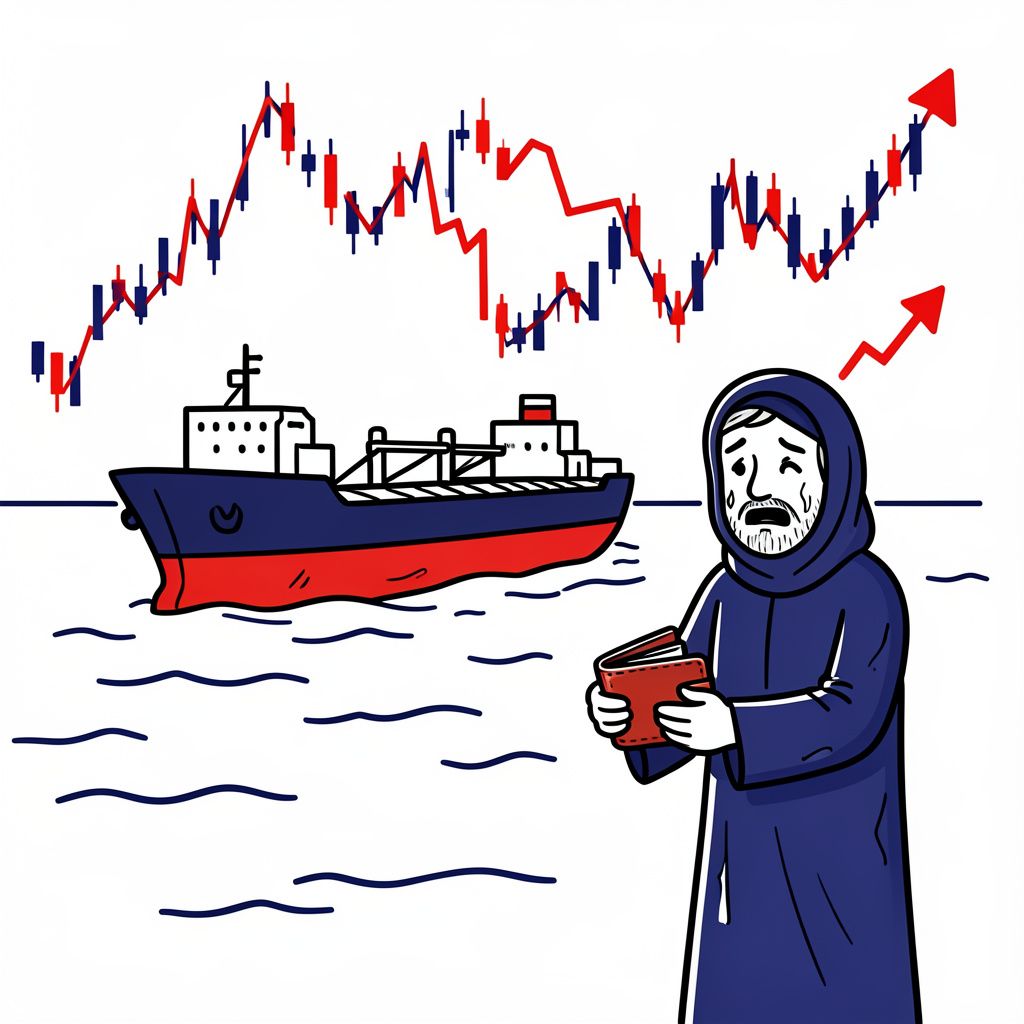
In September 2026, Iran shipped zero crude oil for the first time since tracking began. As U.S. blockades choke exports, domestic inflation has spiked near 90 percent.
Oil Export Collapse and Revenue Shortfall
Iran’s crude oil production has fallen to 2 million barrels per day, roughly half of prewar levels [1]. In September 2026, the country shipped zero oil, marking the first time since Kpler began tracking in 2013 that no loadings occurred [1]. The last successful crude loading occurred on 2026-08-25 [1]. Onshore stockpiles reached 70 million barrels, close to its pandemic peak [1]. Iran risks exhausting sellable crude by 2026-10-31 if current export rates continue [1]. The US-led blockade and sanctions are cited as the primary driver of the foreign exchange shortfall [7]. Iranian Oil Minister Mohsen Paknejad resigned on or around 2026-10-02 amidst allegations of a $2 billion revenue deficit [7]. Gulf oil exports are recovering, with Saudi Arabia’s crude exports rising to approximately 6.1 million barrels per day in September 2026 [8]. Total crude shipments from six Gulf countries reached approximately 15.5 million barrels per day as of 2026-09-29 [8].
Inflation Discrepancies and Household Impact
Official government data reveals a 10% annualized contraction in GDP between March and June 2026 [1]. While the Statistical Center reported annual inflation at 73.6% as of September 22, 2026, independent economist Steve Hanke estimates the figure at approximately 143% [2]. This represents a discrepancy of nearly 69.4 percentage points 69.4 [2]. Food inflation reached 108.8%, with tobacco inflation specifically hitting 162.7% [2]. Rural annual inflation stood at 88% versus 71.1% in urban areas [2]. The Consumer Price Index for households nationwide reached 729.8 in September, up 4.2 percent from the previous month [5]. Year-on-year inflation for rural households reached 108.9 percent in September [5]. Economic experts blame the budget deficit and the government’s ways of financing it as being among the main drivers of inflation in Iran [5].
Geopolitical Ramifications and Market Response
Traffic through the Strait of Hormuz has normalized as of 2026-09-29, reducing Iran’s influence over the waterway [1]. Shipping costs for a Very Large Crude Carrier have surged to $1.6 million per day, a 2,300% increase over 2025 costs [1]. The US military has mobilized 10,000 additional troops and deployed an additional aircraft carrier battle group toward the Middle East region as of 2026-10-02 [3]. President Trump has indicated an intent to secure a ceasefire following the 2026-11-02 midterm elections [3]. On 2026-10-03, NCRI supporters held rallies outside Sweden’s Parliament in Stockholm to protest the Iranian regime’s execution of political prisoners [4]. On October 4, 2026, Iran’s Foreign Ministry summoned the Norwegian ambassador to Tehran to lodge a formal protest regarding unauthorized Starlink satellite internet operations [4]. The situation reflects a convergence of economic, political, and strategic pressures toward a systemic crisis [6].
Sources
- www.cnn.com
- iranfocus.com
- www.npr.org
- www.ncr-iran.org
- www.instagram.com
- www.facebook.com
- www.theguardian.com
- macromap.in