Russian Business Leaders Urge Ruble Devaluation to Cover War Budget Deficit
Moscow, Thursday, 15 October 2026.
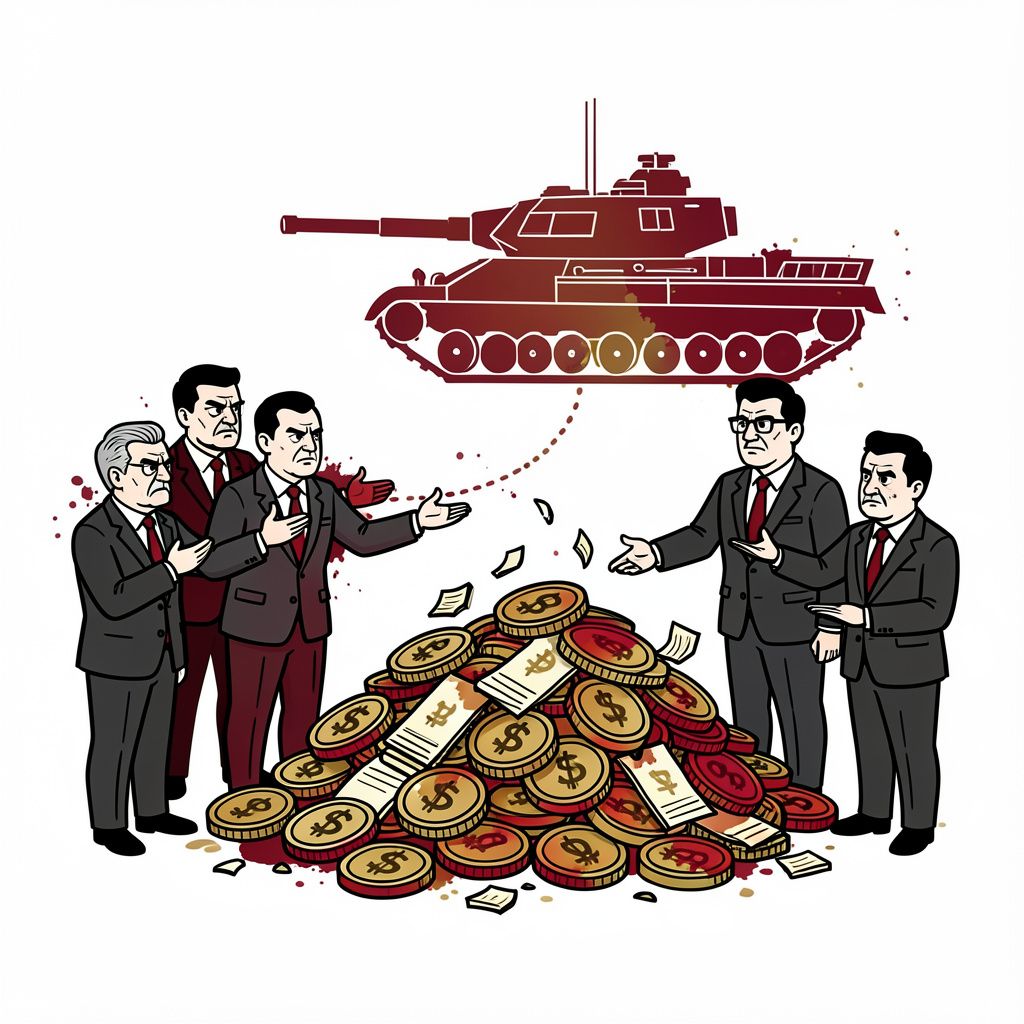
Russia’s major business lobby has urged the government to intentionally weaken the ruble rather than hike corporate taxes to address a massive military budget shortfall.
Corporate Resistance to 2027 Fiscal Tightening
On October 14, 2026, Alexander Shokhin, chairman of the Russian Union of Industrialists and Entrepreneurs (RSPP)—a business lobby representing domestic enterprises accounting for roughly 60% of Russia’s gross domestic product—submitted an official proposal to Prime Minister Mikhail Mishustin opposing planned tax increases for 2027 [1][2][3]. Designed by the Ministry of Finance to cover a surging military budget deficit, the draft legislation includes an “excess profits tax” targeting metallurgical and mining companies, expected to yield 600 billion rubles (~$7.15 billion) over three years [1][2][3]. The RSPP argued that this measure functions as an economic turnover tax and violates government promises to preserve fiscal stability through 2030 [1][2][3].
Alternative Proposals: Currency Weakening and Rate Cuts
To bridge the fiscal shortfall without penalizing corporate capital, the RSPP advocated for a controlled devaluation of the ruble alongside cuts to the Central Bank of Russia’s key interest rate [1][2][3]. The lobby group asserted that a weaker exchange rate would expand the tax base for export-oriented industries and simultaneously reduce state budget expenditures on debt servicing and domestic loan subsidies [1][2][3]. As an alternative to sector-specific excess profit taxes, the RSPP suggested a temporary 0.5 to 1 percentage point increase in the general profit tax rate across the entire economy for three years, combined with expanding the Federal Investment Tax Deduction to 10–12% [3].
Widening Fiscal Gaps and Surging Defense Outlays
The fiscal pressure stems significantly from currency dynamics and rising war costs [1][2]. While original 2026 budget projections anticipated an average exchange rate of 92.2 rubles per US dollar, the currency averaged 76.3 rubles per dollar in the first half of the year—a divergence of -17.245% from baseline estimates [1][2]. Stronger ruble dynamics contributed to a 23% decline in treasury receipts from natural resources, resulting in a expected 1.6 trillion ruble ($19.1 billion) shortfall in oil and gas tax revenue [1][2]. Consequently, the 2026 budget deficit expanded to 7.3 trillion rubles ($87 billion) [1][2]. For 2027, the deficit is projected at 5.5 trillion rubles (~$59.6 billion), or 2.2% of GDP, driven by a 6% increase in overall expenditures to 48.8 trillion rubles, with national defense spending rising to 17.1 trillion rubles [2].
Broader Tax Novelties and Economic Strains
The proposed fiscal package also features a maximum 22% personal income tax rate on passive income—including interest on bank deposits and dividend earnings—as well as a 22% value-added tax on foreign e-commerce purchases, projected to generate 1.5 trillion rubles in 2027 and 2.2 trillion rubles across 2028–2029 [2][3]. These fiscal adjustments coincide with broader domestic economic pressures, including consumer lending slowing to a six-year low, stagnating national output growth, and deteriorating consumer sentiment driven by inflation and elevated defense expenditures [1].