Suburban Chicago Homeowners Pay More Property Tax as Local Data Centers Receive Multimillion-Dollar Tax Relief
Chicago, Sunday, 23 August 2026.
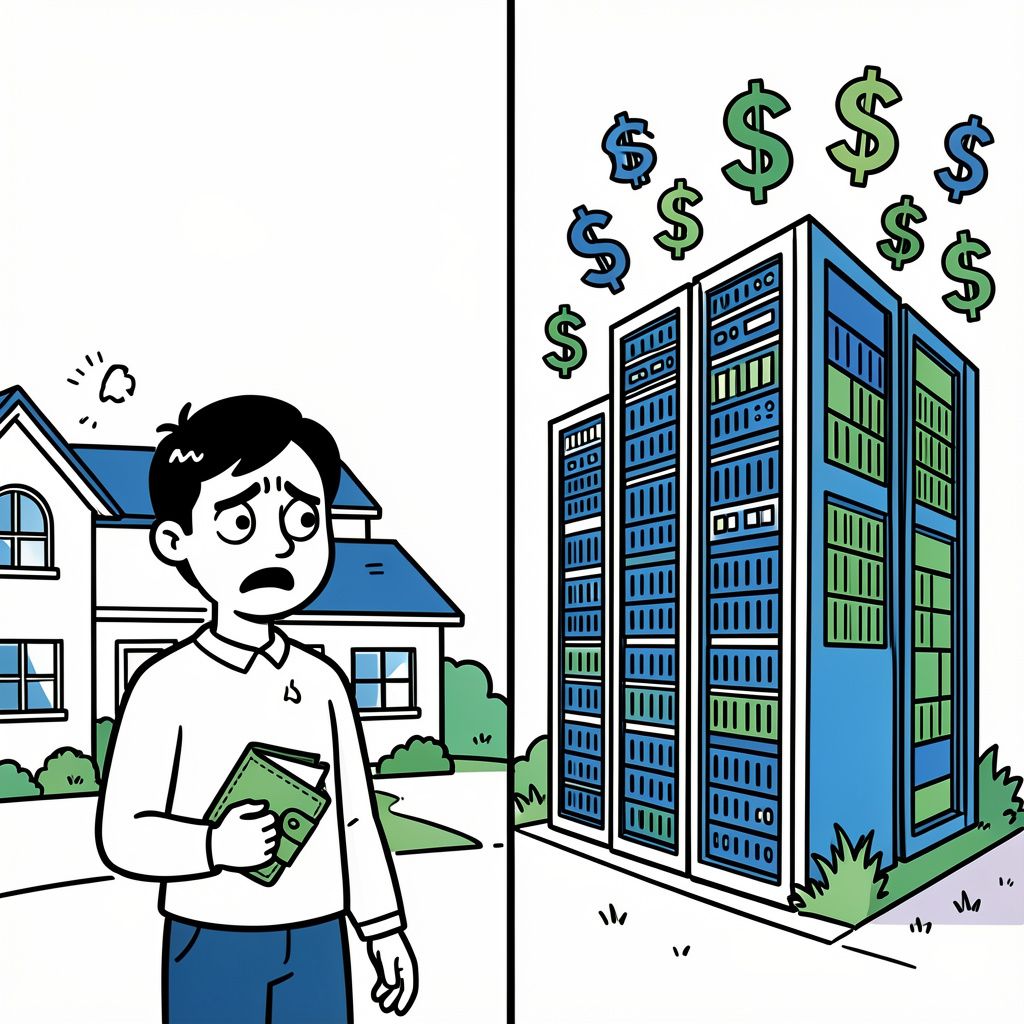
Massive tax breaks granted to tech data centers near Chicago have wiped out nearly $2 billion in taxable property value, shifting a $100 million tax burden onto local homeowners.
The Fiscal Shift onto Suburban Homeowners
An investigation published in August 2026 revealed that digital infrastructure developers operating data centers near Chicago’s O’Hare International Airport have secured nearly $100 million in local property tax incentives [1]. This tax relief was achieved because 18 northwest suburban data centers obtained multimillion-dollar reductions in taxable value from Cook County officials [1]. In total, assessment reductions and incentives removed nearly $2 billion from the total taxable property value in communities like Elk Grove Village, Northlake, and Franklin Park [1]. While these incentives were originally intended to attract tech investments and boost economic growth, the resulting reduction in commercial contributions has created a massive revenue deficit for local municipal services and school districts [1].
The Impact on Suburban Homeowners
To absorb this revenue shortfall, local taxing authorities have shifted the financial burden onto surrounding suburban homeowners through increased property tax assessments [1]. The impact is particularly stark in Northlake, where the average homeowner would save more than $2,000 annually—representing a reduction of approximately 30%—if local data centers were not granted these valuation reductions and incentives [1]. In the 2025 tax year, the 18 identified data centers paid nearly $71 million in property taxes [1]. In Northlake, three data centers alone comprised approximately 28% of the city’s tax base that year, demonstrating how heavily local municipalities rely on these facilities [1].
Valuation Disputes and the ‘Dark Store’ Strategy
Cook County Assessor Fritz Kaegi has actively opposed these massive valuation reductions, frequently clashing with data center operators and their appraisers [1]. A key battleground emerged on August 21, 2026, involving a Microsoft Azure data center located at 601 Northwest Ave. in Northlake [1]. Microsoft appealed for a property valuation of nearly $250 million [1]. In contrast, Kaegi’s office, represented by director of valuations research David Lehman, calculated the property’s value at $873 million—derived from its 2009 sale price of $182 million plus an estimated $650 million in subsequent upgrades, calculated as 832.000 million [1]. The Cook County Board of Review ultimately set the Microsoft facility’s final value at approximately $364 million, significantly lower than the assessor’s estimate [1].
The Strategy Behind Data Center Valuation Appeals
This discrepancy highlights a broader industry trend where data center owners employ the “dark store theory” during appeals [1]. Under this strategy, operators argue their highly specialized, capital-intensive facilities should be valued as if they were vacant warehouses [1]. This effectively classifies expensive backup power generators, chillers, and industrial equipment as non-taxable “personal property” rather than permanent “real property” [1]. As Assessor Kaegi noted, this methodology is akin to waving away a large element of real estate value [1]. However, assessing these properties remains exceptionally difficult due to a lack of transparent market data, as leasing and sales information in the data center sector is highly secretive and proprietary [1].
School Districts and Local Infrastructure Under Pressure
The fiscal pressure of these tax disputes often forces local school districts to settle with data center owners before cases reach the state’s Property Tax Appeals Board (PTAB) [1]. School districts face the risk of paying out massive retroactive refunds if they lose at the state level, which can create immediate multi-million dollar tax burdens for the rest of the community [1]. For instance, a Digital Realty property in Northlake was initially assessed at $191 million, but after the owner appraised it at $56.2 million, the company reached a settlement with the Leyden Township school district to value the property at $61.5 million—less than half of its $137 million sale price from nearly a decade prior [1].
Tax Incentives and Community Cost-of-Living
In Elk Grove Village, 11 of the 18 O’Hare-area data centers benefit from special Cook County tax incentives for industrial properties [1]. These incentives automatically reduce taxable property value by 60% for 10 years, before gradually returning to the baseline over the final two years [1]. Active tax incentives on five data center complexes in Elk Grove Village erased more than $280 million in taxable value last year, yielding approximately $14.5 million in tax savings for the developers [1]. While Elk Grove Village Mayor Craig Johnson defends these incentives as necessary to stay competitive, critics like Kasia Tarczynska, a senior research analyst with Good Jobs First, point out that these massive tech corporations have ample cash to build these facilities and pay their fair share of taxes [1].
A Growing Political Backlash and Regulatory Pauses
The mounting public frustration over rising residential tax bills has triggered a significant political and regulatory backlash in Illinois [1]. On May 30, 2026, demonstrators held a rally at the State Capitol in Springfield to demand stricter regulations on data center construction [1]. Following the legislature’s failure to pass regulatory bills during the spring session, Illinois Governor JB Pritzker issued an executive order on June 5, 2026, temporarily pausing applications for the state’s data center tax credit program [1]. This state-level pause reflects a growing national friction between municipal efforts to attract AI and cloud infrastructure and the political backlash from residential taxpayers facing higher cost-of-living burdens [1].
Local Opposition and Zoning Moratoriums
The backlash has also reached local zoning boards [2]. On August 20, 2026, the Stickney village board of trustees unanimously voted to enact a moratorium banning data center zoning changes or approvals, specifically targeting the site of the Hawthorne Race Course, which closed in July 2026 [2]. Digital Realty, through an affiliate, had agreed to acquire the 40.5-hectare site for $90 million, with the sale scheduled to close on September 1, 2026 [2]. Stickney Mayor Mitch Milenkovic expressed strong opposition, citing concerns over round-the-clock noise from cooling systems and backup generators [2]. Chicago Mayor Brandon Johnson has also requested that the City Council pass a moratorium on new data centers, signaling a dramatic shift in how local governments view these digital giants [2].