Inside California's $349 Billion Budget Plan: Economic Impacts and Local Backlash
Sacramento, Monday, 18 May 2026.
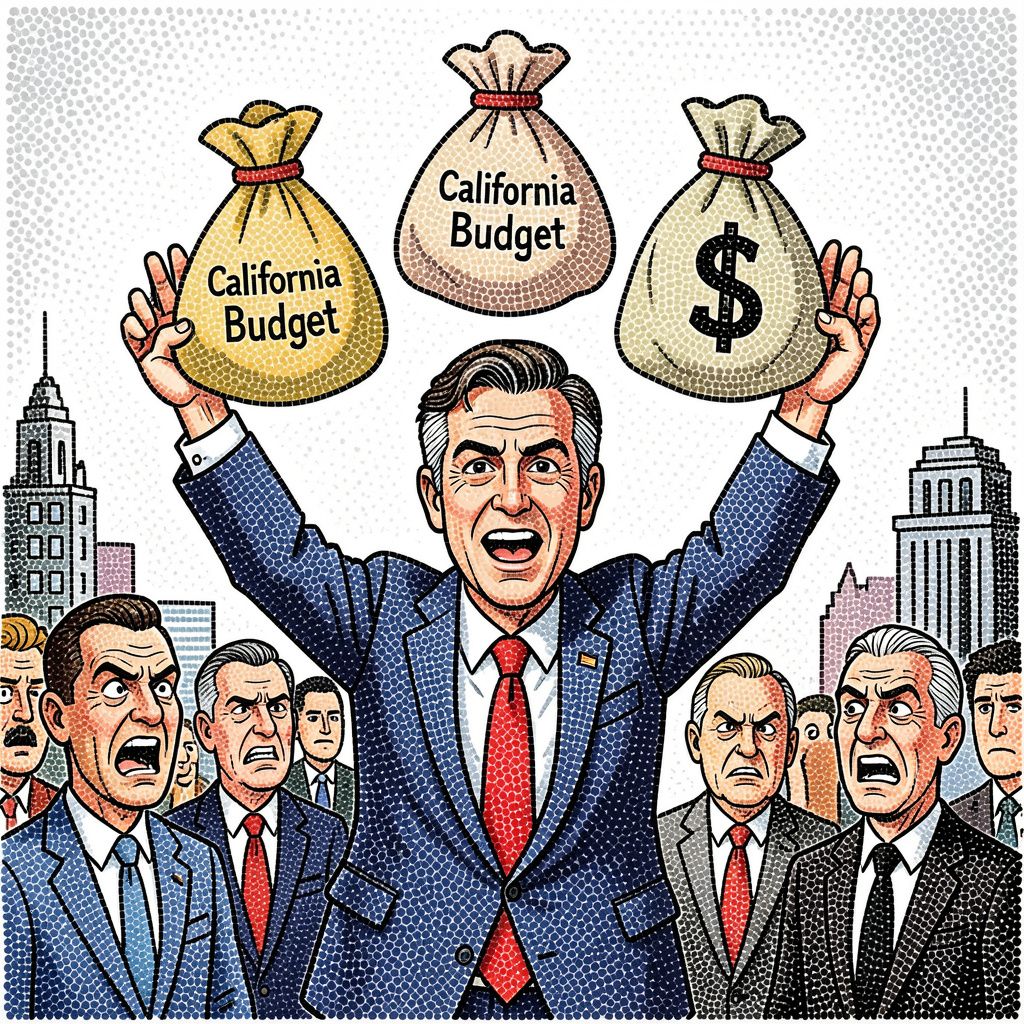
Governor Newsom’s $349.4 billion budget revision aims to close state deficits but faces severe backlash for shifting healthcare and homelessness costs directly onto local cities and counties.
Navigating a $349.4 Billion Fiscal Landscape
On May 14, 2026, Governor Gavin Newsom, a member of the Democratic Party [GPT], released the May Revision for the 2026-27 California State Budget [1][2]. The revised framework outlines $349.4 billion in total state fund expenditures, aiming to eliminate projected deficits through July 2028 [2]. While tax revenues for the current fiscal year have exceeded expectations by approximately $25 billion according to the Legislative Analyst’s Office, the state still faces the risk of future budget deficits ranging from $20 billion to $30 billion [3]. To bridge the immediate gap, the budget relies on a General Fund of $246.6 billion [1].
The May Revise introduces a mix of new revenue sources projected to generate $1.9 billion in the 2026-27 fiscal year and $4.9 billion by 2027-2028 [2]. These mechanisms include a digital software sales tax, a permanent limitation on business tax credits, and a new managed care organization (MCO) tax [2]. Simultaneously, the administration proposes a 50 percent reduction in the annual $800 business filing fee for new enterprises over the next three years [alert! ‘The source outlines this as a proposal; its implementation is pending final legislative approval’] [3]. However, the Pacific Research Institute notes that if the May Revise is adopted, total state spending under Governor Newsom’s tenure will have expanded by nearly 70 percent since 2019, a period during which personal income has grown 30 percent slower than state spending [3].
Healthcare Cuts and Medi-Cal Restructuring
A significant portion of the budget rebalancing relies on extensive modifications to the Medi-Cal system, prompting concern among healthcare advocates [2]. Beginning in 2026, the administration plans to freeze new Medi-Cal enrollments for undocumented adults and eliminate certain benefits [4]. By July 1, 2027, monthly premiums for adults aged 19 to 59 with unsatisfactory immigration status will increase from $30 to $50, representing a 66.667 percent hike [2]. Furthermore, starting January 1, 2027, Medi-Cal asset limits for disabled adults and seniors will be reinstated at $2,000 for individuals and $3,000 for couples, while members with unsatisfactory immigration status will transition from managed care to fee-for-service models [2].
These healthcare adjustments are heavily influenced by federal policy shifts. Effective October 1, 2026, a federal mandate will reduce the matching rate for emergency services provided to Affordable Care Act (ACA) expansion adults with unsatisfactory immigration status from 90 percent to 50 percent [2]. This federal reduction creates a $669 million General Fund burden for California in 2026-27, which is projected to increase to $718 million in subsequent years [2]. Graham Knaus, a local government advocate, criticized the administration’s approach, stating that the May Revision doubles down on federal cuts and leaves struggling families without adequate healthcare or food [4].
The Burden on Local Governments
The fiscal recalibration has drawn sharp criticism from local government entities, who argue the state is offloading its financial responsibilities onto cities and counties [4]. The California State Association of Counties (CSAC) highlighted a $233.6 million shift in In-Home Supportive Services (IHSS) costs from the state to county governments [4]. According to CSAC, this maneuver undermines the existing fiscal structure and directly strains local safety net services [4]. Additionally, the revision proposes $1.8 billion in cuts directly from the general fund [4].
Homelessness funding has also become a major point of contention. While the budget maintains $500 million for the Homeless Housing, Assistance and Prevention (HHAP) program, it introduces a new mandate requiring cities and counties to match state funds to access the money [4]. Cal Cities CEO Carolyn Coleman noted that the Governor is simultaneously proposing cuts to Round 7 of the HHAP grant program, warning that such reductions will force municipalities to close shelter beds and stall progress on unsheltered homelessness [4]. Furthermore, the plan seeks to prohibit cities from imposing impact fees on state-subsidized affordable housing projects [4].
Economic Trade-offs and the Path Ahead
The broader economic implications of the budget have sparked debate over California’s fiscal trajectory. Arnold Sowell Jr., Executive Director of the nonprofit advocacy group NextGen California, urged the Governor to maintain crucial investments, citing the economic strain caused by federal budget cuts and gas price inflation exacerbated by the ongoing war in Iran [1]. NextGen California has expressed disappointment over proposed cuts to bills supporting immigrant legal counsel (AB 2600), healthy food financing (AB 2213), and college student food benefits (SB 961) [1]. Despite these cuts, the revision does include $141.9 million for Next Generation 9-1-1, $248.5 million for substance abuse prevention, and $100 million for disaster rebuilding [4].
Conversely, economic analysts caution against relying on tax increases to solve the structural deficit. According to the Pacific Research Institute, raising the top personal income tax brackets (currently 9.3 percent and above) by 1.5 percentage points to close half of the projected deficit would carry severe economic consequences [3]. Their modeling suggests such a tax hike would reduce average household income growth by nearly $1,050, cost the state roughly 140,000 jobs, and diminish California’s overall economic growth by nearly 2.1 percent [3]. As negotiations between the Governor and the Legislature proceed between May 17 and June 15, 2026, these competing priorities will define the final budget required by the July 1 start of the new fiscal year [1].