Michael Burry Forecasts AI Sector Collapse and Potential Market Panic by 2027
New York, Wednesday, 14 January 2026.
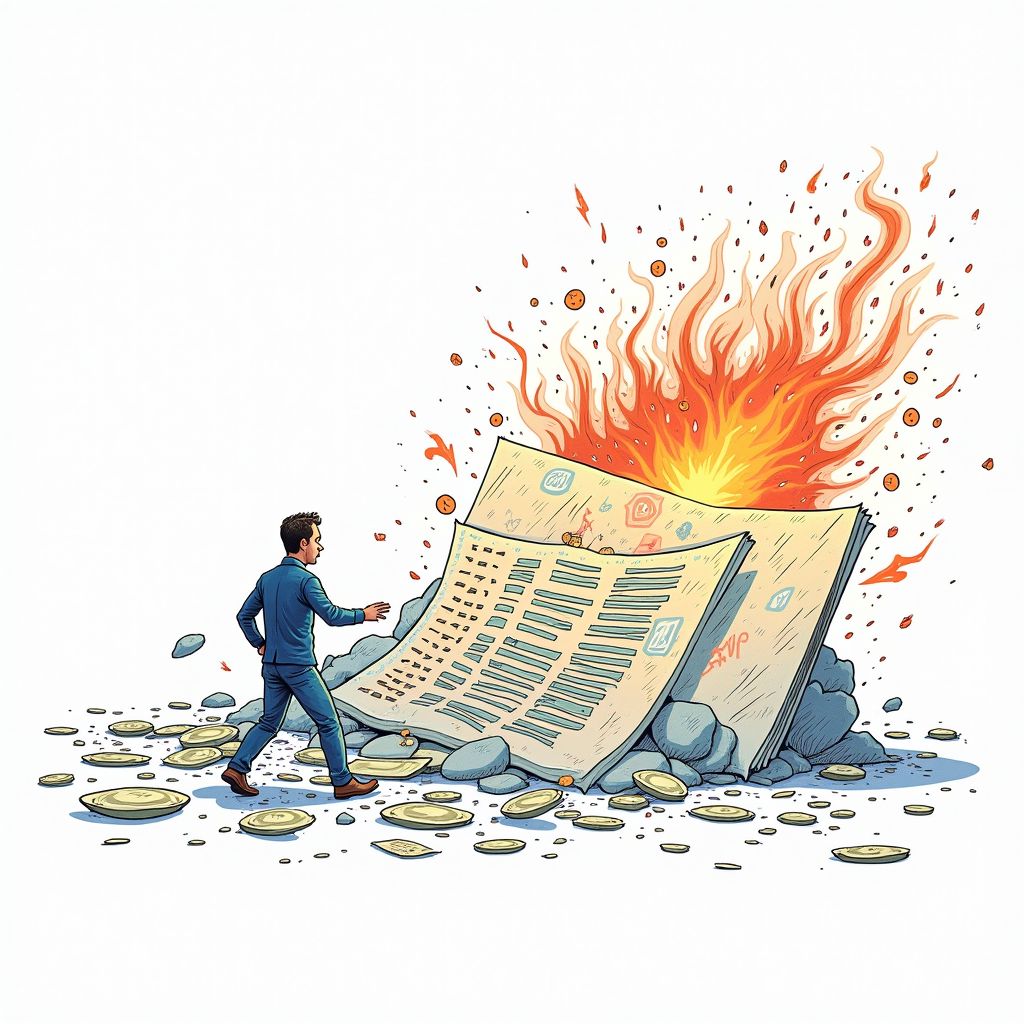
Predicting nearly all AI companies will face bankruptcy, Burry warns of a potential 2026-2027 market panic, arguing the sector resembles a ‘department store escalator’ that benefits users, not investors.
Forecasting a Sector-Wide Collapse
Michael Burry, the investor who famously predicted the 2008 housing market meltdown, has issued a stark warning that the artificial intelligence boom is precipitating a wave of bankruptcies [1]. On January 12, 2026, Burry stated that a market panic could unfold as early as 2026 or 2027, driven by diminishing returns on the massive capital poured into the sector [1][3]. Despite Nvidia’s stock rising 12-fold since the start of 2023 to reach a market capitalization of $4.5 trillion, Burry argues the company is “simply the purest play” for investors seeking to bet against the AI bubble [2].
The Return on Invested Capital Crisis
The core of Burry’s thesis rests on the deteriorating Return on Invested Capital (ROIC) within the tech sector [3]. He observes that software giants like Microsoft, Google, and Meta are pivoting from asset-light business models to becoming capital-intensive hardware operations, burdened by the costs of data centers, chips, and energy [3]. According to Burry, this shift will inevitably pressure shares as companies realize they “should not be spending so much” and are forced to write off assets [2]. He asserts that the metric to watch is ROIC, which is destined to fall as these companies transform into infrastructure-heavy entities [3].
The ‘Escalator’ Dilemma
To explain why technological adoption does not guarantee investment returns, Burry employs an analogy involving Warren Buffett and a department store escalator from the 1960s [4]. He argues that while an escalator benefits the customer, it provides no competitive moat to the business owner if every competitor installs the same technology [1]. Consequently, Burry predicts that while AI will enrich users, it will crush investors, noting that “almost all AI companies will go bankrupt” as they struggle to differentiate themselves in a saturated market [1].
Skepticism on Palantir and Nvidia
This skepticism extends to data analytics firm Palantir. Burry contends that Palantir’s valuation is sustained primarily by marketing rather than fundamentals, stating there are “virtually no earnings after stock-based compensation” [5]. He dismisses the firm’s current standing, suggesting that like Nvidia, its competitive edge is temporary and heavily reliant on aggressive promotion by leadership [5]. He characterizes Nvidia’s current dominance as “lucky” and prone to technological obsolescence as new chip solutions emerge annually [2][5].
The $300 Billion Revenue Gap
Burry identifies a massive discrepancy between infrastructure spending and actual utility revenue as a harbinger of the crash. He projects that Nvidia will sell $400 billion in chips this year, yet the market holds less than $100 billion in application-layer use cases to monetize that hardware [2]. This creates a shortfall of 300 billion, a gap that Burry suggests indicates the market is in a bubble similar to the 2000 data transmission crisis [2]. He warns that customers are overstating the lifespan of these chips to flatter profits, a practice that will lead to future writedowns [2].
Winners Amidst the Losers
However, Burry does not view all tech giants equally. In a January 12, 2026 interview, he indicated that Google might be “pulling ahead” of rivals like Amazon and Microsoft [5]. He attributes this resilience to Google’s significant cash reserves—approximately $98 billion as of its Q3 earnings—and its ability to overcome “search inertia” [5]. Unlike Nvidia, which he views as vulnerable, he believes some Big Tech companies possess the staying power to survive the coming downturn due to their established dominance outside of the AI buildout [2][5].
A Looming Correction
The timeline for this potential correction is immediate. Burry questions whether the inevitable write-downs of AI spending will trigger the “Panic of 2026” or 2027 [1]. He draws a direct parallel to the dot-com era, labeling OpenAI—valued at $500 billion in October 2025—as the “Netscape of our time” [3]. Just as Netscape’s 1995 IPO sparked a boom that burst five years later, Burry warns that the current cycle of capital expenditure must eventually face the reality of economic value added [3].
Sources
- www.capitalaidaily.com
- www.businessinsider.com
- www.businessinsider.com
- www.marketwatch.com
- stocktwits.com