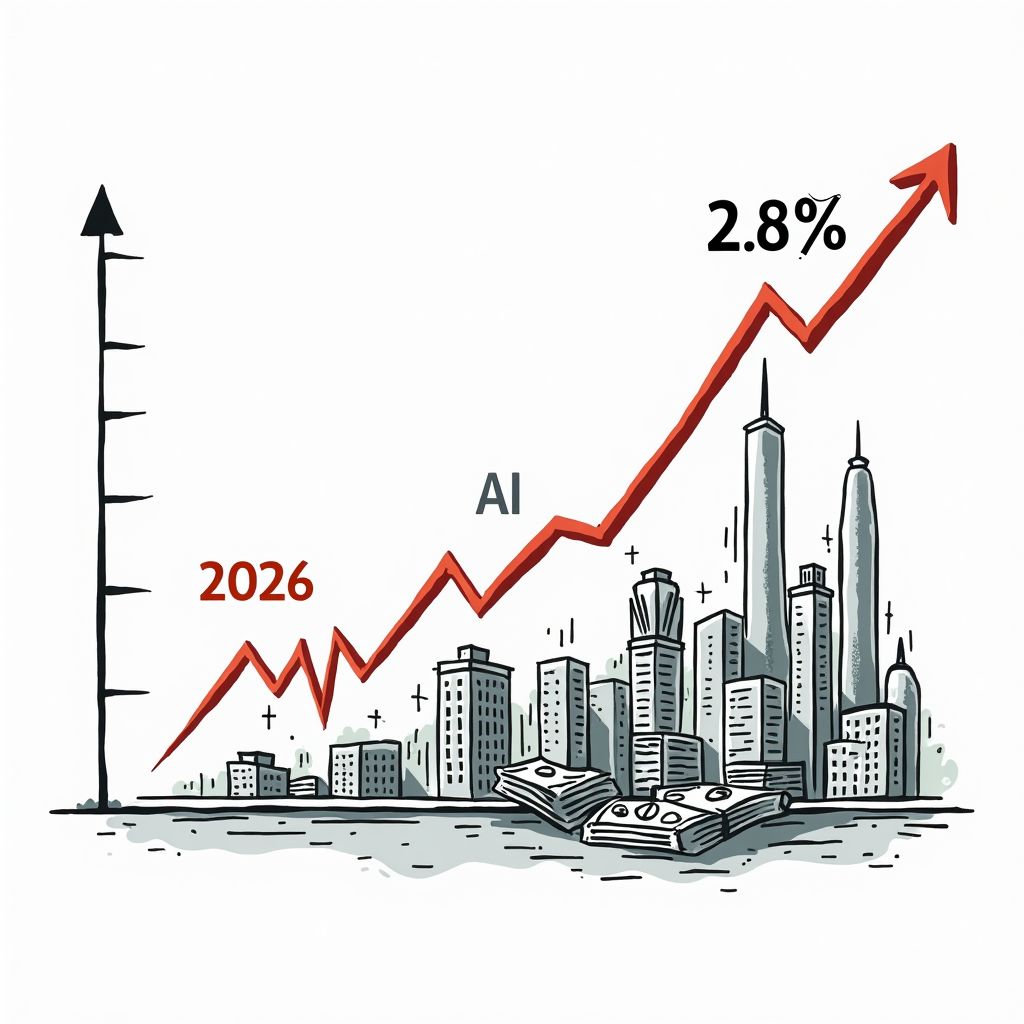
Global Economy Projected to Outperform Expectations with 2.8 Percent Growth in 2026
New York, Saturday, 20 December 2025.
Goldman Sachs predicts 2.8 percent global growth for 2026, beating consensus. This outlook relies on US tax cuts and massive AI infrastructure spending often missed by official economic statistics.
Drivers of Resilient Global Growth
Goldman Sachs Research anticipates that the global economy will expand by 2.8 percent in 2026, a projection that exceeds the consensus among economists [1]. This optimistic outlook is predicated heavily on specific fiscal dynamics in the world’s two largest economies: the United States is expected to see growth bolstered by tax cuts and a reduction in tariff drag, while China’s economy is forecast to rely on surging exports to counterbalance domestic weakness [2][5]. While the headline number is strong, the composition of this growth varies significantly by region. In the Euro area, growth is projected to reach 1.3 percent in 2026 [1]. Conversely, China faces internal headwinds; its property sector is estimated to create a 1.5 percentage point drag on GDP growth, forcing a reliance on external trade that is expected to push its current account surplus to nearly 1 percent of global GDP over the next three to five years [1].
The Hidden Impact of AI Investment
A critical component of this economic narrative is the “true” impact of artificial intelligence, which standard metrics appear to be underreporting. Since the release of ChatGPT in 2022, investment in AI infrastructure has added an estimated $160 billion to “true GDP,” yet the Bureau of Economic Analysis (BEA) has officially recorded only $45 billion of this impact [4]. This discrepancy suggests that official data captures roughly 28.125 percent of the actual economic activity generated by the sector, leaving a significant portion of growth hidden from standard indicators [4]. The scale of this investment is staggering; since 2022, U.S. firms have increased spending on AI infrastructure by $400 billion [4].
Inflation Trajectories and Policy Shifts
Looking toward price stability, the forecast suggests that core inflation in developed markets will decline to levels generally consistent with central bank targets in 2026 [1]. In the United States, the inflationary impact of tariff pass-through is expected to diminish sharply in the second half of the year [1]. Furthermore, wage pressures appear contained; nominal wage growth in the U.S. is currently tracking below the 4 percent rate considered sustainable for a 2 percent inflation target, while U.K. wage growth remains close to its sustainable rate of 3 percent [1]. As these pressures recede, policy rates in developed markets are expected to converge lower, with further cuts forecast for the U.S., U.K., and Norway [1]. However, market observers note that this growth target relies on policy tailwinds materializing as expected, advising a strategy of “disciplined optimism” given the sensitivity of these forecasts to assumptions about trade and inflation [5].