How Alternative Federal Calculation Methods Could Disrupt Economic Forecasting
Washington, Saturday, 25 April 2026.
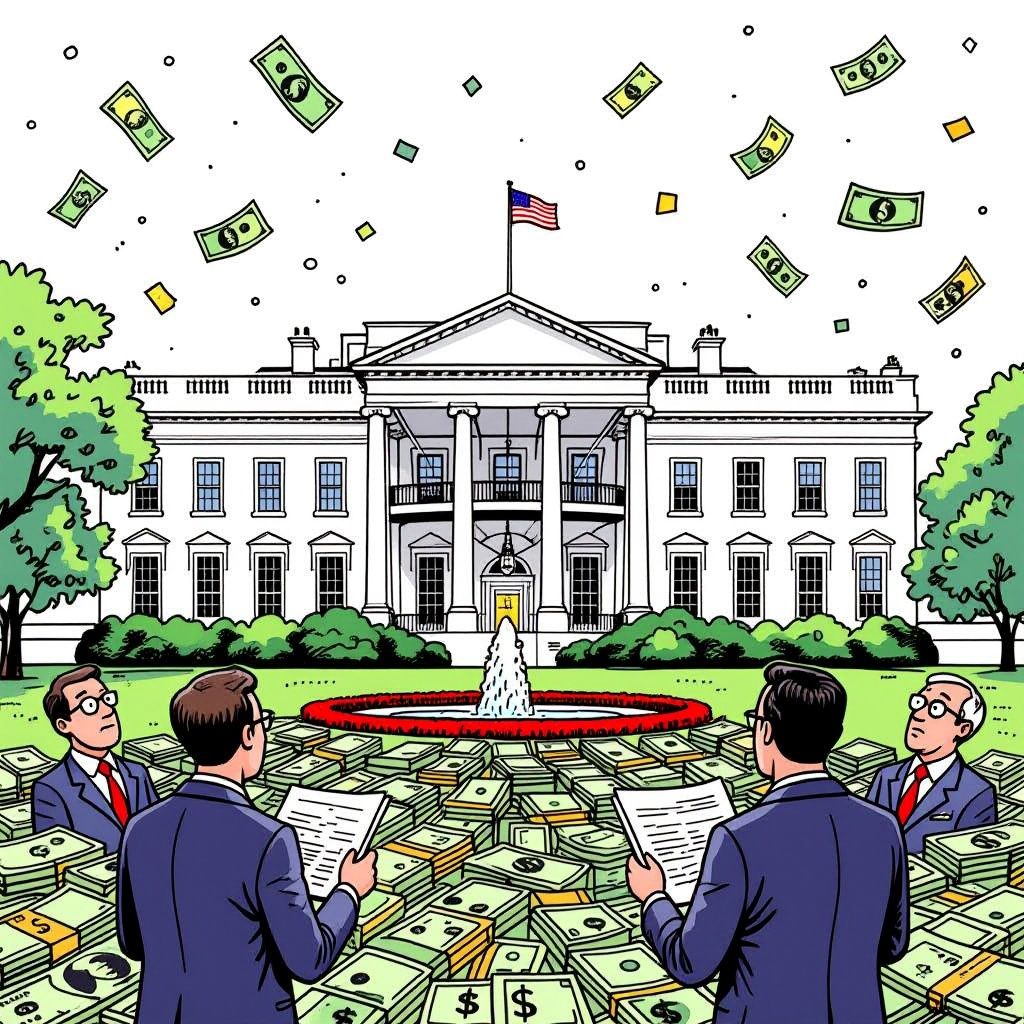
The White House recently endorsed alternative mathematical calculations for pricing data. This departure from standard arithmetic introduces significant uncertainty for economists and business leaders relying on accurate federal forecasting.
Redefining Percentages in the Oval Office
On April 21, 2026, during a congressional hearing, Health and Human Services Secretary Robert F. Kennedy Jr. publicly defended President Donald Trump’s unconventional mathematical approach to drug pricing [1]. This defense continued during an April 23, 2026, Oval Office event focused on pharmaceutical costs [1][3]. During the proceedings, Secretary Kennedy argued that reducing the price of a drug from $600 to $10 represents a “600% reduction” [1]. Furthermore, he asserted that a price drop from $600 to $100 equates to a “600% savings,” despite standard arithmetic dictating a savings of 83.333 percent, or 83% [1]. This methodology aligns with earlier assertions made by President Trump in the summer of 2025, where he claimed his administration would reduce drug prices by figures such as 1,000%, 600%, 500%, and 1,500%, insisting that “nobody else” could achieve such numbers [1].
Legislative Action and Tariff Formulas
The introduction of alternative calculation methods extends beyond healthcare rhetoric and into international trade and national security policies [1]. President Trump has previously established international trade tariff rates based on his own proprietary formulas rather than conventional economic models [1]. Furthermore, the administration has utilized contested figures to justify military actions; for instance, President Trump previously cited a demonstrably false claim that 300 million individuals in the United States died from drugs in 2024 to justify military strikes on civilian boats [1]. Such deviations from verified data create a volatile environment for global markets, which rely heavily on predictable, standardized metrics to price risk and forecast growth [GPT].
Implications for Economic Stability
The foundation of modern financial forecasting relies on universally accepted mathematical constants and transparent data [GPT]. When the executive branch embraces “mathematical relativism,” it introduces unprecedented risk for investors, entrepreneurs, and policymakers [1]. Bill Lueders, commenting on the administration’s data practices, noted that the President appears willing to generate numbers to prove his claims, “even if he has to make them up” [1]. As the administration continues to implement its policy agenda into late April 2026 and beyond, the financial sector must now account for a dual-track data environment: one based on standard arithmetic, and another based on the White House’s alternative calculations [1][3].