Russian Economic Growth Slows as War Costs and Infrastructure Damage Strain Market
Moscow, Thursday, 30 July 2026.
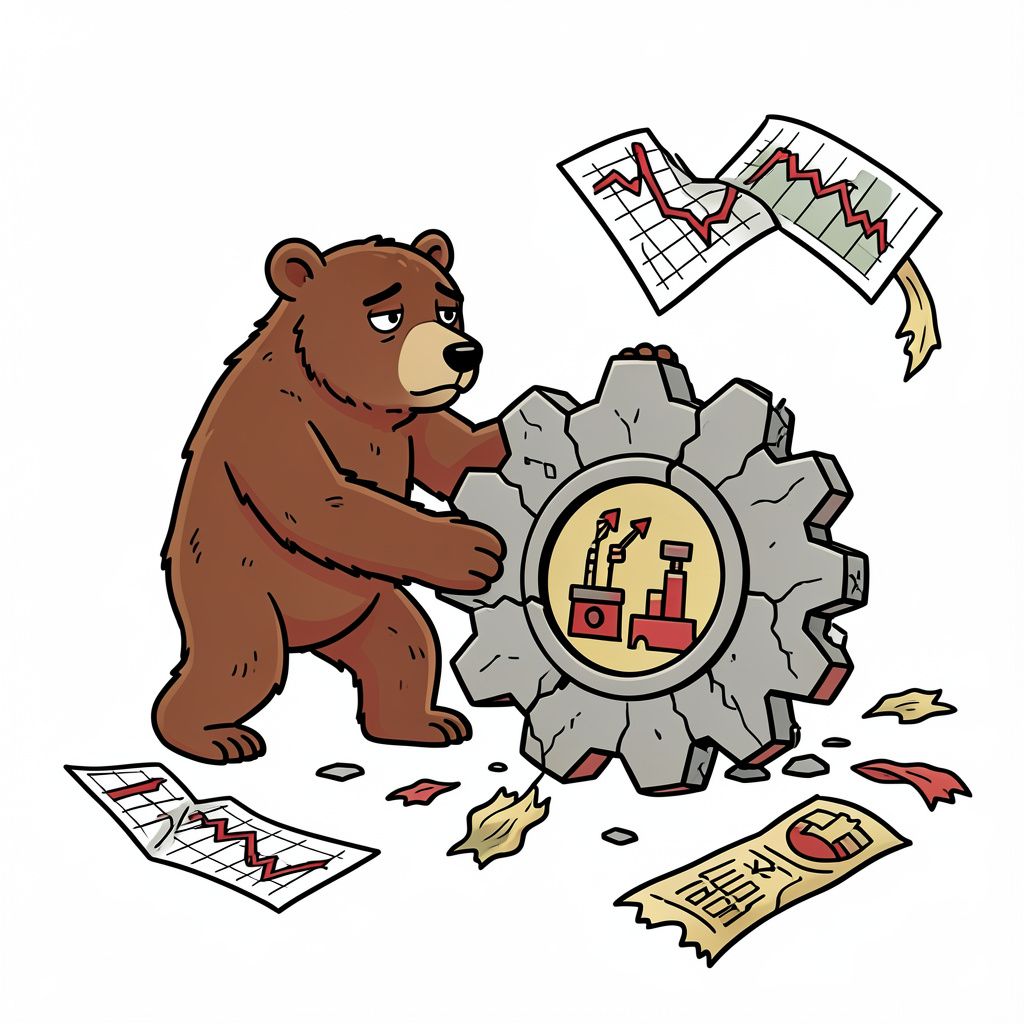
Russia’s economy grew just 0.3% in the first half of 2026, weighed down by contracting civilian industries, escalating inflation, and slowing momentum in defense manufacturing.
Economic Stagnation in the First Half of 2026
Russia’s economic expansion ground to a near-halt in the first half of 2026, registering just 0.3% GDP growth as severe strain on the civilian economy failed to sustain military manufacturing [1]. This figure represents a sharp slowdown compared to 1.2% growth in the first half of 2025 and 0.9% in the second half of 2025 [1]. Monthly data indicates a slight acceleration later in the period, with Monthly GDP Year-over-Year increasing to 1.10 percent in June from 0.30 percent in May of 2026 [2]. Preliminary data from the economy ministry confirmed the 1.1% year-on-year growth in June following the 0.3% growth in the previous month [4].
Sectoral Contractions and Defense Slowdown
Industrial output in non-defense sectors experienced notable contractions while wartime production lost momentum, highlighting systemic limits in Moscow’s ability to finance prolonged military operations [1]. Defense-related production growth decelerated significantly in the first half of 2026, with fabricated metal goods such as bombs and shells rising only 8.8%, down from 18% in 2025 [1]. Civilian industries saw sharp declines during the same period, including a 6.3% drop in clothing production and a 9.1% drop in metallurgical output [1]. Petroleum product output fell 7.7% in the first half of 2026, marking a critical vulnerability in the energy sector [1].
Defense Spending Eats Budget
In early June 2026, Ministry of Finance and Central Bank officials warned President Vladimir Putin that war spending is straining the national economy and risking dangerous budget deficits [3]. During the first quarter of 2026, Russia spent $76.2 billion on defense, representing 65% of federal revenues for that period and a 30% increase compared to the first quarter of 2025 [3]. The budget deficit for January through April 2026 reached $79.3 billion, surpassing the total deficit recorded for the entire year of 2025 [3]. Officials are squeezing every other sector of the economy so that at least some growth continues in the military industry [1].
Escalating Fiscal Deficits
The Russian Finance Ministry faces significant pressure to service government debt and cover a ballooning budget deficit, which is now projected to reach 8 trillion rubles, double the initial estimate of 3.8 trillion rubles [6]. This projected budget deficit represents 3.6% of Russia’s GDP, a figure currently deemed manageable by the authorities but vulnerable to volatility in oil revenues [6]. The increase from the initial estimate represents a percentage increase of 110.526 percent over the original target [6]. Debt servicing costs for 2026 have reached 3.9 trillion rubles, an amount exceeding the entire originally planned budget deficit [6].
Infrastructure Attacks Compound Woes
Russian oil refineries have lost approximately 45% of total production capacity due to Ukrainian drone strikes, according to data reported on 30 July 2026 [1]. Economic contraction began in 2026 for the first time since 2023, exacerbated by Ukrainian strikes on Russian refineries which have caused fuel shortages and ruble weakness [3]. President Putin admitted on 28 June 2026 that attacks on infrastructure facilities create obvious problems and observed a certain shortage, though he claimed it was not critical [3]. Deputy Prime Minister Aleksandr Novak declared the fuel market difficult but controlled on 23 June 2026 [3].
Logistics and Retail Disruptions
Wildberries, which handles annual sales equivalent to approximately 3% of Russia’s GDP, is experiencing warehouse attacks that may trigger merchant bankruptcies as of 29–30 July 2026 [1]. Potential disruptions threaten to cause widespread merchant bankruptcies, unpaid loans and taxes, and fiscal strain on the federal budget and banking sector [1]. Reports indicate that attacks have damaged at least 8 warehouses representing more than 10% of the company’s logistics capacity [5]. These logistics network targets demonstrate a shift in strategy beyond energy infrastructure [5].
Monetary Policy and Inflation Risks
On 24 July 2026, the Central Bank of the Russian Federation lowered its 2026 GDP growth forecast range to 0.0–1.0 percent, down from a previous 0.5–1.5 percent [3]. The Central Bank also raised its inflation forecast to 6%–7%, from 4.5%–5.5%, citing the sharp increase in fuel prices and temporary losses of production capacity [5]. On 28 July 2026, the Central Bank of Russia reduced the key interest rate by 0.25 percentage points to 14%, signaling that high rates will persist longer than anticipated [6]. Central Bank Governor Elvira Nabiullina warned that pro-inflationary risks prevail despite the symbolic rate cut [6].
Long-Term Economic Outlook
Sberbank and the Central Bank of Russia forecast 2026 economic growth between 0% and 0.5%, with the risk of growth disappearing entirely [1]. At best, Russia will finish the year with no growth, according to senior fellow at the Peterson Institute for International Economics Elina Ribakova [1]. Experts warn government-debt sustainability will likely deteriorate thereafter, with a potential crisis emerging within 1–2 years [6]. The Finance Ministry intends to maintain current fiscal policy through gritted teeth until the end of 2026 [6].
Sources
- united24media.com
- tradingeconomics.com
- jamestown.substack.com
- www.tradingview.com
- x.com
- www.themoscowtimes.com