Europe’s Trade Deficit with China Hits €1 Billion Per Day—Is a Trade War Inevitable?
Brussels, Sunday, 21 June 2026.
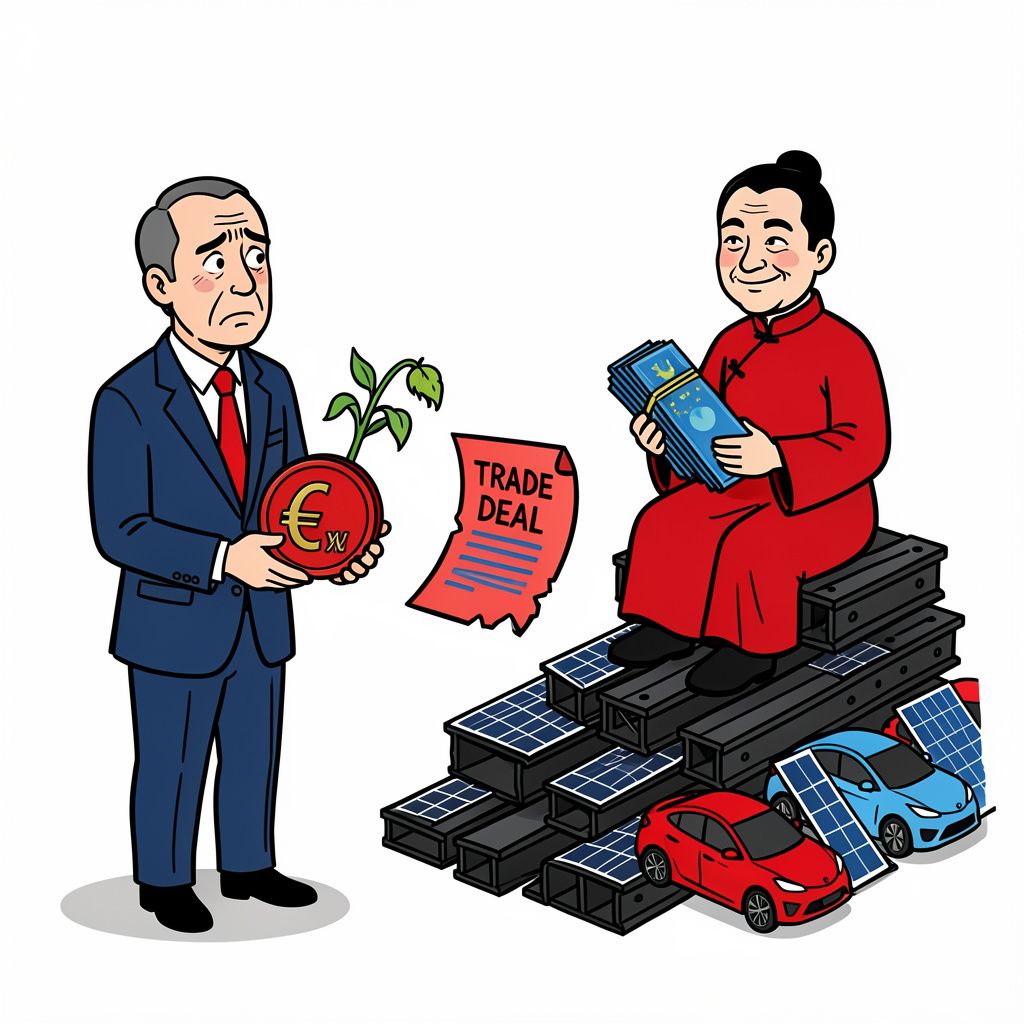
Europe’s trade deficit with China surged to a record €360.6 billion in 2025, deepening by 10% in early 2026. With daily losses nearing €1 billion, the EU is abandoning diplomacy for Trump-style tariffs, risking a full-blown trade war. China’s dominance in EVs, steel, and solar panels—backed by state subsidies—has left European industries struggling. Now, leaders warn of a ‘world of wolves,’ as retaliatory measures loom, threatening supply chains and inflation. Will Europe’s bold shift reshape global trade—or backfire?
The €360.6 Billion Warning: How China’s Trade Surplus Became Europe’s Economic Headache
In 2025, China’s goods trade surplus with the European Union reached a record €360.6 billion, marking a 15% increase from the previous year [1]. The imbalance has only deepened in 2026, with the first four months of the year showing a further 10% expansion [1]. To put this into perspective, the EU is now losing approximately €1 billion per day to its trade deficit with China [6]. This figure is not merely a statistical anomaly but a growing economic concern that has prompted European leaders to reconsider their long-standing diplomatic approach to Beijing [1][2].
From Diplomacy to Defiance: Europe’s Shift Toward Trump-Style Tariffs
For years, the European Union maintained a conciliatory stance toward China, prioritizing dialogue over confrontation. However, the bloc’s patience appears to be wearing thin. European Commission President Ursula von der Leyen has accused China of distorting trade and limiting market access for European firms, a sentiment echoed by French President Emmanuel Macron, who warned of potential tariffs to address the surplus [2][3]. This shift mirrors the aggressive trade policies of former U.S. President Donald Trump, who imposed sweeping tariffs on Chinese goods under Section 301 investigations [1]. The EU is now preparing its own toolbox of trade defenses, including new tariffs and supply chain diversification requirements, signaling a departure from its traditionally cautious approach [4].
The Domino Effect: How China’s Subsidies Are Reshaping Global Supply Chains
The root of Europe’s trade imbalance lies in China’s state-backed industrial policies, which have flooded global markets with subsidized goods. Electric vehicles (EVs), steel, and solar panels—sectors where China holds a dominant position—have become flashpoints in the escalating trade tensions [1]. In 2024, the EU imposed additional duties on Chinese EVs, only to face retaliatory measures targeting European dairy products and brandy [7]. Despite these tariffs, Chinese EV imports rebounded in the first quarter of 2026, with hybrid vehicles filling the gap left by traditional models [7]. The situation is further complicated by China’s control over critical minerals, including rare earths, which are essential for high-tech and green industries. In response to U.S. and EU trade barriers, Beijing has restricted exports of these materials, disrupting supply chains for European manufacturers [5].
A House Divided: Europe’s Struggle for Unity on China
While European leaders agree on the need to address the trade imbalance, consensus on how to proceed remains elusive. On June 18, 2026, EU leaders gathered in Brussels to debate new measures, but their discussions revealed deep divisions [4]. France, Italy, the Netherlands, and Lithuania have pushed for tougher actions, including additional duties or quotas to reduce reliance on Chinese imports [7]. Spain, however, has distanced itself from these proposals, highlighting the bloc’s internal fractures [7]. The European Commission has been tasked with developing a unified strategy, but diplomats warn that missteps could leave European industries vulnerable to retaliation [4]. As one EU official put it, ‘We live in a world of wolves now. We no longer live in a world of pink ponies and rainbows’ [2].
The Cost of Action: Inflation, Profits, and the Risk of Retaliation
Business leaders across Europe are sounding the alarm over the potential fallout from escalating trade restrictions. New tariffs could disrupt manufacturing costs, drive up inflation, and squeeze corporate profitability [1]. The EU’s trade deficit with the rest of the world already swung from a €7.3 billion surplus in April 2025 to a €7.1 billion deficit in April 2026, underscoring the broader economic strain [8]. Companies heavily reliant on Chinese supply chains, particularly in the automotive and renewable energy sectors, face the greatest risks [1]. Meanwhile, China has shown little hesitation in retaliating against trade barriers. In addition to tariffs on European goods, Beijing has imposed restrictions on rare earth exports, a move that could cripple industries dependent on these critical materials [5].
Sources
- fortune.com
- www.facebook.com
- www.bloomberg.com
- wtvbam.com
- www.instagram.com
- www.facebook.com
- www.facebook.com
- www.facebook.com