New White House Ballroom Design Reveals Massive Underground Military Complex
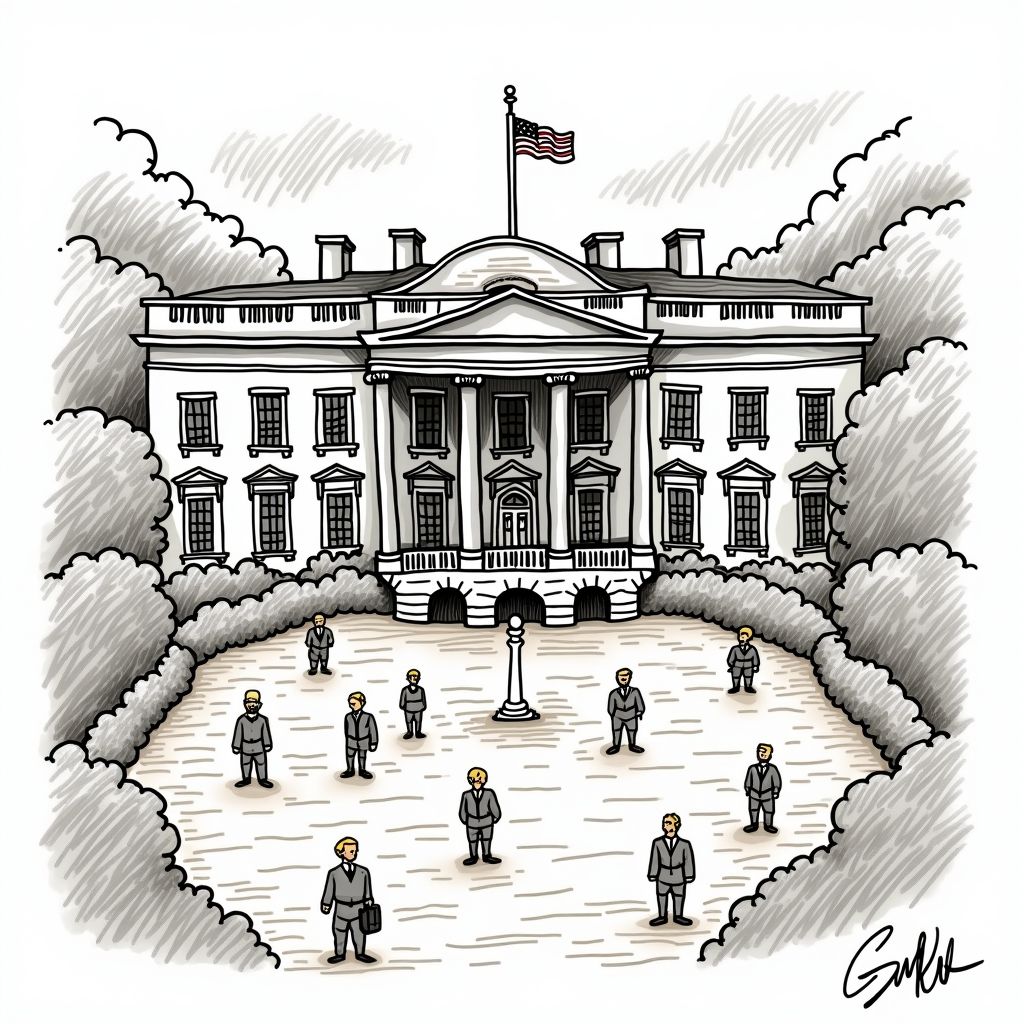
Washington, Monday, 30 March 2026.
President Trump revealed the proposed $400 million White House ballroom will conceal a massive, highly fortified underground military complex, driving intense architectural debate ahead of final regulatory votes.
A Dual-Purpose Expansion
Speaking to reporters aboard Air Force One on Sunday, March 29, 2026, Republican [GPT] President Donald Trump confirmed that the highly publicized White House ballroom project is fundamentally tied to military infrastructure [1][3]. Trump described the planned event space as essentially functioning as a “shed” to cover a massive military complex currently under construction beneath it [3][5]. To secure this new subterranean facility, the above-ground ballroom will feature high-grade, bulletproof glass and a drone-proof roof [1][5]. The revelation provides new context for the project, which began with the demolition of the White House East Wing in October 2025 [3].
The financial and physical scale of the intended construction is unprecedented for the modern White House. The administration estimates the project will cost $400 million, an amount President Trump asserts will be entirely financed through private donations rather than taxpayer funds [2][5]. In terms of physical footprint, the proposed ballroom will be 60 percent larger than the White House Executive Residence by floor area, and more than three times as large by cubic volume [2][4]. Designed to accommodate large gatherings, the space could potentially fit 1,500 guests, representing a 50 percent increase over the 1,000-guest capacity that industry standards suggest is necessary for its dimensions [4].
Architectural Friction and Administration Defense
The sheer size and aesthetic choices of the ballroom have drawn sharp criticism from architectural experts and historic preservationists. A recent interactive feature published by The New York Times highlighted several controversial design elements, noting that the structure will dwarf the existing White House and disrupt the historical symmetry of the complex [2][4]. Specific critiques focus on the planned south portico, which features massive columns but no functional doors into the ballroom, and an east colonnade that utilizes “masonry niches” designed to mimic windows rather than actual glass panes [2]. Furthermore, the project will require rerouting the original White House driveway designed by renowned landscape architect Frederick Law Olmsted [4]. Planning commission member Phil Mendelson publicly questioned the necessity of the ballroom’s 12.19-meter ceiling height, emphasizing that the building is “the People’s House” and not the personal property of any single president [4].
The Trump administration has forcefully rebuffed these architectural critiques. On March 29, 2026, White House Press Secretary Karoline Leavitt disparaged the experts cited by The New York Times, characterizing them as individuals who have “never built anything” [1][2]. Leavitt defended the project as a long-needed modernization that will be delivered at no cost to the American taxpayer [1][2]. Echoing this sentiment, White House spokesman Davis Ingle touted President Trump as “the best builder and developer in the entire world,” while the project’s lead architect, Shalom Baranes, conceded during a March 2026 planning commission review that elements like the massive south portico are driven by aesthetic decisions rather than absolute functional necessity [4].
Regulatory Hurdles and Looming Deadlines
Despite the administration’s aggressive push, the project remains entangled in legal and regulatory challenges. The National Trust for Historic Preservation filed a lawsuit alleging the administration bypassed mandatory public input and review processes [5]. While a federal judge rejected an initial request to block the construction in February 2026, noting the preservationist group needed to amend its legal arguments, a final decision on an injunction to halt the project is expected by the end of March 2026 [3][5]. Despite these legal headwinds, President Trump maintained on March 29 that the construction is “ahead of schedule and under budget” [5].
The immediate future of the ballroom and its underlying military complex hinges on a critical regulatory vote scheduled for Thursday, April 2, 2026 [2][4]. The National Capital Planning Commission, which has received a flood of negative public comments labeling the design as “hideous” and “appalling,” will make a final determination on the project [3]. Will Scharf, the chair of the planning commission and White House staff secretary, indicated he will participate in the vote after reviewing public correspondence, arguing that without President Trump’s rapid timeline and private fundraising, the infrastructure upgrade could languish for years [4]. If approved, the White House intends to formally begin building the above-ground ballroom structure in the spring of 2026 [alert! ‘Exact start date in spring 2026 remains unconfirmed pending regulatory approval’] [2][4].