Beijing Simulates Taiwan Port Blockade in New Live-Fire Military Drills
Taipei, Monday, 29 December 2025.
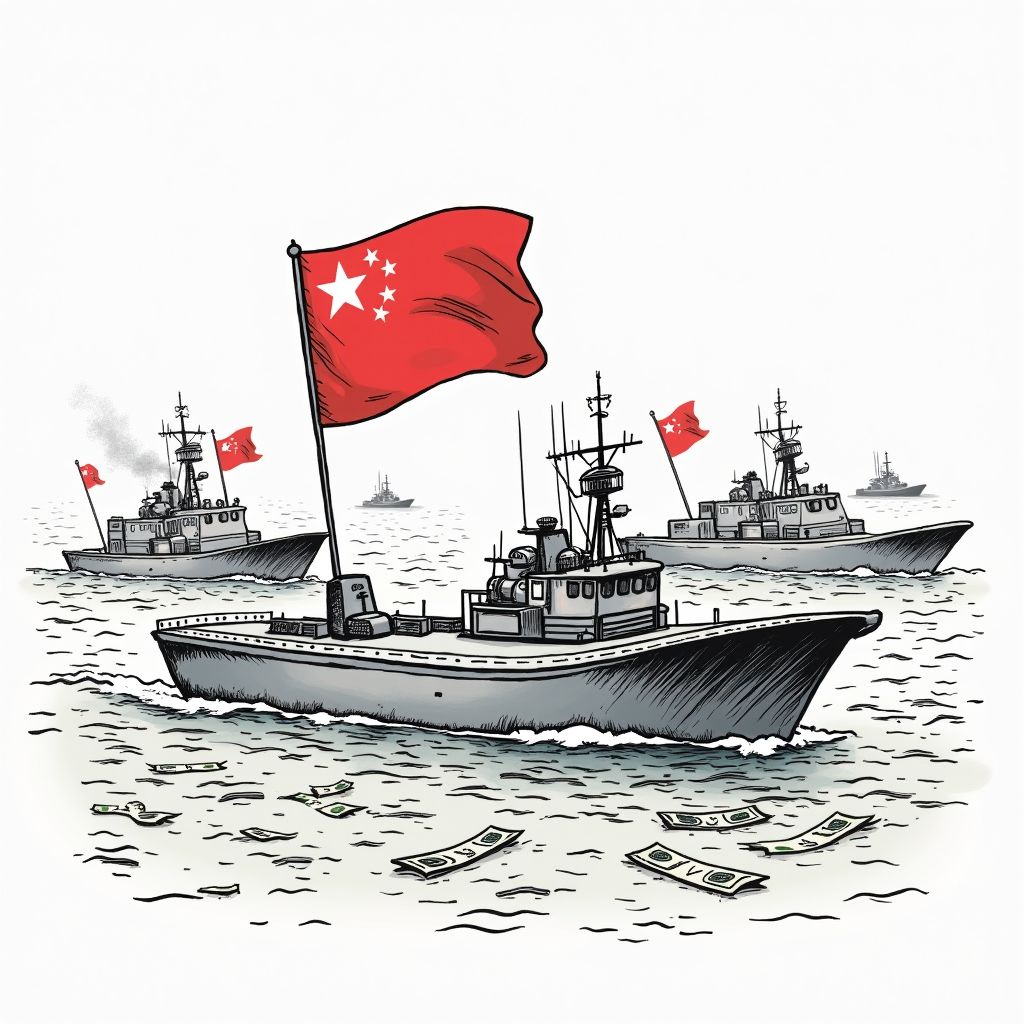
On December 29, 2025, China initiated “Justice Mission 2025,” a two-day live-fire exercise explicitly simulating a blockade of Taiwan’s critical ports. This operation, involving naval, air, and rocket forces, serves as a direct response to recent US arms sales, marking a sharp escalation in regional geopolitical tensions.
Operational Scope and Tactical Objectives
The People’s Liberation Army (PLA) Eastern Theater Command has designated these maneuvers “Justice Mission 2025,” deploying a comprehensive array of military assets including destroyers, frigates, fighters, bombers, and long-range missiles [1][2]. According to Senior Colonel Shi Yi, the operations focus on the “joint seizure of comprehensive superiority” and patrolling sea-air combat readiness in waters to the north, southwest, southeast, and east of Taiwan [4][8]. The drills, which began on Monday, are scheduled to continue through Tuesday, December 30, with live-fire activities planned for a ten-hour window between 08:00 and 18:00 in five specific zones surrounding the island [2][3]. A distinct feature of this operation is the explicit simulation of a blockade on key ports, a strategy designed to test the PLA’s ability to sever the island’s external access [1][3]. The exercises involve aircraft approaching Taiwan from multiple directions to execute rapid maneuvers and test “all-dimensional deterrence” against intervention from outside the island chain [1][3][4].
Strategic Signaling and External Interference
Beijing has framed these actions as a “stern warning” to “separatist forces” and external actors, specifically following the United States’ recent approval of a substantial arms sales package to Taipei [1][2]. While reports vary on the exact valuation—placing the deal between $10 billion and $11 billion—the sale has drawn sharp rebuke from Chinese officials, who claim such support pushes the Taiwan Strait toward a “perilous situation” [1][3]. The timing is significant; just last week on December 21, Beijing imposed sanctions on 20 U.S. defense-related companies and 10 executives in retaliation [2]. The narrative accompanying the hardware is equally aggressive; the PLA released themed posters declaring the operation a “Shield of Justice,” warning that any foreign interlopers or separatists attempting to breach this shield would be “eliminated” [2]. This follows preliminary movements detected on Sunday, December 28, when unmanned aerial vehicles and long-range rockets were deployed to the north and southwest of the Taiwan Strait to test target acquisition capabilities [2].
Taipei’s Defensive Posture and Future Outlook
In Taipei, the government immediately condemned the exercises, with the Defense Ministry describing China as “the biggest destroyer of peace” in the region [2][3]. On Monday, Taiwanese forces were placed on alert, establishing a response center and conducting their own “rapid response exercises” to counter the perceived threat [3]. Presidential Office spokesperson Karen Kuo criticized Beijing for disregarding international norms and utilizing military intimidation against neighboring countries [2][3]. These developments occur against a backdrop of intensifying deadlines and strategic goals; U.S. intelligence has previously assessed that Beijing aims to possess the capability to invade Taiwan by 2027 [1]. Coinciding with this timeline, Taiwan’s President Lai Ching-te has vowed to achieve a “high level of combat preparedness” by the same year [1]. As the drills continue, the focus remains on the PLA’s demonstration of anti-access/area denial capabilities, signaling a growing readiness to challenge the status quo in the Taiwan Strait [1].
Sources
- www.theguardian.com
- abcnews.go.com
- www.cbsnews.com
- eng.mod.gov.cn
- www.ft.com
- www.news.cn
- www.xinhuanet.com
- www.news.cn