NFL Replaces Sunday Night Football Game to Protect Primetime Ratings
New York, Tuesday, 17 November 2026.
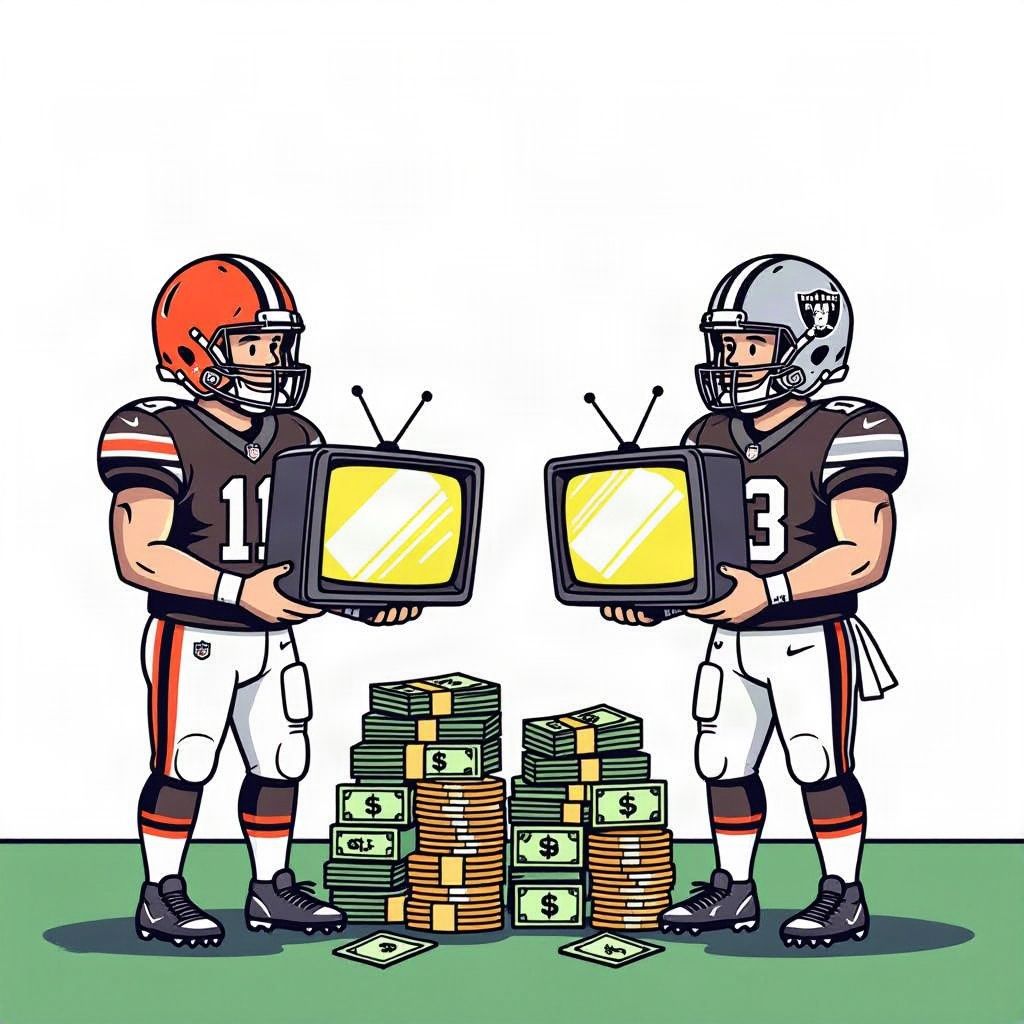
The NFL flexed the Browns-Raiders matchup into prime time, leveraging Cleveland’s historic 4-0 home start to maximize television viewership and advertising revenue over an injured Patriots squad.
Prime-Time Shuffle: NFL Prioritizes Ratings Over Tradition
The National Football League moved decisively on Tuesday, 17 November 2026, to swap the Week 12 ‘Sunday Night Football’ slot on NBC, replacing the New England Patriots–Los Angeles Chargers tilt with the Las Vegas Raiders visiting the Cleveland Browns [1][2]. The shift underscores the league’s longstanding practice of ‘flex scheduling,’ a mechanism designed to elevate competitive matchups and safeguard prime-time viewership—an engine that drives both broadcast ratings and six- and seven-figure ad rates [6]. The decision deadline for Week 12 flex moves was Tuesday at 4 p.m. ET, giving the NFL a narrow 24-hour window to finalize the change and notify teams and broadcasters [5][8].
Cleveland’s Hot Start Creates Prime-Time Appeal
Cleveland’s 6-4 record and franchise-best 4-0 home start through mid-November made the Browns a natural draw for a national audience [1]. The league’s internal analytics—fed by real-time attendance, social-media buzz, and betting-line movement—clearly favored the Raiders-Browns pairing over the Patriots-Chargers pairing, whose combined 10-10 record and recent losing streaks offered less commercial upside [2][3]. The Browns’ dramatic 24-point comeback against Houston on 9–15 November—ending a 17-0 deficit—further burnished their prime-time credentials, prompting pundits to label the game a ‘must-watch’ for late-season playoff positioning [1][2].
Patriots’ Quarterback Injury Adds Business Logic to the Swap
The Patriots’ slide continued on 10 November in Munich, where a 35-10 loss to the Detroit Lions ended with starting quarterback Drake Maye suffering a lower-leg injury [1]. Missing their top signal-caller, New England entered its Week 12 bye with a 5-5 record and no clear path to regaining momentum, reducing the commercial draw of the originally scheduled primetime matchup [2][3]. From a broadcaster’s standpoint, the Raiders-Browns pairing presented a higher-risk, higher-reward scenario: Cleveland’s recent surge and rookie quarterback Fernando Mendoza’s debut created storyline momentum that advertisers pay a premium to attach their brands to [1][6].
Flex Scheduling Mechanics and Media Revenue Impact
Under the NFL’s flexible scheduling policy introduced in 2006, the league can flex up to two Sunday Night Football games between Weeks 5–10 and as many as needed from Weeks 11–17 [6][8]. The mechanism is explicitly tied to optimizing television ratings; the NFL’s broadcast partners—NBC, ESPN, and Prime Video—negotiate rights deals worth billions annually, and primetime slots command rates roughly 2.5 * regular afternoon time [GPT]. For Week 12, the shift displaced the Patriots-Chargers game to a 4:05 p.m. ET slot, while the Tennessee Titans-Jacksonville Jaguars game moved forward to 1:00 p.m. ET, illustrating the league’s willingness to reshuffle the entire day’s slate to protect marquee programming [1][3].
Week 12 Schedule: What Fans Can Expect
The revised Week 12 slate kicks off with three early games at 1:00 p.m. ET, including the Saints-Bengals, Ravens-Texans, and Giants-Colts matchups [1]. The afternoon slate also features Falcons-Vikings at 1:00 p.m. ET, a game highlighted by rookie quarterback Michael Penix Jr.’s debut—a storyline that drew early social-media chatter and betting interest [2][3]. The Titans-Jaguars tilt moves to a 4:05 p.m. ET window, while the marquee Raiders-Browns game lands at 8:20 p.m. ET on NBC [1][5]. The week concludes with the Panthers-Buccaneers Monday Night Football game, providing a final commercial opportunity for ESPN and advertisers [1].
Sources
- www.cbssports.com
- www.espn.com
- blog.ticketmaster.com
- www.nbcsports.com
- amfoo.de
- www.tiktok.com
- www.facebook.com
- 247sports.com