NASA Awards Ten Billion Dollars to Commercial Partners to Build Permanent Moon Outpost
Washington, Monday, 9 November 2026.
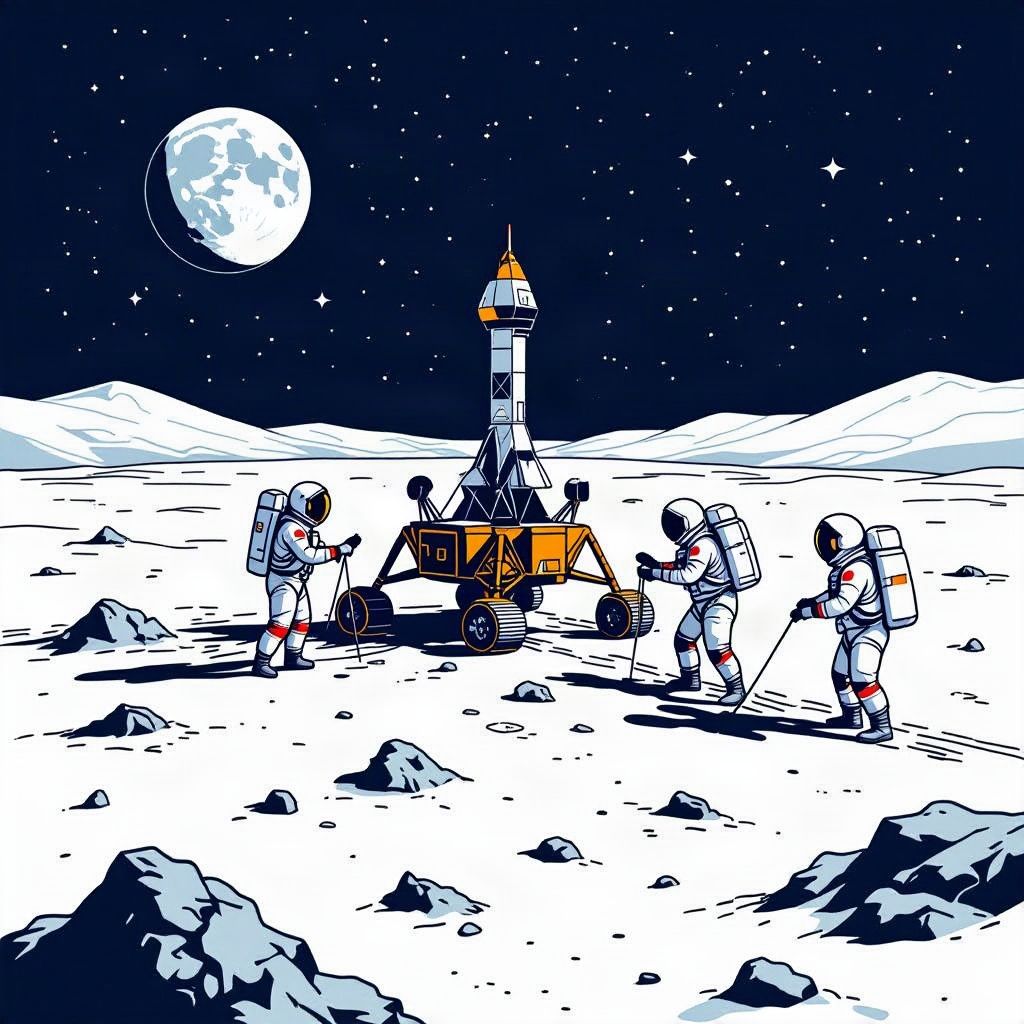
NASA awarded up to $10 billion in commercial contracts to construct a permanent lunar outpost by 2032, highlighted by a nuclear-powered rover mission targeting the Moon’s South Pole in 2028.
NASA’s Ambitious $10 Billion Lunar Initiative
On Saturday, November 7, 2026, at the MAX POWER aerospace expo in Cape Canaveral, Florida, NASA unveiled a groundbreaking $10 billion commercial framework to accelerate the construction of a permanent lunar outpost by 2032 [1][2][3]. This initiative builds upon NASA’s earlier recruitment drive to expand its astronaut corps, as previously reported [4], and represents a pivotal shift from planning to execution in the agency’s lunar ambitions. The contracts, awarded under the revamped Commercial Lunar Payload Services (CLPS) 2 program, mark a tenfold increase from the original $2.6 billion CLPS 1.0 framework, now valued at $4.2 billion [1][2][3]. The expansion reflects NASA’s strategic pivot to a mission-by-mission deployment model, enabling greater flexibility and scalability in lunar infrastructure development.
Corporate Partnerships and Strategic Contracts
NASA selected eight aerospace leaders—Blue Origin, Firefly Aerospace, Intuitive Machines, ispace-U.S., Lockheed Martin Space, Northrop Grumman Space Systems, SpaceX, and Voyager Technologies—to compete for lunar delivery missions under the CLPS 2 framework [1][2][3]. The selection underscores NASA’s commitment to diversifying its commercial partnerships while fostering innovation in lunar logistics. Blue Origin secured a flagship $94 million base contract, with an additional $140 million performance-based option, to deliver the nuclear-powered PROMISE rover to the Moon’s South Pole using its Blue Moon Mark 1 lander by late 2028 [1][2][3]. The rover, developed by NASA’s Jet Propulsion Laboratory using repurposed Mars rover components, will conduct 18-month observations focused on mapping and in-situ resource utilization [1][3]. Concurrently, NASA awarded six transportation task orders totaling approximately $1.3 billion under the Venture-Class Acquisition of Dedicated and Rideshare (VADR) program to Arrow Science and Technology, Blue Origin, and Impulse Space [1][2][3]. These contracts prioritize cargo transport and orbital demonstrations, including SpaceX’s planned 2028 deployment of communications satellites via Starship to establish a cislunar network [1][2][3].
Economic and Technological Implications
The $10 billion infusion into the lunar economy is expected to catalyze significant growth across multiple sectors, from aerospace manufacturing to telecommunications and robotics [5]. The CLPS 2 framework’s indefinite-delivery/indefinite-quantity structure, with a maximum value of $10 billion over a decade, provides long-term stability for contractors while incentivizing technological advancements [1][2][3]. For instance, the PROMISE rover’s nuclear propulsion system, estimated to cost $234 million when including performance options, exemplifies the high-stakes investments NASA is making in next-generation lunar mobility [1][3]. Meanwhile, the VADR program’s $1.3 billion allocation for orbital transport services could reduce costs by ƒ{(1.3e9 / 4.2e9) * 100 }% compared to traditional mission architectures, according to industry analysts [GPT]. These contracts also align with NASA’s broader Moon Base program, which is structured in three phases: robotic exploration and infrastructure demonstrations through 2029, followed by sustained human presence and commercial integration from 2029 to 2032 [2].
Infrastructure and Future Milestones
Beyond transportation, NASA is investing in critical lunar infrastructure, including the Mini-Communications and Solar Tower (miniCAST), a power and communications hub to be developed by Honeybee Robotics, Redwire, and Yank Technologies [1][2]. Components for miniCAST are slated for assembly at NASA’s Marshall Space Flight Center in Alabama, with a solicitation for fully integrated systems expected in early 2027 [2]. These efforts complement the agency’s phased approach, which includes targeted task orders under the NextSTEP-3 B program to address data gaps in Moon Base architecture [2]. NASA Administrator Jared Isaacman emphasized the iterative nature of this campaign, stating, ‘We are building the Moon Base mission by mission’ [2][3]. With Phase One focusing on robotic precursors and commercial deliveries, Phase Two (2029–2032) will prioritize crewed landings and habitat deployment, culminating in a permanent outpost by the decade’s end [2]. The timeline reflects NASA’s accelerated schedule, which has compressed what was once a multi-decade endeavor into a seven-year sprint [alert! ‘The urgency underscores lessons learned from Artemis program delays and geopolitical competition in space’].
Sources
- www.space.com
- www.nasa.gov
- www.foxbusiness.com
- wsnext.com
- seekingalpha.com
- spacenews.com
- x.com
- www.reddit.com
- www.facebook.com