Leaked Specifications Suggest AMD's Upcoming Processor Beats Nvidia's Top Model
Santa Clara, Sunday, 20 September 2026.
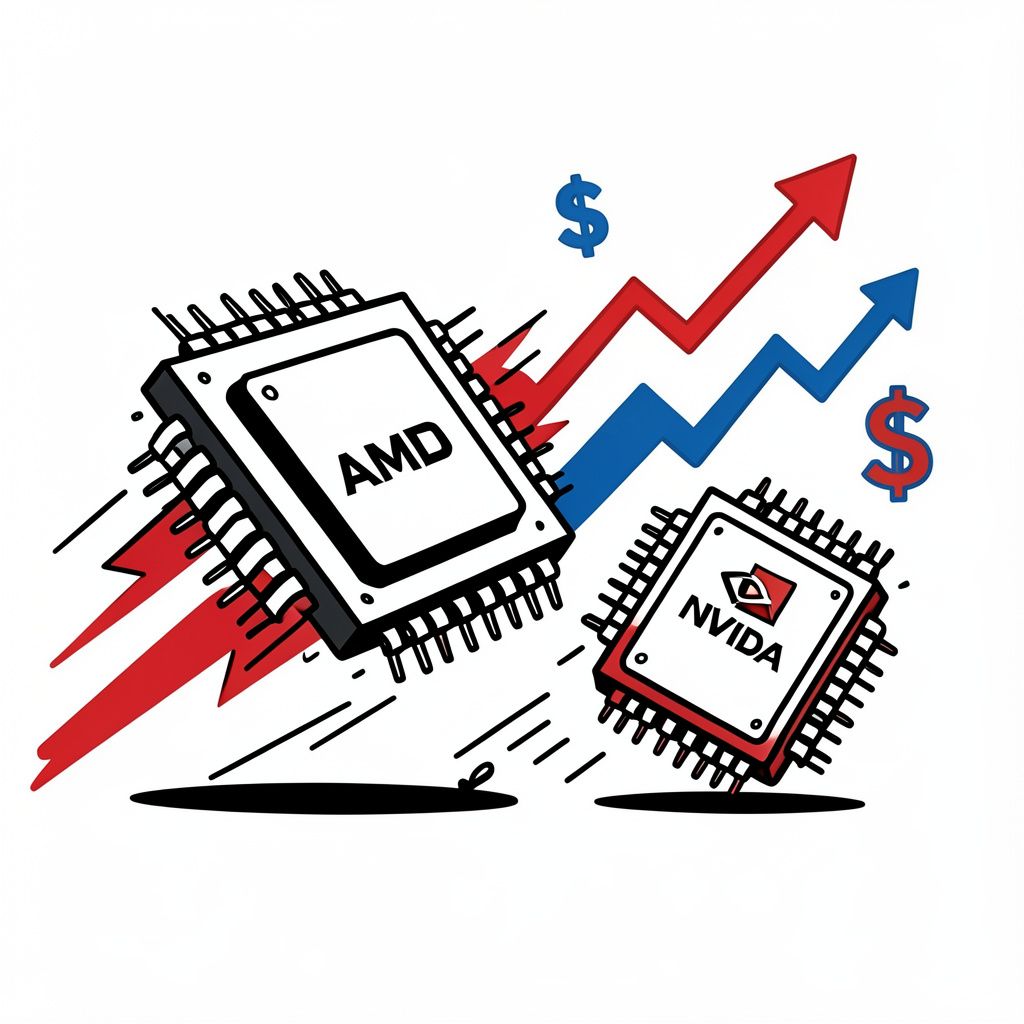
Leaked data indicates AMD’s upcoming flagship graphics chip outperforms Nvidia’s top model by up to 25% in high-end tasks, driven by AI processing units operating 18 times faster.
Architectural Shifts and Neural Processing
The core of the reported performance gain lies in the RDNA 5 architecture’s redesigned computing structure. Leaks indicate the flagship Radeon RX 10800 XT will feature 12,800 shader cores, a significant increase achieved by doubling the packaging density to 128 cores per compute unit [1]. Central to this upgrade is the introduction of unified Neural Array nodes, which replace smaller matrix accelerators found in previous generations [1]. Each Neural Array node reportedly contains 1,024 FMA lines for low-precision calculations, contributing to a claimed 18-fold increase in performance over prior modules [1]. This hardware fusion supports proprietary FSR 5 Neural Rendering technology, aiming to match the latency benefits of NVIDIA’s isolated Tensor Cores [2].
Memory Capacity and Local AI Workloads
Beyond raw processing speed, memory capacity distinguishes the upcoming AMD flagship from current market leaders. The Radeon RX 10800 XT is projected to include 48 GB of GDDR7 memory, exceeding the 32 GB found in the NVIDIA GeForce RTX 5090 [2]. This 50% increase in video RAM allows for the loading of 8K textures and complex geometric scenes without compression artifacts [2]. Crucially for enterprise and developer sectors, this capacity enables the local execution of large language models like Llama 3 70B on a single GPU, a task often constrained by memory limits on competing hardware [2]. Insider data suggests these specifications are intended to secure a strong position in the premium PC segment before competitors release their next wave of solutions [3].
Market Timeline and Competitive Landscape
The release timeline for these technologies indicates a heated competitive period through 2027. While NVIDIA released DLSS 5 on September 1, 2026, limiting support to GeForce RTX 50 Series GPUs, AMD’s response is expected to arrive with the RDNA 5 generation [5]. Technical databases list AMD’s AT0 GPU with RDNA 5 architecture for a 2027 release, featuring a PCIe 6.0 interface [4]. However, some roadmaps suggest a potential shift to 2028 for the next generation of Radeon GPUs, creating uncertainty around the exact launch window [5]. Investors and consumers are advised to monitor official announcements, as purchasing current-generation adapters at speculative prices may prove irrational given the impending performance leap [3].