Trump Dismisses Intelligence Linking Foreign Hackers to Cyberattack on Water Infrastructure
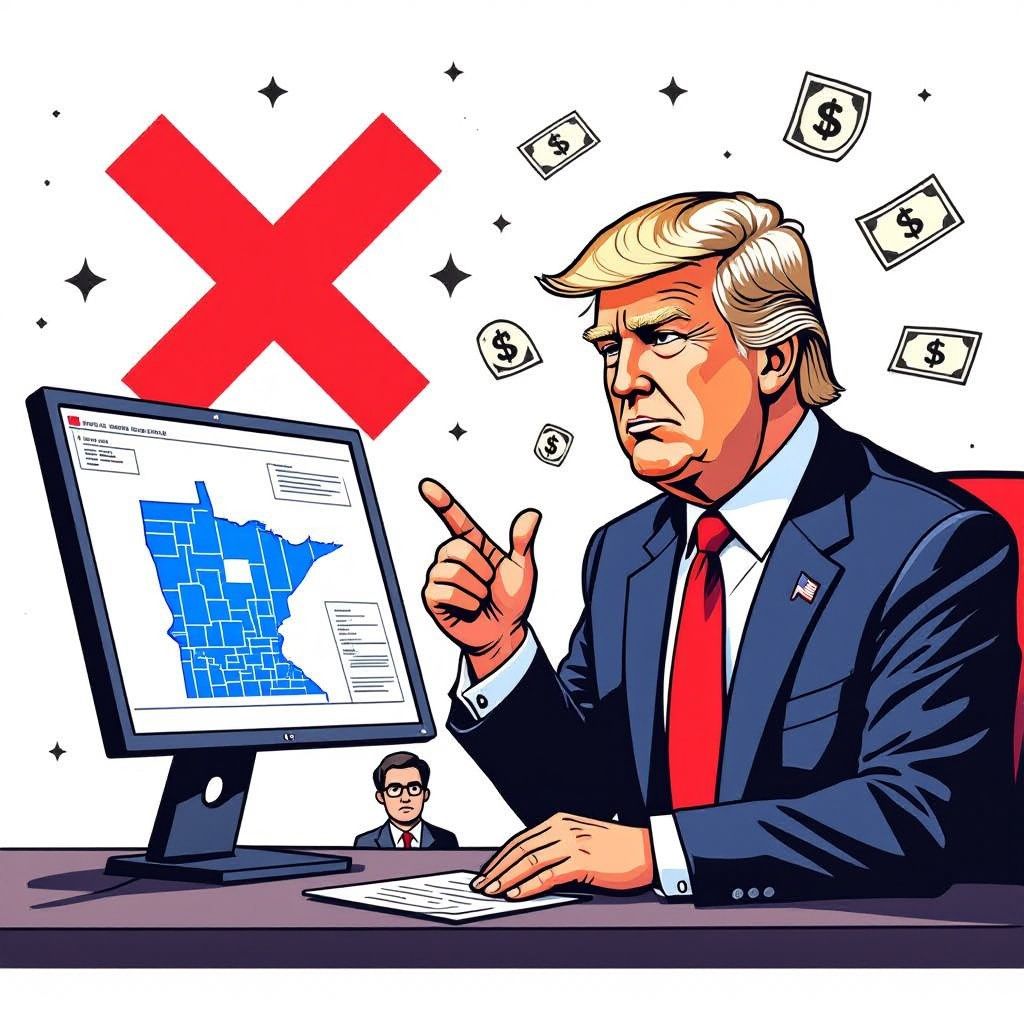
Minneapolis, Friday, 31 July 2026.
President Trump rejected intelligence linking an attack on 30 Minnesota water facilities to foreign actors, choosing instead to blame local officials, raising concerns over national cybersecurity coordination.
Presidential Statement and Attribution Dispute
On Friday, 31 July 2026, President Donald Trump publicly dismissed intelligence reports suggesting Iranian involvement in recent cyberattacks targeting Minnesota’s critical municipal water systems [1][3]. Speaking during a Cabinet meeting at Camp David, Maryland, the President placed responsibility on local state officials, specifically arguing that domestic political mismanagement was to blame for the vulnerabilities [2]. Trump stated, “I think I blame it on Minnesota because they’re grossly incompetent,” referring to the cyberattack on more than 30 water plants [1]. This statement directly contradicts ongoing investigations by U.S. officials who are probing whether Iran or hackers associated with the country could be behind the incidents [2]. The President’s comments raise significant questions among political analysts regarding national infrastructure defense protocols and the potential economic exposure for public-private utilities operating key U.S. infrastructure [1][4].
Timeline of the Cyber Incident
The coordinated cyberattack targeted operational technology at more than 30 Minnesota community water systems on Sunday, 26 July 2026, and Monday, 27 July 2026 [1][5]. Attackers focused on programmable logic controllers (PLCs) and human-machine interfaces, which are used to remotely monitor and control equipment [2][5]. While Minnesota IT Services (MNIT) stated as of 30 July 2026, they had not yet determined the “specific actor” responsible, federal agencies had warned of Iranian-affiliated groups targeting U.S. water, power, and government infrastructure just days prior [1][5]. Despite disruptions, including a temporary shutdown of well and water treatment plant controls in Braham and a shift to manual operations in Plymouth and South St. Paul, the Minnesota Department of Health reports no threat to drinking water [1][5].
Political Fallout and Attribution Dispute
Minnesota Governor Tim Walz, a Democrat, responded to Trump on social media, stating that the President is aware of the responsible party and that other states were also affected [1][2]. Walz noted that federal cuts by the Department of Government Efficiency (DOGE) weakened cyber security, claiming, “DOGE took an axe to CISA and left the U.S. exposed to cyber attacks” [2]. The Governor characterized the incident as modern warfare, illustrating there is “no plan to win a war with Iran” [2]. This exchange highlights the friction between the federal executive branch and state leadership regarding cybersecurity investments and the allocation of responsibility for critical infrastructure protection [1][2].
Intelligence Community and Federal Investigation
The Federal Bureau of Investigation (FBI) initiated an investigation into potential links between Iran and the cyberattacks targeting water infrastructure systems in Minnesota on 30 July 2026 [4]. U.S. cybersecurity agencies, including the Cybersecurity and Infrastructure Security Agency (CISA), are investigating the possibility of Iranian involvement [5]. A July 22 advisory from CISA and the FBI warned that Iranian hackers have been targeting water systems and other PLCs, emphasizing that operators should restrict direct internet access [5]. While Minnesota IT Services has not attributed the activity to a specific actor, investigators have identified similarities among the incidents across Minnesota, including the timings of the attacks and the types of technology involved [5].
Broader Geopolitical Tensions
This incident occurs amidst heightened tensions between the U.S. and Iran, following a period of escalating conflict in July 2026 [4]. On 29 July 2026, the U.S. launched strikes against Iran following a surprise missile attack on U.S. forces in the Middle East [4]. Secretary of Defense Pete Hegseth reported that the ongoing US war with Iran has incurred costs totaling $37.5 billion as of 21 July 2026 [4]. President Trump attended a dignified transfer ceremony for four US service members killed in conflict with Iran on 22 July 2026, underscoring the human cost of the geopolitical strain [4]. On 29 July 2026, President Trump publicly vowed to execute a retaliatory strike following a failed Iranian attack on American forces [4].
Operational Impact and Public Safety
MNIT said there are no active requests from Minnesota localities for residents to change their water use and that it is working with federal investigators in the probe [2]. In a statement, MNIT clarified that “impacted” means investigators confirmed malicious activity involving a system’s technology, but it does not mean every affected community experienced a disruption to water service [2]. The Minnesota Department of Health is researching the effect on local water systems, with the agency not aware of “any active requests” from cities to “modify their drinking water usage” [5]. Previous Iranian-linked attacks on U.S. water infrastructure include a 2023 breach of programmable controllers at several facilities by hackers affiliated with the Islamic Revolutionary Guard Corps [1].