RE/MAX Board Faces Legal Scrutiny Over $880 Million Merger Agreement
Denver, Tuesday, 28 April 2026.
Multiple law firms are investigating RE/MAX’s board for potential fiduciary breaches, questioning if its recent $880 million merger unfairly benefits insiders at the expense of public shareholders.
The Mechanics of the $880 Million Transaction
On April 27, 2026, The Real Brokerage Inc. (NASDAQ: REAX) and RE/MAX Holdings, Inc. (NYSE: RMAX) announced a definitive merger agreement yielding an implied enterprise value of approximately $880 million [4]. Under the terms of the deal, RE/MAX stockholders are presented with a choice: receive either $13.80 in cash per share or 5.152 shares of the newly formed entity, designated as the Real REMAX Group [2][3][4]. The transaction is backed by a $550 million financing commitment from Morgan Stanley Senior Funding, Inc. and Apollo Global Funding, LLC, which is intended to refinance existing RE/MAX debt and fund the cash consideration [4].
Structural Limitations and Shareholder Dilution
While the $13.80 cash offer provides a baseline valuation, the payout structure contains significant limitations. The aggregate cash option is strictly capped between $60 million and $80 million [2][3]. Consequently, if a large majority of shareholders elect to receive cash, their requests will be subject to heavy proration [2]. In a scenario where all shareholders opt for the cash buyout, individuals would receive only about one-quarter of their compensation in cash, with the remainder distributed as Real REMAX Group stock [3]. Upon the transaction’s expected closure in the second half of 2026, Real Brokerage shareholders are projected to own approximately 59% of the combined company, leaving RE/MAX shareholders with a 41% stake on a fully diluted basis [2][4].
Mounting Legal Scrutiny and Fiduciary Concerns
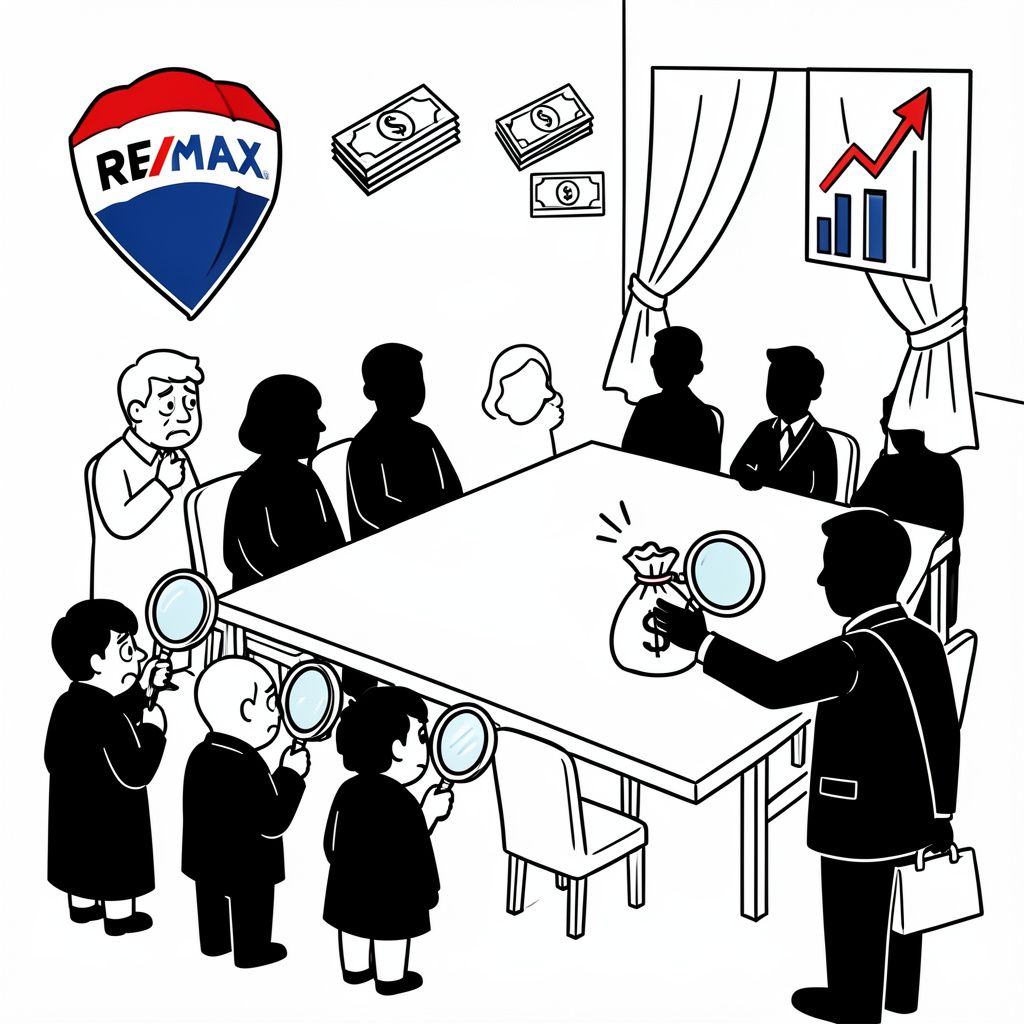
The complex structure of the deal immediately triggered a wave of legal scrutiny. On April 28, 2026, securities litigation firm Bleichmar Fonti & Auld LLP (BFA) announced a formal investigation into the RE/MAX board of directors, specifically naming co-founder and chairman David Liniger [1]. BFA is examining whether the proposed merger price is unfairly low and whether company insiders are securing potentially unfair benefits that are not being shared with public stockholders [1]. This probe compounds actions initiated a day earlier on April 27 by several other law firms, including Ademi LLP, Brodsky & Smith, and Halper Sadeh LLC [2][5][6].
Allegations of Deal Protection and Insider Benefits
The legal investigations collectively focus on potential breaches of fiduciary duty and the fairness of the sale process [2][5][6]. Ademi LLP and Halper Sadeh LLC allege that the merger agreement contains restrictive deal-protection terms that unreasonably limit competing transactions by imposing significant penalties for accepting a superior bid [2][6]. Furthermore, the scrutiny highlights potential conflicts of interest regarding change-of-control arrangements [2]. Liniger, who commands approximately 38% of RE/MAX’s voting power, has already committed to voting in favor of the transaction, raising questions among investigators about whether the board adequately explored alternatives to maximize shareholder value [1][4].
Market Reaction and Strategic Synergies
Financial markets reacted with immediate volatility to the merger announcement. On April 27, 2026, RE/MAX shares surged 21.20% to close at $9.69 [4]. However, this market price remained well below the cash offer, leaving a spread of 4.11 dollars per share, indicating potential market skepticism about the deal’s completion or the effects of the cash proration [3][4]. Conversely, Real Brokerage shares plummeted 27.43% to $1.95, reflecting investor anxiety over integration risks and the debt load required to finance the $880 million enterprise valuation [4]. Both stocks have suffered severe historical contractions; RE/MAX remains down approximately 85% from its all-time high, while Real Brokerage has shed roughly 70% of its value since its peak in August 2024 [3].
Execution Risks in a Changing Real Estate Landscape
Strategically, the merger attempts to bridge a significant operational divide. Real Brokerage CEO Tamir Poleg described the acquisition as a “transformational moment,” aiming to fuse Real’s centralized, artificial intelligence-powered software platform with RE/MAX’s expansive global network of over 145,000 agents and nearly 8,500 franchisees [4]. The combined entity projects a pro forma 2025 revenue of roughly $2.3 billion and an adjusted EBITDA of $157 million before synergies [4]. Management anticipates achieving annual cost synergies of $30 million by 2027 [4]. However, analysts note that merging Real’s centralized technological model with RE/MAX’s decentralized, capital-light franchise structure presents substantial cultural and operational hurdles, which [alert! ‘potential for agent attrition remains uncertain’] could impact the realization of these projected financial benefits [4].
Sources
- www.globenewswire.com
- www.prnewswire.com
- wolfstreet.com
- www.kavout.com
- www.globenewswire.com
- natlawreview.com