Massive Persian Gulf Oil Spills Expose Critical Gaps in Maritime Insurance
Muscat, Friday, 14 August 2026.
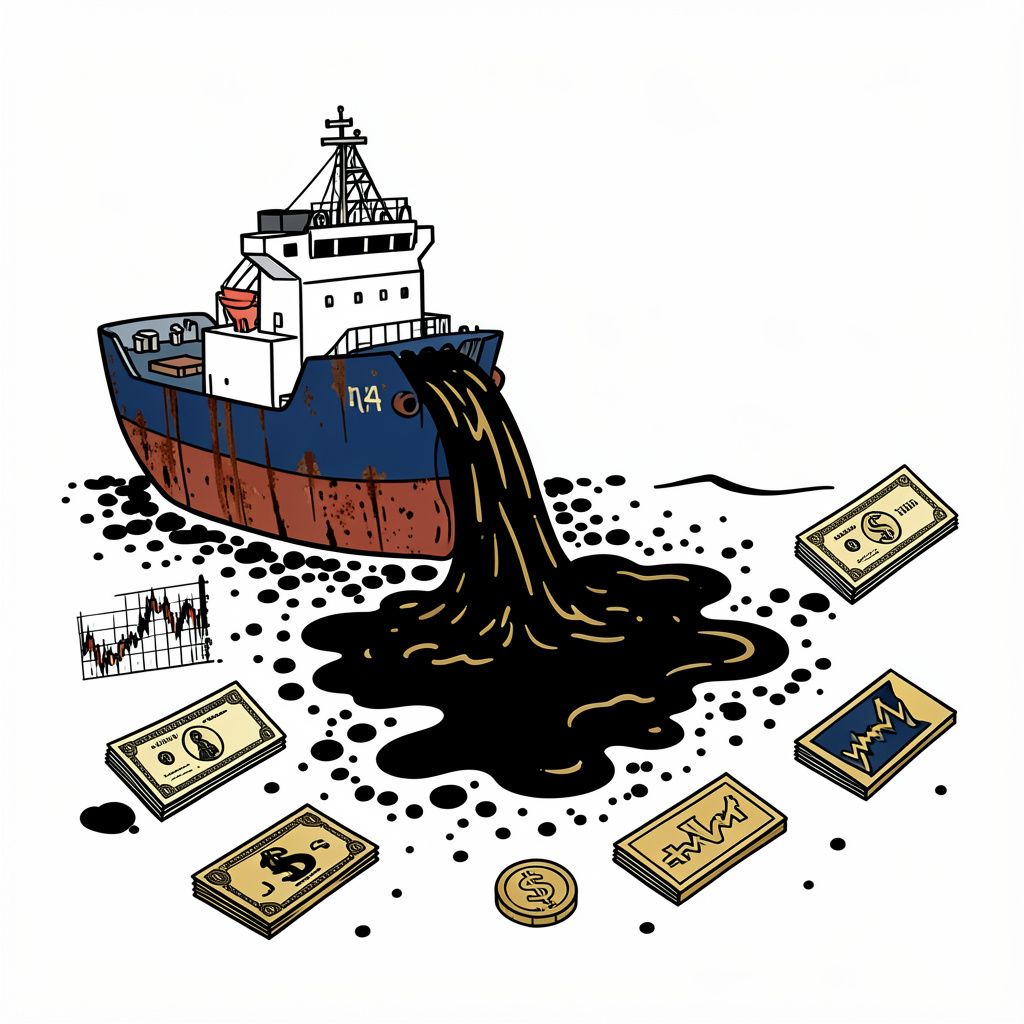
Unregulated shadow fleet tankers and war-risk exclusions have left a 2,000-square-kilometer Persian Gulf oil spill completely uninsurable, creating an unprecedented liability crisis for global shipping.
Escalating Environmental Damage
As of 12 August 2026, oil residues from a struck bulk carrier and a grounded tanker have expanded across the Persian Gulf and Gulf of Oman, hitting Iran’s Qeshm Island and covering over 40 kilometers of Omani coastline [1]. Satellite imagery confirms the slick from the grounded tanker has grown to more than 2,000 square kilometers, fouling significant stretches of the coastline near Ras Madrakah [1][3]. Iranian environmental officials reported on 12 August 2026 that cleanup operations had largely cleared an oil slick affecting Qeshm Island, which had spread from Soza beach to the Shib Deraz area and Hara mangrove forests [1]. The International Maritime Organization confirmed the landfall on the Omani mainland on the same day, validating the severity of the contamination [1].
Growth Trajectory and Monitoring
The spill from the grounded tanker expanded significantly in recent weeks, reaching over 2,000 square kilometers by satellite analysis on Wednesday, 12 August 2026 [1]. This represents a sharp increase from 45 square kilometers recorded on 26 July 2026, indicating a massive acceleration in environmental impact [2]. The growth rate of the spill surface area over this period is calculated as 4344.444 percent [2]. Monitoring results from Oman’s Environment Authority showed that beaches in the Ras Madrakah area were affected by oil pollution, with expectations that a coastal stretch of up to 40 kilometers in the area would be affected [2].
Shadow Fleet and Vessel Origins
A separate, ongoing environmental crisis involves the Caroline Bezengi, a Suezmax tanker carrying approximately 159,000 cubic meters of Russian crude, which has been leaking since running aground on the Hallaniyat Islands off Oman’s Dhofar coast in June 2026 [1]. The vessel departed Novorossiysk, Russia, in April 2026, and its registered owner and operator are China-based, with the vessel sanctioned by the EU and UK [1]. Satellite imagery from TankerTrackers indicates a separate slick near Qeshm Island originated from the Liberia-flagged, Greek-managed bulk carrier Minoan Pioneer, which was struck by a projectile on 3 August 2026 [1]. The Minoan Pioneer incident resulted in one missing crew member and an engine room blackout, complicating immediate response efforts [1].
Insurance Gaps and Liability
International Oil Pollution Compensation Funds rules exclude liability for environmental damage caused by acts of war or hostilities, complicating Iran’s potential claims for compensation regarding the Minoan Pioneer incident [1]. Iran has claimed upwards of a trillion dollars in environmental and economic damages as the slick spreads, questioning who is responsible for compensating for these losses [1]. The spill remains uncontained due to monsoon winds preventing salvage crews from reaching the vessel, and there is currently no insurer or compensation fund covering the cleanup, as the incident is classified as an act of war [4]. This liability crisis underscores the growing operational and financial risks posed by unregulated shadow fleet vessels operating near vital maritime choke points [1].