Shield of the Americas Pact Authorizes Lethal Military Force Against Cartels
Washington D.C., Sunday, 8 March 2026.
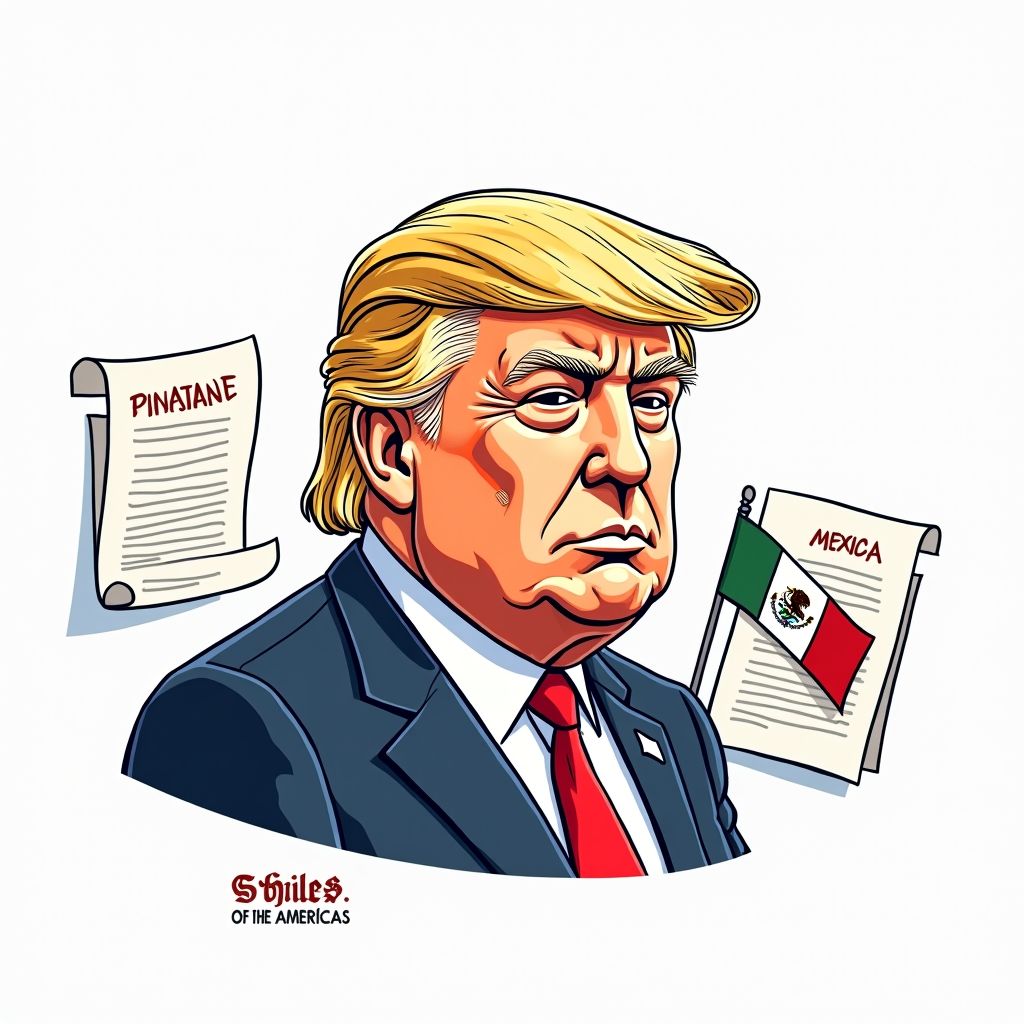
President Trump’s ‘Shield of the Americas’ initiative marks a pivot to militarized regional policy, explicitly authorizing lethal force against cartels and signaling a departure from diplomatic soft power.
Militarizing the Hemisphere
On Saturday, March 7, President Donald Trump formally unveiled the enforcement mechanisms of the “Shield of the Americas,” a pact that pivots away from traditional diplomatic soft power toward a militarized strategy. Speaking at his resort in Doral, Florida, the President confirmed that the agreement, also referred to as “America’s Counter Cartel Coalition,” explicitly authorizes the use of lethal military force to dismantle transnational criminal organizations [1][4]. This announcement aligns with the administration’s newly established “Donroe Doctrine,” a policy framework aimed at restoring American preeminence in the Western Hemisphere by enlisting regional allies to aggressively pursue U.S. security objectives [3][6].
Lethal Force as Policy
The President’s rhetoric at the inaugural summit left little room for ambiguity regarding the rules of engagement. “The only way to defeat these enemies is by unleashing the power of our militaries,” Trump told the assembled leaders, urging them to mobilize their armed forces against drug cartels and gangs rather than relying solely on law enforcement [2]. He emphasized that the heart of the agreement is a commitment to using “lethal military force to destroy the sinister cartels and terrorist networks” [1][4]. This aggressive posture is not merely theoretical; earlier this week, the U.S. military led an operation targeting a “narco-terrorist” supply complex in Ecuador at the request of the Ecuadorian government, signaling that direct intervention is already underway [4].
A Coalition of “Likeminded” Allies
The summit gathered heads of state and representatives from over a dozen Latin American nations, including Argentine President Javier Milei, Salvadoran President Nayib Bukele Ortez, and Chilean President-elect José Antonio Kast [3][6]. The coalition, which reportedly includes at least 17 signatory countries, represents a significant alignment of right-leaning and security-focused administrations in the region [4][6]. The State Department described the gathering as a coalition of the United States’ “strongest likeminded allies” working to stop foreign interference and narco-terrorist gangs [2]. Despite the call for hemispheric unity, President Trump maintained a distinct cultural distance, remarking that he was “too busy” to learn Spanish and telling the audience, “I’m not learning your damn language,” noting that Secretary of State Marco Rubio held the advantage in that department [1].
Administrative Shake-ups and Domestic Hurdles
The rollout of this initiative coincides with significant personnel changes within the Trump administration. Kristi Noem, formerly the Secretary of Homeland Security, has been appointed as the Special Envoy for the Shield of the Americas [5]. This reassignment follows her removal from the DHS role amidst a partial government shutdown that has left the department unfunded for 20 days [5]. Noem, who faced scrutiny over a $220 million ad campaign and other controversies, stated she looks forward to working with Secretary Rubio and Secretary of War Pete Hegseth to “dismantle cartels” in her new capacity [2][5]. To fill the vacancy at DHS, the President has nominated Oklahoma Republican Senator Markwayne Mullin, though his appointment requires Senate confirmation [5].
Global Context and Security Implications
While the administration focuses on regional stability through the “Donroe Doctrine,” global tensions remain high. The President’s schedule on Saturday also included a somber flight to Dover Air Force Base for the dignified transfer of six U.S. troops killed in a drone strike in Kuwait [2][4]. Furthermore, the administration recently reestablished diplomatic relations with Venezuela after the U.S. military ousted former President Nicolás Maduro in January 2026, creating a complex geopolitical landscape for the new coalition to navigate [4]. As the “Shield of the Americas” moves from proposal to policy, the U.S. is effectively deputizing Latin American militaries to act as extensions of its war on drugs, betting that lethal force will succeed where previous diplomatic efforts have struggled.