Wealthy Shoppers Drive US Economic Growth as Mass Market Pulls Back
Washington, Saturday, 24 January 2026.
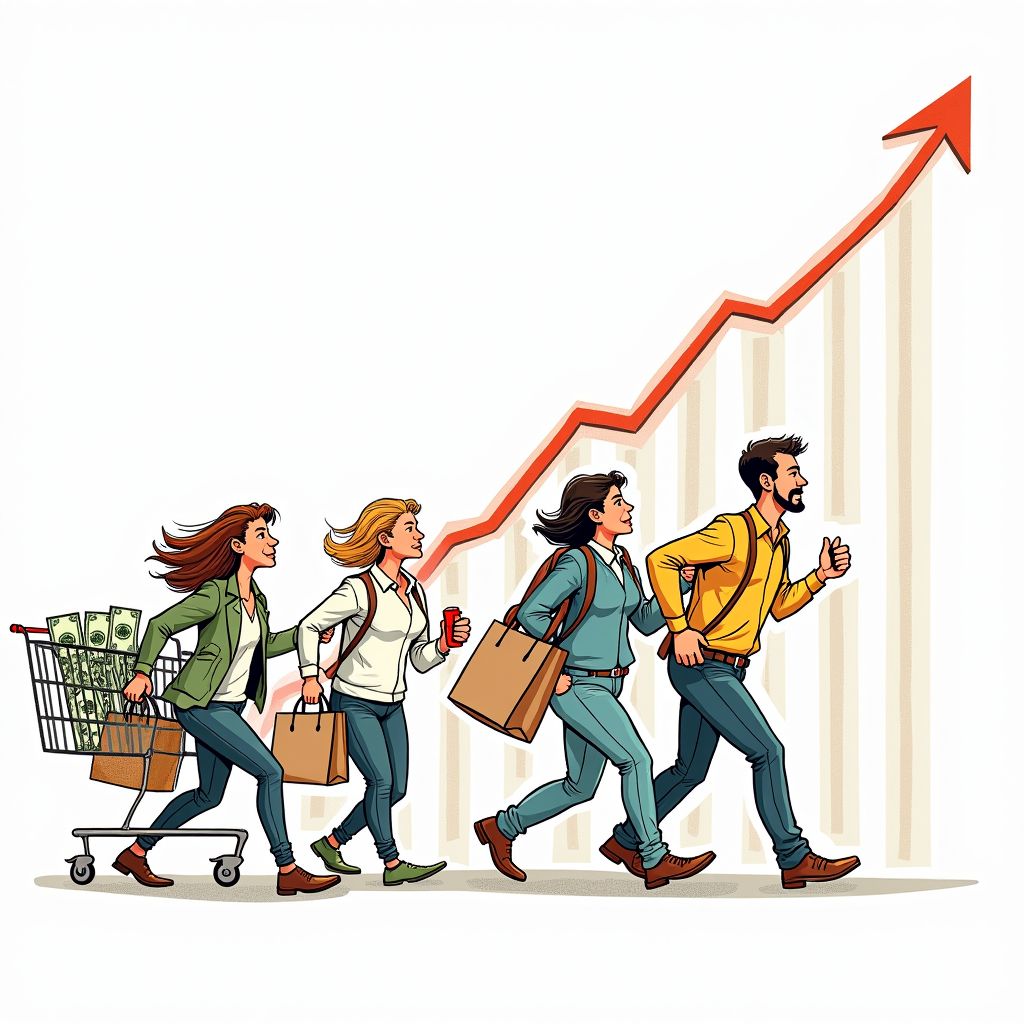
The top 20% of earners now drive 59% of all consumer spending, revealing a fragile ‘K-shaped’ economy where growth depends entirely on affluent households while the mass market tightens.
A Widening Divergence in Consumption
Recent data underscores a deepening divide in the American economy, often described by economists as a “K-shaped” recovery where fortunes diverge sharply based on income. According to a Moody’s Analytics analysis released this week, the top 20% of income earners now account for 59% of all consumer spending in the United States [3]. Conversely, the share of spending contributed by the bottom 80% of earners has plummeted to a record low of 41% [3]. This represents a significant structural shift; for context, the bottom 80%’s share of consumption has fallen by 10.6 percentage points from its peak of 51.5% in 1994 [3]. This concentration of economic power suggests that national growth metrics are increasingly detached from the financial reality of the majority of the population.
Macro Data Masks Micro Struggles
Despite the unequal distribution of wealth, headline economic figures remain robust, largely buoyed by the spending power of the affluent. U.S. consumer spending rose by 0.5% in both October and November 2025, keeping the economy on a trajectory for its third consecutive quarter of strong growth [2]. The Bureau of Economic Analysis (BEA) reported that while spending grew by 0.5% in October, personal incomes rose by only 0.1%, indicating that consumption is outpacing wage growth [4]. This momentum has led the Atlanta Federal Reserve to forecast a 5.4% GDP increase for the fourth quarter of 2025, following a 4.4% annualized growth rate in the third quarter [2]. However, this data arrives alongside a University of Michigan survey conducted between January 20 and January 23, 2026, which reveals that Americans feel worse about the economy now than they did a year ago, highlighting the disconnect between aggregate data and consumer sentiment [1].
Market Bifurcation in Real Time
The corporate sector is already adapting to this bifurcated reality, with major firms reporting divergent trends between their value and luxury offerings. Darden Restaurants, which operates a portfolio of brands catering to different income levels, has observed this split firsthand. CEO Rick Cardenas noted that while the consumer remains resilient, growth is primarily driven by higher-income households [1]. Consequently, Darden has seen a pullback in casual brands among customers earning less than $50,000 annually, while high-end demand remains strong [1]. The disparity is evident in the chain’s product mix, which ranges from a $14 “Never Ending Pasta Bowl” at Olive Garden to a $90 wagyu filet at The Capital Grille [1].
The Risks of Top-Heavy Growth
The reliance on a narrowing base of wealthy consumers places the U.S. economy in a precarious position as it moves through the first quarter of 2026. Mark Zandi, chief economist at Moody’s, warns that the economy is “narrowly perched on the backs of the well-to-do” [3]. The implication is that the current economic expansion is highly sensitive to the fortunes of the rich; if the stock market were to stumble, the resulting wealth effect could trigger a recession that would disproportionately impact lower-earning workers [3]. While President Trump backed off threats to impose new tariffs on European goods on January 20, 2026, alleviating some immediate market pressure, the structural fragility remains [1]. As Tim Quinlan of Wells Fargo notes, affluent spending effectively “papers over” the financial difficulties faced by the majority of the population, creating a vulnerability where the health of the entire economy hinges on the continued confidence of its wealthiest participants [1].