EU and India Finalize 'Mother of All Deals' to Reshape Global Supply Chains
Brussels, Sunday, 8 February 2026.
Integrating markets comprising nearly 25% of global GDP, this historic agreement strategically realigns supply chains away from China, creating a massive new economic counterweight across Eurasia.
A Historic Realignment of Eurasian Trade
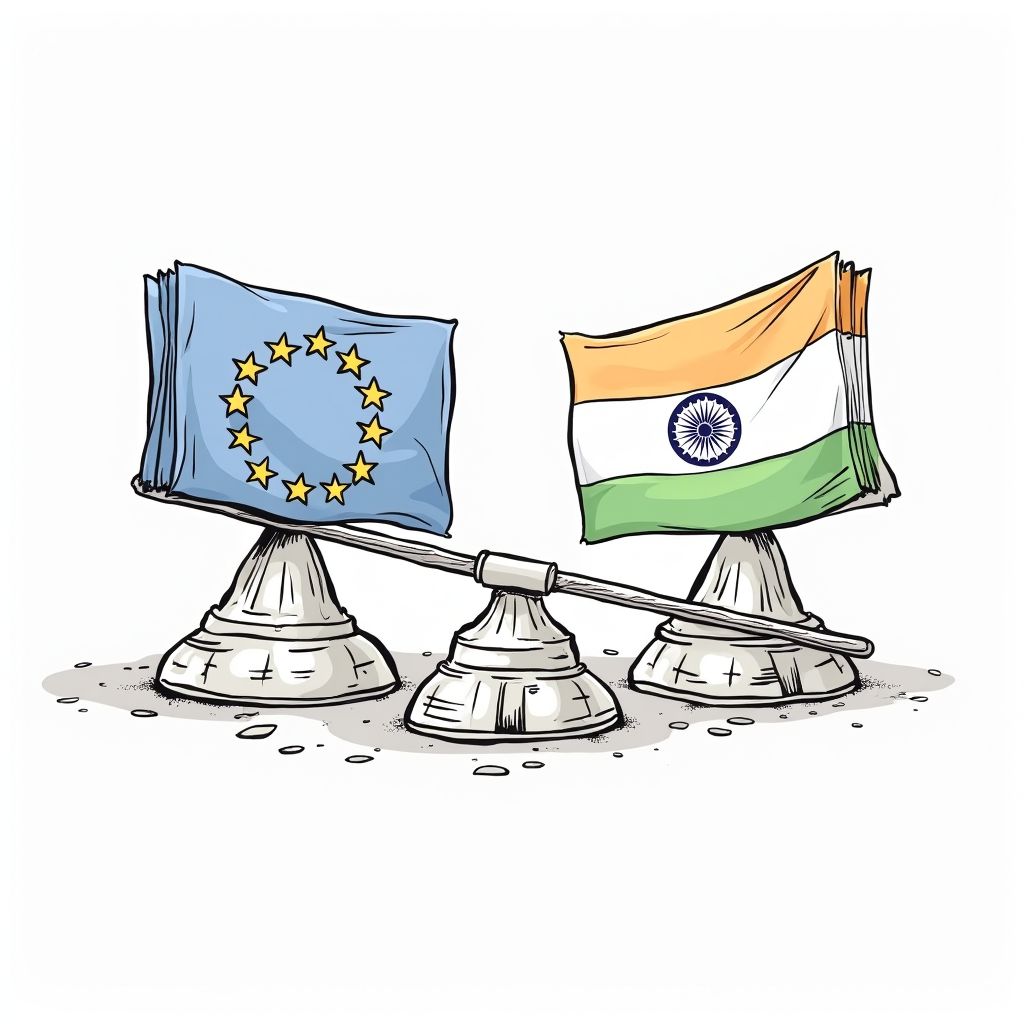
On January 27, 2026, officials from Brussels and New Delhi formally signed a trade pact that European Commission President Ursula von der Leyen has characterized as the “mother of all deals” [6][1]. This agreement, which integrates two economies representing approximately 25% of global GDP and nearly one-quarter of the world’s population, marks a definitive shift in the global economic architecture [1][4]. The deal arrives at a critical juncture for India, which has recently surpassed Japan to become the world’s fourth-largest economy [1]. For the European Union, the agreement is less about mere market expansion and more about a strategic diversification strategy designed to reduce reliance on China, with whom the bloc recorded a staggering trade deficit of €304 billion in 2024 [1][4].
Diverging Paths: Brussels vs. Washington
The timing of this accord highlights a sharp divergence in how Western powers are engaging with New Delhi. While the EU has committed to a full Free Trade Agreement (FTA) with binding dispute settlement mechanisms and deep services commitments, the United States has pursued a more transactional path [7]. The US-India interim framework is anchored by a reciprocal tariff rate of 18% and explicitly ties trade to national security tools and the containment of “non-market policies” [7]. This contrasts with the EU’s approach, which prioritizes regulatory alignment and sustainability [7]. The urgency for India to secure the European market was likely accelerated by friction with Washington; under the Donald Trump administration, India has faced tariffs as high as 50% on exports to the US, penalized for perceived protectionism and its energy trade with Russia [5].
Navigating the Green Transition
A defining feature of this modern trade alliance is its focus on sustainability, though this remains a point of friction. The agreement includes a dedicated chapter on trade and sustainable development, yet it does not offer India specific exemptions from the EU’s Carbon Border Adjustment Mechanism (CBAM) [6]. This regulatory instrument allows the EU to impose tariffs on carbon-intensive imports, a mechanism that trade experts warn could act as a significant non-tariff barrier for Indian exporters [5][6]. To mitigate these transition costs, the EU has committed €500 million over the next two years to assist India in decarbonizing its industries and meeting these rigorous new standards [6].
Sources
- theconversation.com
- policy.trade.ec.europa.eu
- conference.sciencespo.fr
- eu-india.org
- frontline.thehindu.com
- india.mongabay.com
- www.moneycontrol.com