How the Las Vegas Grand Prix Became a Multi-Billion-Dollar Economic Juggernaut
Las Vegas, Sunday, 22 November 2026.
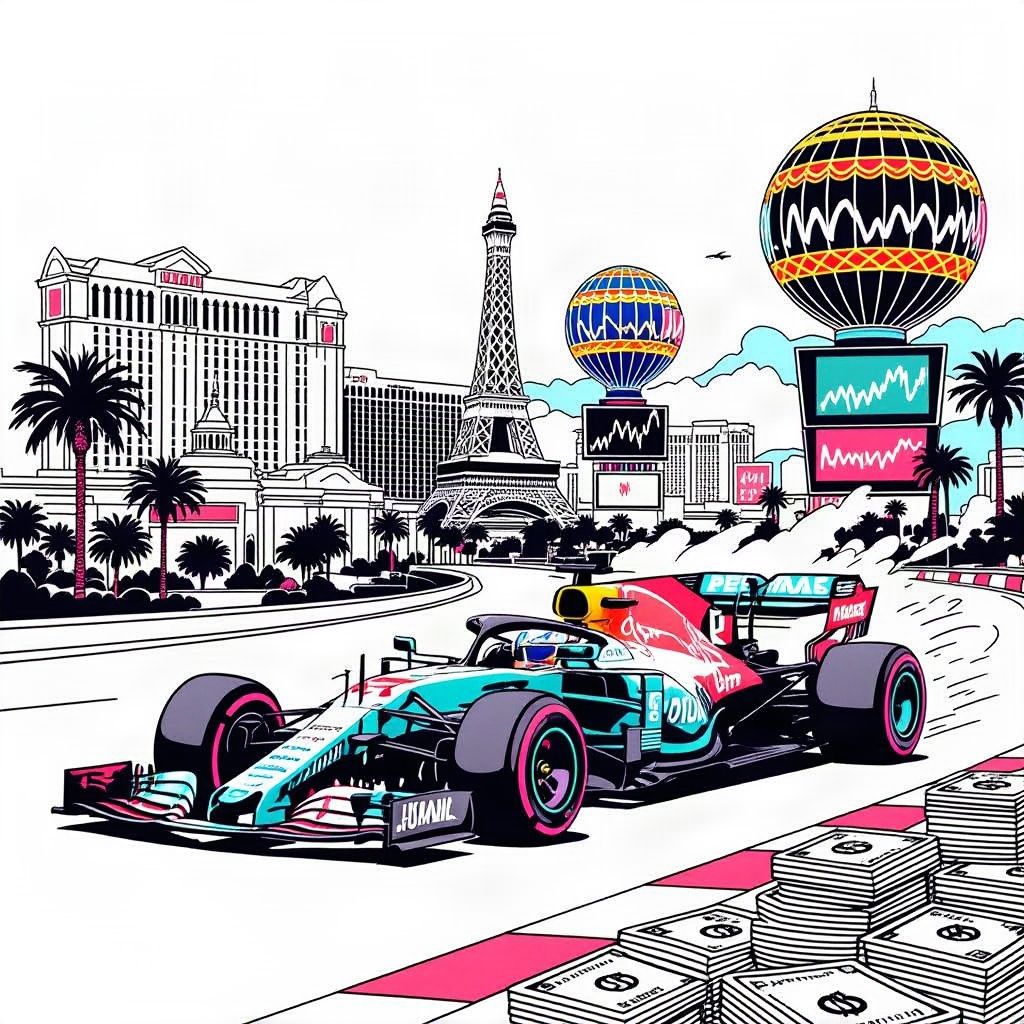
Despite weather challenges, Formula One’s Las Vegas Grand Prix has generated $3.2 billion for Southern Nevada, cementing its reputation as an indispensable, Super Bowl-scale asset contracted through 2037.
From Turbulent Start to Financial Juggernaut
Liberty Media Corporation (NASDAQ: FWONA) has transformed the Las Vegas Grand Prix—now in its fourth year—into a cornerstone of Formula One’s commercial strategy, anchoring a $3.2 billion economic impact in Southern Nevada over three editions, with projections to continue growing through 2037 [1][3]. The event’s trajectory reflects a dramatic turnaround from its inaugural 2023 iteration, which faced logistical chaos including a loose water valve cover on race day, local opposition, and legal challenges [2]. Yet by November 2026, the Grand Prix has matured into a Super Bowl-scale spectacle, drawing global luxury brands and corporate sponsors seeking unparalleled hospitality and brand visibility on the Las Vegas Strip [GPT]. The transformation underscores Formula One’s ability to convert adversity into a premium asset, leveraging the city’s unmatched entertainment infrastructure to host an event that now rivals traditional marquee sports in economic output.
Economic Engine: Numbers That Define the Grand Prix’s Scale
The Las Vegas Grand Prix’s financial footprint is staggering. Over its first three years, the event generated 3.200 billion in economic impact for Southern Nevada, contributing $45 million in tax revenue in its debut year alone and $43 million each in the subsequent two years [2][3]. This revenue stream has cemented the race’s role as a critical driver of the local economy, particularly for hospitality operators. According to the Las Vegas Convention and Visitors Authority, the average visitor during race week in 2024 spent $2,400 excluding race tickets, with spending concentrated on premium hospitality, dining, and entertainment packages [2]. The event’s extension to 2037 ensures long-term planning stability for stakeholders, from hoteliers to corporate sponsors, while also positioning Las Vegas as Formula One’s premier North American destination [1][3]. The economic ripple effect extends beyond race weekend, with pre-event activations and post-event tourism sustaining year-round engagement.
Luxury Brand Investment and Corporate Sponsorship Surge
The Grand Prix’s commercial appeal lies in its ability to offer ultra-premium hospitality packages, attracting high-profile sponsors and luxury brands eager to align with the event’s elite audience. Mercedes-AMG PETRONAS F1 Team, for instance, has leveraged the race as a platform for technical showcases, with driver George Russell highlighting its significance in the Formula One calendar [1]. Russell described the Las Vegas Grand Prix as the ‘biggest one, bar Monaco, from an entertainment perspective,’ underscoring its appeal to both casual fans and corporate partners [2][3]. The event’s ability to command premium pricing for hospitality suites and trackside experiences has driven a surge in corporate demand, with brands across automotive, technology, and lifestyle sectors investing heavily. This demand is further amplified by the race’s integration into the F1 calendar, which includes high-profile announcements such as the return to 2.1-litre V8 engines in 2030, agreed upon during race week in November 2026 [2]. Such partnerships not only enhance the event’s prestige but also create synergies that extend the race’s commercial reach.
Weather Disruptions and Operational Resilience
Despite unpredictable weather challenges, including rain and cold temperatures during the opening day of the 2026 Grand Prix, the event has demonstrated operational resilience [1]. The first two practice sessions were severely disrupted, with limited running due to wet conditions and a damp circuit, forcing teams to adapt quickly [1]. Mercedes driver Kimi Antonelli noted the ‘strange day’ caused by weather, while George Russell topped FP2 with a 1:47.272 lap time during the most favorable dry period [1]. Such disruptions, while challenging, have become a recurring theme for the Las Vegas Grand Prix, testing the adaptability of teams and organizers. However, the event’s ability to proceed under variable conditions—with FP3 and qualifying scheduled under improved forecasts—highlights the robustness of its operational framework [1][2]. This adaptability has been crucial in maintaining the Grand Prix’s reputation as a must-attend event, even in the face of environmental unpredictability.
Community Collaboration and Long-Term Vision
The Las Vegas Grand Prix’s success is not solely a result of its commercial appeal but also its commitment to community collaboration. Organizers worked closely with the Clark County administration and the Las Vegas Convention and Visitors Authority to mitigate disruptions and build local support during the event’s turbulent early days [2]. This collaborative approach has been instrumental in transforming initial skepticism into widespread acceptance. Emily Prazer, Chief Commercial Officer for F1 and President of the Las Vegas GP, acknowledged the organization’s early missteps, stating, ‘We had to admit where we perhaps were a little bit bull in a china shop about it’ [2]. The lessons learned from the inaugural 2023 race have informed subsequent editions, with a focus on community engagement and stakeholder communication. This long-term vision is reflected in the event’s contract extension through 2037, ensuring that the Grand Prix remains a cornerstone of both Formula One and Las Vegas’ economic landscape for years to come [1][3].
Sources
- www.mercedesamgf1.com
- www.theguardian.com
- f1chronicle.com
- www.instagram.com
- www.facebook.com
- www.facebook.com
- www.facebook.com
- www.instagram.com