Russia’s Economy Defies Sanctions: How War is Fueling Unexpected Growth
Moscow, Tuesday, 23 June 2026.
Despite Western sanctions, Russia’s war-driven economy has grown 12% in GDP per capita since 2022, defying predictions of collapse. Military production and state control are keeping the economy afloat—but labor shortages and shadow trade networks may undermine long-term stability. This resilience challenges the effectiveness of sanctions and reshapes global economic strategies.
The Military-Industrial Complex: Russia’s Economic Engine
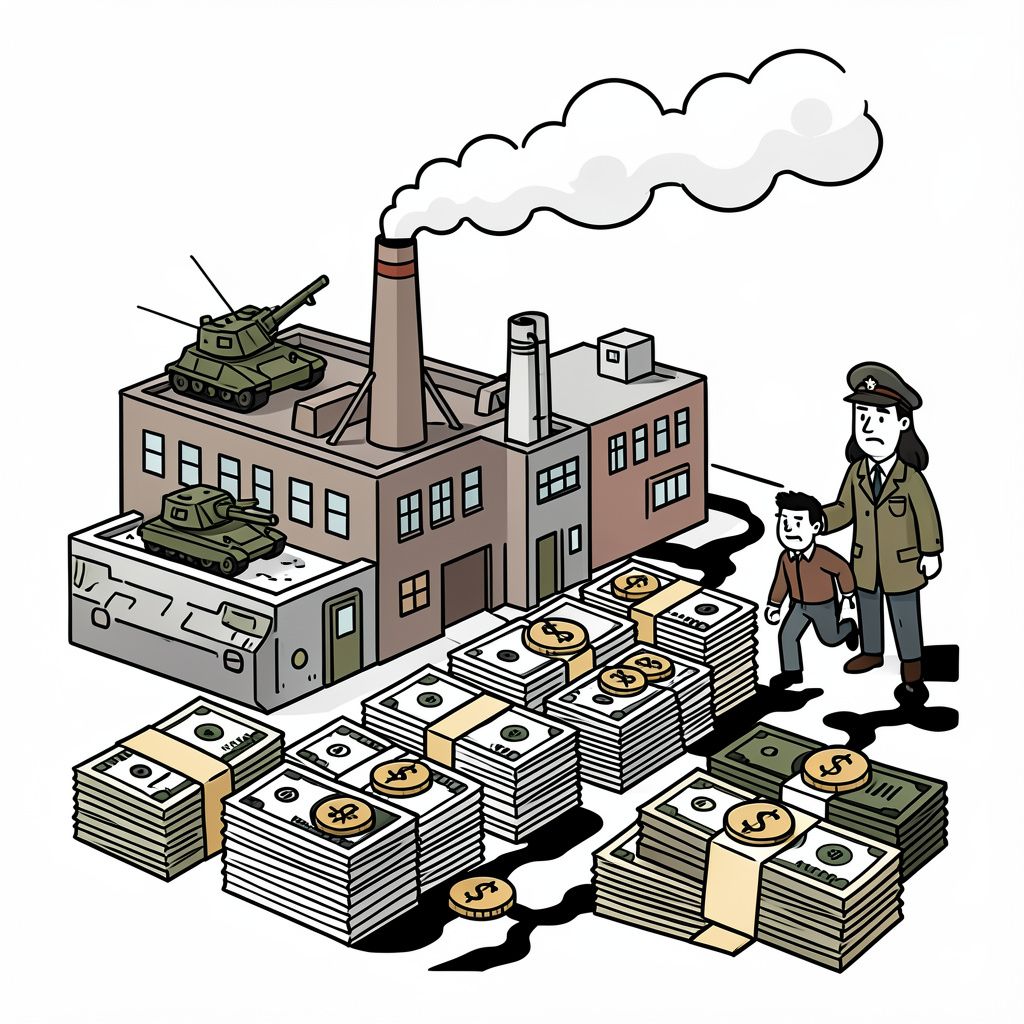
Russia’s economic resilience since 2022 stems primarily from its pivot to a war economy, where military production has become the dominant growth sector. Official figures show that defense spending reached 6.7% of GDP in 2025, up from 3.9% in 2021 71.795, representing a 71.8% increase in share of economic output [1]. This military Keynesianism has created what economists term a ‘sanctions-proof’ industrial base, with arms production facilities operating at 98% capacity as of Q1 2026 [1]. The state-owned Rostec corporation alone has added 120,000 jobs since 2022, while private defense contractors like Almaz-Antey have expanded their workforce by 45% during the same period [7]. This employment boom in the military sector has offset losses in other industries, particularly technology and consumer goods, where sanctions have had more pronounced effects [1].
The Shadow Trade Networks Keeping Russia Afloat
While Western sanctions have officially severed many economic ties, Russia has developed an extensive shadow trade network that continues to supply critical components. Analysis of customs data reveals that imports from ‘neutral’ countries like Turkey, Kazakhstan, and the UAE increased by 42% between 2022 and 2025 [1]. These nations serve as intermediaries, re-exporting Western goods to Russia through complex supply chains that obscure the final destination. The most critical imports include semiconductors (up 187% since 2021), machine tools (up 123%), and industrial chemicals (up 89%) [7]. The effectiveness of this shadow trade is evident in Russia’s continued production of advanced weaponry, including the reported assembly of 120 new tanks per month in 2026, matching pre-war production levels [1]. However, this reliance on indirect trade routes has increased costs by an estimated 30-40%, creating persistent inflationary pressures [1].
Labor Shortages: The Achilles’ Heel of Russia’s War Economy
Russia’s economic resilience faces a growing demographic crisis that threatens long-term sustainability. The country has lost an estimated 1.3 million working-age men since the war began in 2022, either through military casualties or emigration [7]. Official unemployment figures stand at just 2.8% as of May 2026, but this masks severe labor shortages in key industries [1]. The construction sector alone reports 400,000 unfilled positions, while manufacturing faces a shortfall of 250,000 skilled workers [7]. The government has responded with controversial measures including: raising the military conscription age to 35, offering citizenship to foreign workers who enlist, and implementing mandatory overtime in critical industries [1]. These stopgap solutions have temporarily maintained production levels but are creating social tensions. Worker protests in industrial cities like Tolyatti and Nizhny Tagil increased by 156% in 2025 compared to pre-war levels [7].
The State’s Growing Economic Dominance
Since 2022, Russia has witnessed an unprecedented expansion of state control over the economy, fundamentally altering its economic structure. The government has nationalized assets worth an estimated 1.2 trillion roubles (≈12.7 billion USD) through legal mechanisms including challenges to 1990s privatizations, accusations of Ukraine support, and prosecutions for corruption [7]. High-profile seizures in 2025-2026 include: Alexander Galitsky’s Almaz Capital Partners (8 billion roubles), Dmitry Kamenshchik’s Domodedovo Airport, Denis Shtengelov’s KDV Group, and Konstantin Strukov’s Yuzhuralzoloto Group [7]. This state expansion extends beyond asset seizures - the government now controls 78% of banking assets, up from 61% in 2021, and has established price controls on 127 essential goods [1]. While these measures have stabilized key sectors, they have also created what economists term ‘zombie companies’ - state-supported enterprises that would be unviable under normal market conditions. The share of such companies in Russia’s industrial sector increased from 18% in 2021 to 35% in 2025 [1].
The Ideological Divide: Technocrats vs. Militarists
Russia’s economic policy is increasingly shaped by a bitter struggle between two competing factions within the elite. The technocratic camp, led by figures like Igor Shuvalov (Chairman of VEB.RF), advocates for maintaining market mechanisms and preserving Russia’s integration with global financial systems [7]. Shuvalov has publicly criticized ‘the rise of anti-capitalist sentiment’ and warned against ‘returning to Soviet-style governance’ [7]. In contrast, the militarist-ideological faction, represented by figures like philosopher Alexander Dugin, calls for complete economic mobilization, constitutional revisions to enshrine state control, and the rejection of neoliberal economic principles [7]. This ideological battle came to a head at the June 2026 St. Petersburg International Economic Forum (SPIEF), where Dugin advocated for ‘de-Westernisation’ and increased central planning, while Shuvalov defended market mechanisms [7]. The forum’s transformation from an investment showcase to an ideological platform reflects the broader shift in Russia’s economic governance, where political considerations increasingly override economic rationality [7].
The September 2026 Elections: A Turning Point for Russia’s Economy
The upcoming State Duma elections in September 2026 represent a critical juncture for Russia’s economic trajectory. These will be the first national elections held under conditions of genuine economic contraction since Vladimir Putin consolidated power in the early 2000s [3]. The Kremlin faces a delicate balancing act: maintaining sufficient economic stability to prevent public unrest while continuing to fund the war effort. Current polling suggests that economic concerns have overtaken security issues as the primary voter priority, with 62% of Russians citing inflation and job security as their top concerns, up from 38% in 2023 [7]. The government has responded with a series of populist measures including: a 15% increase in pensions, a 20% raise for public sector workers, and price controls on essential goods [1]. However, these measures have further strained the budget, with the deficit reaching 4.5% of GDP in Q1 2026 [1]. Analysts warn that the elections could trigger one of three scenarios: (1) a technocratic shift toward economic liberalization if the current leadership perceives vulnerability, (2) an acceleration of militarization if hardliners gain influence, or (3) increased repression if economic conditions deteriorate further [3]. The choices made in the coming months will reveal more about Russia’s actual strategic position than any economic indicator, according to geopolitical analysts [3].
Global Implications: The Sanctions Paradox
Russia’s economic resilience has created a paradox that challenges Western policy assumptions. Despite over 16,000 individual sanctions imposed since 2022, Russia’s GDP per capita has grown by 12% in real terms, while its military production has reached record levels [1]. This performance has led to growing skepticism about the effectiveness of sanctions as a geopolitical tool. A 2026 study by the Kiel Institute for the World Economy found that sanctions have been most effective in restricting Russia’s access to advanced technology (particularly semiconductors and aerospace components), but least effective in limiting its overall economic activity [1]. The study concludes that ‘sanctions have reshaped rather than crippled the Russian economy,’ forcing it into a more autarkic and militarized model [1]. This resilience has prompted a re-evaluation of Western strategy, with some policymakers advocating for: (1) increased focus on secondary sanctions targeting neutral countries facilitating trade with Russia, (2) expanded export controls on dual-use technologies, and (3) greater coordination with non-Western allies to close loopholes [1]. For global business leaders, Russia’s economic trajectory presents complex challenges. While some sectors like energy and commodities continue to offer opportunities, the increasing state control and geopolitical risks make long-term investments precarious. The World Bank’s 2026 risk assessment warns that ‘Russia’s economic model is becoming increasingly incompatible with global supply chains,’ creating persistent vulnerabilities for multinational corporations [GPT].